What does the One Health Concept stand for?
It has been seen in the recent-past that various health related issues having enormous-socio-economic impact across the globe are emerging. These include emergence of new infections, re-emergence of existing diseases that are often neglected; detection of antimicrobial resistance at human-animal-environment interface and influence of climate change on vector-borne diseases and vector epidemiology.
Global health is facing growing threats posed by emerging zoonoses and impacted as loss of hundreds of billions of US dollars causing massive economic damage in the past 20 years. An estimated 1.7 million viral species are circulating among wildlife and 50 % of these have the potential to cause human infections. Emergence of novel viruses and pandemics are usually influenced by socio environmental factors.
Food safety
Besides these, rising-food-safety-issues owing to changes in food preferences and global warming are also of great concern for various sectors. That can’t be tackled effectively by remaining confined to respective professional silos. Implementing the One Health concept on ground is the need of the hour where collaborative-synergistic-efforts can be appreciated to attain optimal health for people; domestic animals, wildlife, plants and the environment.
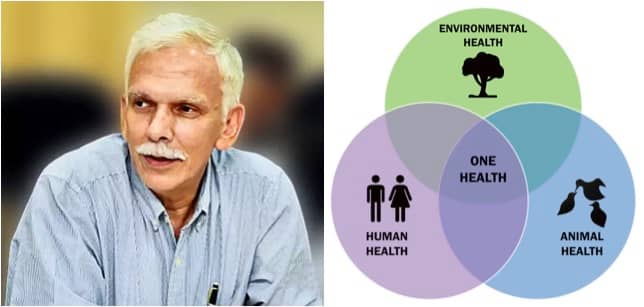
The One Health concept recognizes that animal health, human health and the environment are inter-connected and inter-dependent. While numerous steps have been taken to promote the concept of One Health across nations, as well as in India; we must recognize the urgency to implement this concept now, more so than ever, with the onset of the pandemic. Evidently, the pandemic has hindered the progress of all development indicators, therefore; the One Health approach shall help in early detection, prevention, and control of public health emergencies (e.g. Covid-19) and mitigation of endemic zoonotic infections.
How does the One Health Concept aim to combat zoonotic diseases?
It is now well known that during the last three decades; more than two third of the emerging infectious diseases of humans were found to have originated from animals. These diseases can be mitigated with the help of a robust animal health surveillance system, including wildlife.
Controlling zoonotic pathogens at their animal source is not only important for animal health outcomes; but it is also the most effective and economic way of protecting people. Our efforts are more anthropocentric, there cannot be a stronger case for expanding and reinventing the entire Animal-Husbandry-sector for disease-prevention; control and surveillance to minimize the threat to human health.
The Department of Animal Husbandry and Dairying’ (DAHD) initiative to implement an effective One Health framework; by establishment of One Health-Support Unit (OHSU) will strengthen systemic capacity to better manage animal health and reduce disease incidence; at a national and international level.
National Animal Disease Control Programme
DAHD has initiated to implement National Animal Disease Control Programme (NADCP) for FMD and Brucellosis; an important zoonotic infection affecting humans chronically. In collaboration with the MoHFW, we are developing the National Action Plan for eliminating Dog mutated Rabies (NAPRE) in India; which would lead to eradication of dreaded diseases. Further, the department has been working closely with the office of the Principle Scientific Adviser, Government of India to develop an end-to-end digital platform for livestock sector; and also aims to create a unique identification number(UID) for animals and their registration on INAPH will help in real-time reporting of livestock disease and active surveillance of diseases.
How can the One Health concept be implemented effectively and efficiently in India?
Initiating and sustaining the momentum for the One Health approach requires leveraging the cooperation and strengths of diverse sectors – both public and private – including livestock, human health, wildlife, environment, technology and finance to develop solutions for these local, national and global challenges.
DAHD will focus on the interventions for overcoming challenges related to – veterinary manpower shortages, limitations of diagnostic services and epidemiological support, lack of information sharing between human and animal health institutions, and inadequate coordination on food safety at slaughter, distribution, and retail facilities.
One health concept
Strengthening the livestock sector is one of the pre-requisites for effective implementation of One Health. Therefore, to strengthen the infrastructure and skills of animal health systems in terms of field epidemiological, laboratory and response capacities, would go a long way in implementing the concept.
All sectors relevant to One Health should come forward in an institutionalized formal mechanism for harmonized efforts in addressing these cross-linkages to successfully prevent the spillover of diseases to human population. Besides these, there is also a need to encourage a policy environment which enables core capacity building in order to respond to EID challenges.
Never miss an important dairy update
Follow DairyNews7x7 on Google to get live milk prices, policy alerts, and daily headlines directly in your feed.