Logo
IndianGlobalBlogsPublicationsPodcastsMarketAboutContact
Logo
IndianGlobalBlogsPublicationsPodcasts
7News
Mandatory Daily Record of Production and Raw Material UtilisationHeritage Foods inaugurates new Ice Cream PlantFSSAI makes registration to all milk vendors in IndiaGujarat Ice Cream Makers Face Cone ShortageSummer Heat to Stress India’s Dairy Cold Chain

Indian Dairy News

FSSAI Licences Get Perpetual Validity
Mar 14, 2026

FSSAI Licences Get Perpetual Validity

India’s food regulator, the Food Safety and Standards Authority of India (FSSAI), has announced a major reform granting perpetual validity to food licences and registration certificates, eliminating t...Read More

Dairy Sector a ‘Safety Net’ for Farmers: NABARD
Mar 14, 2026

Dairy Sector a ‘Safety Net’ for Farmers: NABARD

The Chairman of National Bank for Agriculture and Rural Development, Shaji K V, has highlighted the crucial role of India’s dairy industry in protecting rural livelihoods, describing it as a “safety n...Read More

Bihar Dairy Officer Arrested in ₹30,000 Bribery Case
Mar 14, 2026

Bihar Dairy Officer Arrested in ₹30,000 Bribery Case

A field officer of the district dairy development department in Bihar was arrested by the Vigilance Investigation Bureau (VIB) for allegedly accepting a bribe of ₹30,000 in West Champaran district. Th...Read More

DairyNews7x7
Advertisement

Latest Blogs

See More

Mandatory Daily Record of Production and Raw Material Utilisation
Mar 14, 2026

Mandatory Daily Record of Production and Raw Material Utilisation

I recently reviewed the notification issued by the Food Safety and Standards Authority of India in the context of Schedule IV of the Food Safety and Standards (Licensing and Registration of Food Busin...Read More

FSSAI makes registration to all milk vendors in India
Mar 13, 2026

FSSAI makes registration to all milk vendors in India

The recent advisory issued by Food Safety and Standards Authority of India (FSSAI) mandating registration of milk vendors is a timely and progressive step towards strengthening traceability and accou...Read More

Rajahmundry Milk Incident: Accident or Adulteration?
Mar 10, 2026

Rajahmundry Milk Incident: Accident or Adulteration?

The recent editorial “Bitter Milk” published by The Hindu raises important concerns about food safety in India. The editorial deserves appreciation for attempting to broaden the conversation and under...Read More

Milk Prices Rise in South & West: Is North Next?
Mar 05, 2026

Milk Prices Rise in South & West: Is North Next?

The recent round of retail milk price increases across South India and Maharashtra is no longer an episodic adjustment but a clear signal of structural stress building up in India’s milk economy. Over...Read More

Global Dairy News

Global Dairy Commodity Prices Show Signs of Rally
Mar 14, 2026

Global Dairy Commodity Prices Show Signs of Rally

Global dairy commodity prices have shown a rally in the first quarter of 2026, particularly for products originating from Australia and New Zealand, according to a new Q1 Global Dairy Quarterly report...Read More

How Walmart Keeps Great Value Milk So Affordable
Mar 14, 2026

How Walmart Keeps Great Value Milk So Affordable

Retail giant Walmart has managed to keep the price of its private-label Great Value milk significantly lower than many competing brands through a vertically integrated dairy supply chain and direct co...Read More

Lactose-Free Milk Seen as Growth Driver in Coffee
Mar 13, 2026

Lactose-Free Milk Seen as Growth Driver in Coffee

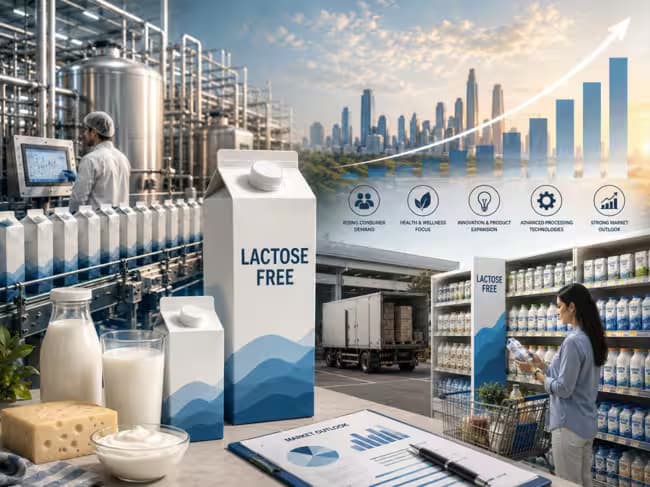
Lactose-free milk is emerging as a major growth opportunity for the dairy industry, particularly in the rapidly expanding coffee and café segment. A recent US-based study highlighted that lactose-free...Read More

DairyNews7x7
Advertisement
Dairy News 7x7

Your trusted source for all the latest dairy industry news, market insights, and trending topics.

FOLLOW US
CATEGORIES
  • Global News
  • Indian News
  • Blogs
  • Publications
  • Podcasts
SUBSCRIBE TO OUR NEWSLETTER

Stay informed with the latest updates and trending news in the dairy industry.

No spam, unsubscribe at any time

GET IN TOUCH
C-49, C Block, Sector 65,
Noida, UP 201307
+91 7827405029dairynews7x7@gmail.com

© 2026 Dairy News 7x7. All Rights Reserved.

Terms of ServicePrivacy Policy
Prefer Us
Prefer Us

Microplastics in Milk and Cheese in Italy- Research report

By DairyNews7x7•Published on July 14, 2025

Microplastics in Milk and Cheese in Italy- Research report
Prefer on

In a recent study published in the journal npj Science of Food, a group of researchers quantified and characterized microplastic (MP) contamination in milk, fresh cheese, and ripened cheese sold in Italian supermarkets.

Background

What if your morning latte came sprinkled with tiny plastic flakes that slip past the tongue? Scientists estimate that people ingest tens of thousands of such fragments yearly, according to recent reviews, yet dairy, a staple for millions, remains understudied.

Plastics line feed bags, milking tubes, cheese molds, and retail wraps, offering countless entry points for debris smaller than 5 millimeters. While seafood and bottled water dominate MP headlines, dairy products also travel equipment-dense routes before reaching consumers.

Identifying when and where fragments accumulate could help redesign processing lines, select safer polymers, and guide smarter packaging policy. Larger, long-term investigations are still needed to pinpoint the riskiest steps and craft effective industry standards.

About the study

Twenty distinct plastic types infiltrated dairy products, including unexpected polymers like polyacrylate (found in paints/adhesives) and silicone (common in seals and gaskets), revealing contamination from diverse industrial sources.

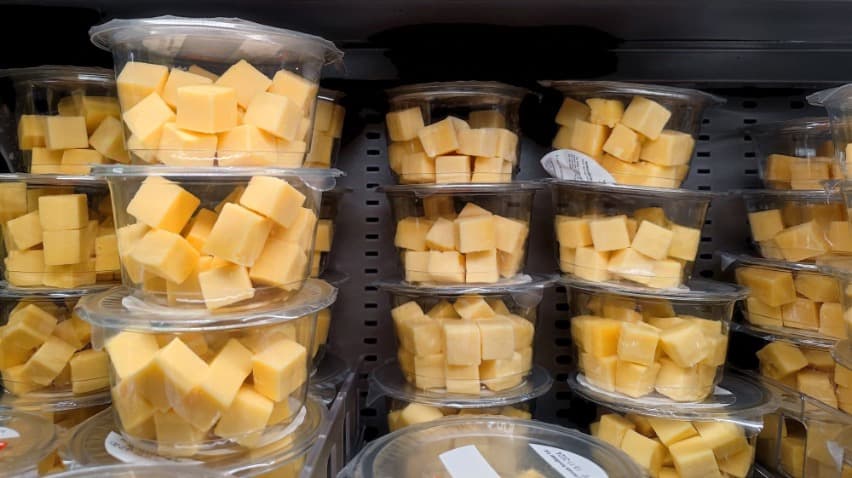
Investigators bought 28 commercial dairy items, such as 4 cartons of ultra-high-temperature (UHT) milk, 10 fresh cheeses aged less than 1 month, and 14 ripened cheeses matured for more than 4 months, from major northern-Italian retailers.

Products arrived on ice at the European Center for the Sustainable Impact of Nanotechnology (ECSIN) and were stored at –20°C until analysis. After thawing, 100 mL of milk or 10 g of quartered cheese underwent sequential enzymatic and alkaline digestion to dissolve organic matter.

Samples received trypsin solution, potassium hydroxide, and ethylenediaminetetraacetic acid (EDTA) in a temperature-controlled shaker, then were vacuum-filtered through 3 μm silver membranes.

Dense particles were separated by triple flotation in saturated sodium chloride (NaCl), refiltered, and oven-dried. Each membrane was scanned with micro Fourier-Transform Infrared spectroscopy in attenuated total reflectance mode (μ-FTIR-ATR); spectra matching at least 80% confirmed polymer identity.

All work took place inside an International Organization for Standardization (ISO) class 7 cleanroom equipped with high-efficiency particulate air (HEPA) filtration. Procedural blanks never exceeded 10 fragments, and spiked-water recoveries averaged 84%, supporting analytical reliability.

Study results

Particles as small as 24 micrometers – thinner than a human hair – slipped into samples, highlighting the challenge of detecting the tiniest plastic fragments lurking in food.

MP appeared in 26 of 28 samples, demonstrating that dairy consumers ingest plastic before food even leaves the refrigerator. Across all items, scientists counted 266 particles spanning 20 polymer types. Poly(ethylene terephthalate) led detections, present in 19 samples, followed by polyethylene in 15 and polypropylene in 12.

Concentrations mirrored processing intensity: ripened cheese averaged 1,857 MP/kg, fresh cheese 1,280 MP/kg, and milk 350 MP/kg, with least-square means differing significantly at P < 0.05. These values echo earlier reports that high-fat, highly processed dairy products such as butter and milk powder harbor the greatest MP loads.

Fragments dominated particle shape, accounting for 77% of observations, whereas fibers comprised 22% and beads less than 1%. Such irregular shards likely arise from friction inside pumps and shredders or abrasion of plastic films.

Size skewed small: one-third measured 51-100 μm, and 20% fell below 50 μm. Smaller dimensions matter because tiny plastics can traverse intestinal barriers more readily than visible debris, which raises toxicological concerns but was not specifically addressed in this study.
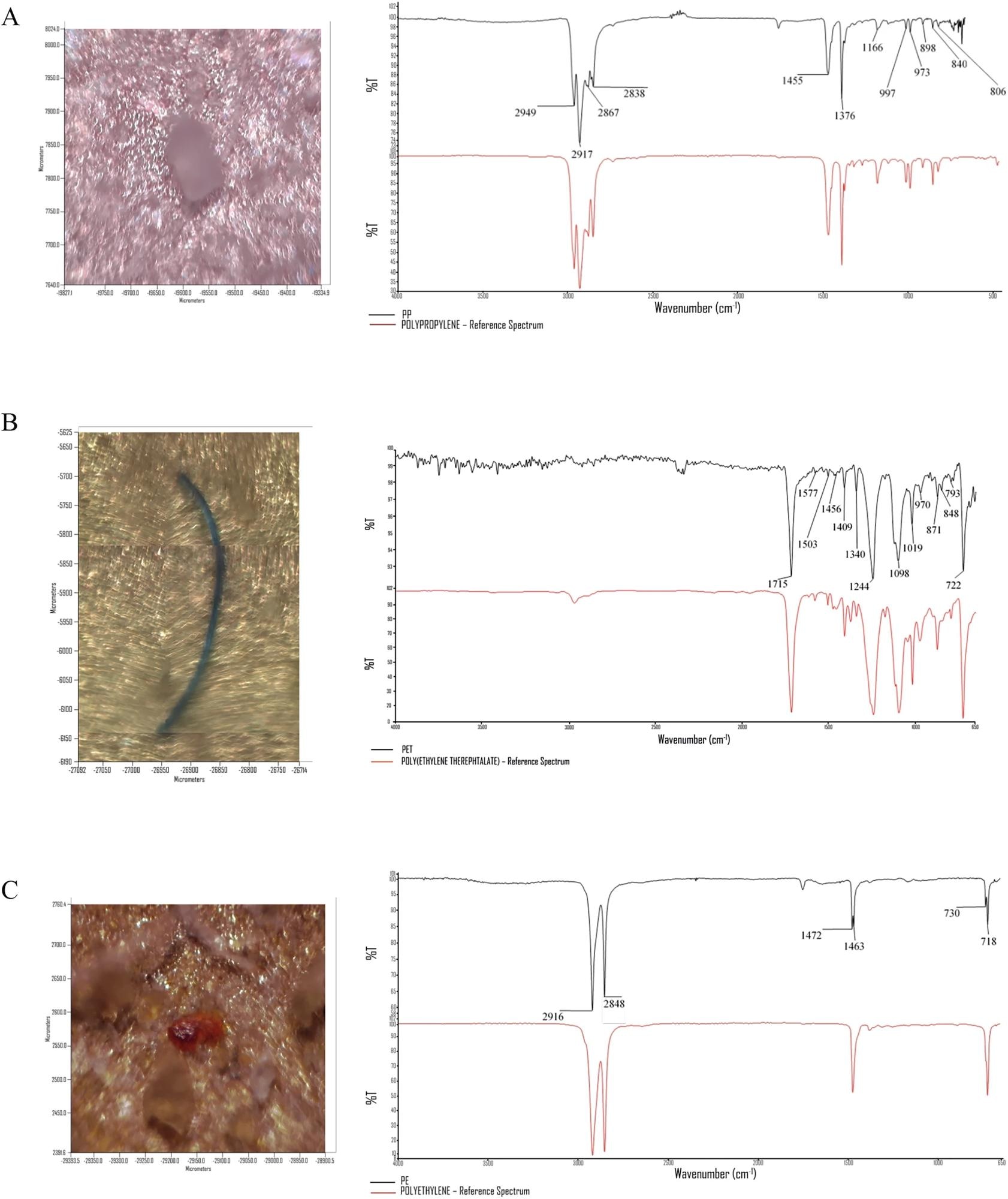
Images and Fourier-transformed infrared micro-spectroscopy in attenuated total reflectance mode analysis (μ-FTIR-ATR) spectra of three identified MP with different shapes and colors: A polypropylene, B poly(ethylene terephthalate), and C polyethylene (black line for MP spectra from dairy products, red line for MP spectra from reference libraries).Images and Fourier-transformed infrared micro-spectroscopy in attenuated total reflectance mode analysis (μ-FTIR-ATR) spectra of three identified MP with different shapes and colors: A polypropylene, B poly(ethylene terephthalate), and C polyethylene (black line for MP spectra from dairy products, red line for MP spectra from reference libraries).

Color analysis offered origin clues: gray particles (68%) were common in polyethylene, polystyrene, and polyvinyl chloride, polymers widely used in gaskets, conveyor belts, and stretch wrap. Transparent fragments, limited to poly(ethylene terephthalate), pointed to bottle-grade plastics, while blue and red flecks suggested food-contact gloves or line markings.

Beyond common plastics, unusual suspects like polyvinylidene fluoride (a specialty plastic) and polyoxymethylene (used in gears) popped up occasionally, suggesting potential contamination from very specific equipment parts.

Statistical dispersion, expressed as the coefficient of variation (CV), differed by polymer. Silicone showed the widest spread (CV ≈ 127%), hinting at sporadic equipment failures, whereas polyacrylate and polyvinyl chloride were more uniformly present (CV ≈ 35-38%). The consistent detection of polyacrylate underscores the need to examine recurring process aids such as cheese-coating resins.

Comparing matrices highlighted cheese-making’s concentrating effect. During curd formation, whey removal reduces mass yet traps solids, including MP. Extended aging intensifies this by evaporating moisture, explaining why ripened cheese contained five times more particles than milk.

The pattern matches studies showing that purified powders and shelf-stable spreads are MP-dense; lengthy contact with plastic molds, aging racks, and barrier wraps appears to be a critical pathway. Together, the data reveal a progressive accumulation of MP along the dairy chain, from farm tubing to supermarket shelf.

Conclusions

Cheese preparation itself could be a contamination risk point: The study meticulously described "quartering" cheese samples (repeatedly cutting and recombining) to get a representative piece, acknowledging this handling step requires extreme care to avoid adding plastic bits during analysis.

To summarize, MP contamination is embedded in everyday dairy products and escalates with each processing and packaging step. Ripened cheeses, celebrated for complex flavor, also concentrate the highest MP loads, many small enough to bypass gastrointestinal defenses.

Findings highlight the urgency of auditing every link in the dairy supply chain, replacing abrasion-prone polymers, bolstering clean-room standards, and developing and testing biodegradable alternatives.

Until such interventions mature, informed consumers, vigilant regulators, and proactive manufacturers share responsibility for reducing invisible plastics that journey from production line to breakfast table, safeguarding both public health and the integrity of a global food staple.

Source : DAirynews7x7 July 14th 2025 Read it full here.  By Vijay Kumar Malesu Reviewed by Susha Cheriyedath, M.Sc. Title Image Credit: JGLmarket / Shutterstock

Journal reference:
  • E. Visentin, G. Niero, F. Benetti, C. O’Donnell & M. De Marchi (2025). Assessing microplastic contamination in milk and dairy products. npj Sci Food 9. DOI: 10.1038/s41538-025-00506-8,

Stay Updated

Get the latest dairy industry news directly in your feed.

Prefer Us on Google Search

Swipe to continue reading

Previous Article

Next Article