Logo
IndianGlobalBlogsPublicationsPodcastsMarketAboutContact
Logo
IndianGlobalBlogsPublicationsPodcasts
7News
Rajahmundry Milk Incident: Accident or Adulteration?Dairy Minister Telangana with Chairman Vijaya visit NDDB AnandScale up India’s dairy cooperative model: Sunita NarainHyderabad Raid Busts ₹18.26 Lakh Fake Ghee UnitNZ Seeks Opposition Support to Advance India Free Trade Agreement

Indian Dairy News

Bitter Milk: Lessons from Rajamahendravaram Case
Mar 10, 2026

Bitter Milk: Lessons from Rajamahendravaram Case

The milk adulteration tragedy in Rajamahendravaram in Andhra Pradesh’s East Godavari district has raised serious concerns about food safety, regulatory oversight and the vulnerability of consumers to...Read More

Sangam Dairy Chief Slams ‘Fake Propaganda’ Claims
Mar 10, 2026

Sangam Dairy Chief Slams ‘Fake Propaganda’ Claims

Dhulipalla Narendra Kumar, who is also a **Sangam Dairy chairman and MLA from Ponnur, strongly criticised leaders of the YSR Congress Party (YSRCP), accusing them of spreading false propaganda and bas...Read More

Nandini Demand Boosts Profits for Dairy Farmers
Mar 10, 2026

Nandini Demand Boosts Profits for Dairy Farmers

Rising demand for Nandini dairy products has significantly increased revenues for the Chikkaballapur District Milk Producers Cooperative Union (CHIMUL) in Karnataka, enabling the cooperative to share...Read More

DairyNews7x7
Advertisement

Latest Blogs

See More
Rajahmundry Milk Incident: Accident or Adulteration?
Mar 10, 2026

Rajahmundry Milk Incident: Accident or Adulteration?

The recent editorial “Bitter Milk” published by The Hindu raises important concerns about food safety in India. The editorial deserves appreciation for attempting to broaden the conversation and under...Read More

Milk Prices Rise in South & West: Is North Next?
Mar 05, 2026

Milk Prices Rise in South & West: Is North Next?

The recent round of retail milk price increases across South India and Maharashtra is no longer an episodic adjustment but a clear signal of structural stress building up in India’s milk economy. Over...Read More

India’s Dairy Climate Paradox: Production Triumph Meets Methane Time-Bomb
Mar 02, 2026

India’s Dairy Climate Paradox: Production Triumph Meets Methane Time-Bomb

India’s rise to the top of the global dairy league board has been one of the most remarkable agricultural success stories of the 21st century. With milk production surpassing 247 million tonnes per ye...Read More

India’s First Cow Culture Museum in Mathura
Feb 16, 2026

India’s First Cow Culture Museum in Mathura

India’s first national “Cow Culture Museum” is set to be established in Mathura, Uttar Pradesh, on the campus of Pandit Deendayal Upadhyaya Veterinary Science University, announced the Uttar Pradesh B...Read More

Global Dairy News

Data Replaces Handshakes in Dairy Lending
Mar 10, 2026

Data Replaces Handshakes in Dairy Lending

The dairy financing landscape is undergoing a major transformation as traditional relationship-based lending gives way to data-driven credit evaluation, according to industry insights. Historically, d...Read More

Rabobank Sees Cautious Dairy Price Recovery
Mar 10, 2026

Rabobank Sees Cautious Dairy Price Recovery

Global dairy commodity prices are showing early signs of recovery in 2026, but the rebound is expected to remain cautious due to abundant global milk supply, according to Rabobank’s Global Dairy Quart...Read More

US-Iran Tensions Raise Indirect Risks for Dairy
Mar 10, 2026

US-Iran Tensions Raise Indirect Risks for Dairy

Escalating tensions between the United States and Iran are creating indirect challenges for the global dairy sector, mainly through higher energy, freight and packaging costs, according to market anal...Read More

DairyNews7x7
Advertisement
Dairy News 7x7

Your trusted source for all the latest dairy industry news, market insights, and trending topics.

FOLLOW US
CATEGORIES
  • Global News
  • Indian News
  • Blogs
  • Publications
  • Podcasts
SUBSCRIBE TO OUR NEWSLETTER

Stay informed with the latest updates and trending news in the dairy industry.

No spam, unsubscribe at any time

GET IN TOUCH
C-49, C Block, Sector 65,
Noida, UP 201307
+91 7827405029dairynews7x7@gmail.com

© 2026 Dairy News 7x7. All Rights Reserved.

Terms of ServicePrivacy Policy
Prefer Us
Prefer Us

Limiting antibiotics for cows may create a new dairy market

By DairyNews7x7•Published on November 05, 2022

Limiting antibiotics for cows may create a new dairy market
Prefer on

Consumers would be willing to buy milk from cows only treated with antibiotics when medically necessary – as long as the price isn’t much higher than conventional milk, according to researchers at the College of Veterinary Medicine.

The findings suggest conventional farmers could tap a potentially large market for this type of milk if they can find the right price point – and that dairy consumers can help slow the rise of antimicrobial resistance.

“Most of the antibiotics produced throughout the world are used for animal agriculture. Therefore, reducing antibiotic use in animals, including dairy cattle, is necessary to tackle antibiotic resistance at a global scale,” said Dr. Renata Ivanek, professor in the Department of Population Medicine and Diagnostic Sciences. She is senior author on the study, which published Nov. 4 in the Journal of Dairy Science.

In the paper, the researchers propose a new label for milk that indicates responsible antibiotic use (RAU), which would leverage consumer preferences to reduce the use of antibiotics on commercial dairy farms. The study showed that, although a consumer’s willingness to pay for the RAU-labeled milk was comparable to how much they would pay for the unlabeled milk, they strongly preferred the RAU-labeled milk over the unlabeled milk option. Therefore, the researchers hypothesize this new RAU label would entice farmers to minimize antibiotics more than they do for conventional, unlabeled milk.

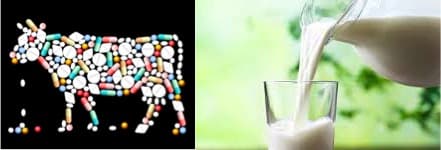
Too much antibiotic treatment in cows leads to the rise of resistant strains of bacteria, which can make antibiotics for both animals and humans less effective, the researchers note. “Consumers should know that their choices are important, and that their understanding of antibiotic use could move the dairy industry toward more sustainable milk production practices,” said Dr. Ece Bulut, research associate in the Department of Population Medicine and Diagnostic Sciences and co-author of the study.

The researchers conducted a nationally representative survey of U.S. adults, finding that half were willing to buy RAU-labeled milk. They also held a randomized, experimental auction with real money and milk, which showed that buyers were also willing to pay for RAU-labeled milk but only slightly more than they are willing to pay for the unlabeled cartons.

“What this means is that there could potentially be a large market for RAU milk as long as the price isn’t much higher than conventional milk, so it’s a possible new option for conventional farmers,” said Robert Schell, M.S. ’19, first author of the study.

A similar label for certified responsible antibiotic use (CRAU) is already used in the poultry industry, Bulut said. CRAU limits the use of medically important antibiotics – antibiotics used in human medicine – in poultry production. The researchers envision that the RAU label would similarly be determined by veterinarians and U.S. Department of Agriculture (USDA) standards, so that any carton of milk with an RAU label would come from a cow treated with antibiotics only when medically necessary.

“The existing literature suggests that larger bodies regulating these sorts of claims, like the USDA and CRAU certification, makes consumers more willing to trust and, as a result, buy products with desirable labels,” said Schell, a doctoral student at the School of Public Health in University of California, Berkeley, who started working on the study as a master’s degree student at the Charles H. Dyson School of Applied Economics and Management.

This study is an important initial step in exploring consumer attitudes toward an RAU label and its potential market for conventional farmers, the researchers said.

The work is the result of collaboration between the College of Veterinary Medicine, the Charles H. Dyson School of Applied Economics and Management, and the Department of Communication in the College of Agriculture and Life Sciences. The researchers also worked with Cornell’s Lab for Experimental Economics and Decision Research as well as Cornell’s Survey Research Institute.

Funding for this study was provided by the National Institute of Food and Agriculture, the USDA and the National Institutes of Health.

Stay Updated

Get the latest dairy industry news directly in your feed.

Prefer Us on Google Search

Swipe to continue reading

Previous Article

Next Article