Latest Blogs
See More
Indian Dairy News
DairyNews7x7
Global Dairy News

DairyNews7x7

Today, most of the milk production in the country is being done through cooperative dairies, that is why today India has reached the first place in the world milk production with 24% share
If milk is traded through the cooperative sector, it has multidimensional benefits for the society, agriculture, villages, milk producers and ultimately the country
When the cooperative sector does dairy business, the first to benefit are the milk producers, because they are not exploited
Many dairies are concerned about the nutrition of pregnant women and their children by giving them laddus, the entire cooperative sector has joined the fight against malnutrition
Shri Narendra Modi has ushered many types of revolutions in the country, which also includes digital revolution
India is also among the fastest growing economies in the field of digital transactions in the world, we will reach the top in the next 4-5 years
We have envisioned such an economic system in which the cooperative plays a role in promoting the cooperative, all milk union officials should study this model
NCDFI should take steps towards natural farming
In his address, Shri Amit Shah said that the dairy and especially the cooperative dairy sector in our country has achieved multi-dimensional goals. He said that if milk trading is not done by the cooperative sector, then milk production remains limited to a middleman and the milk user. But if the cooperative sector trades milk in a cooperative manner, then many dimensions are integrated into it, because the aim is not to make profit only and it has multidimensional benefits to the society, agriculture, villages, milk producers and ultimately the country. He said that India has experienced this success story in the last 50 years.
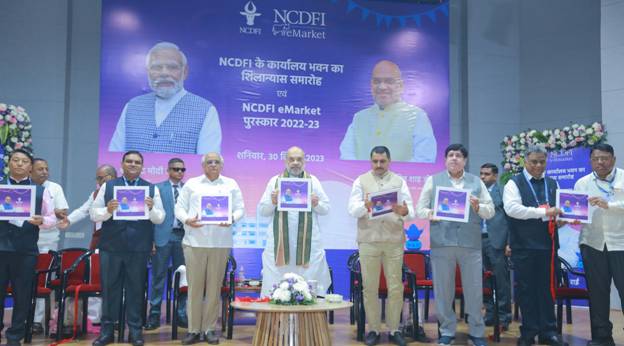
The Minister of Cooperation said that today India has reached the first place in the world's milk production with 24% share and under the leadership of Prime Minister Shri Narendra Modi, milk production in India has increased by about 51% in the last 8 years, which is the highest in the world. This is the fastest increase. Shri Shah said that this has been possible only because most of these productions have been done through cooperative dairies. He said that if cooperative dairy is to be run, then many institutions will have to be formed to nurture it and NCDFI will do this work. In a way, NCDFI is doing the work of providing guidance to all dairies. Shri Shah said that White Revolution started from the village ‘Vasi’ and now headquarters of NCDFI is going to be built in the same Anand district in an area of about 7000 square meters. It will be built at an expense of about Rs 32 crore and will be operated through a solar power plant. He said that the new headquarters building will be a 100 percent green building.
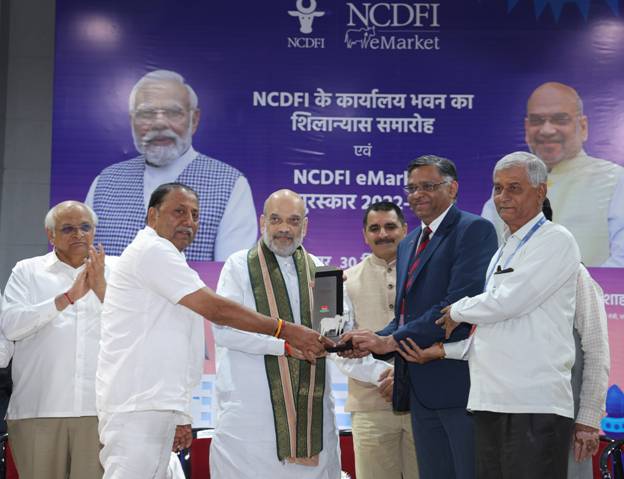
The Union Home Minister and Minister of Cooperation said that when the cooperative sector does dairy business, the first to benefit is the milk producers, because they are not exploited. He said that if someone produces milk alone, he/she does not have the capacity to store the milk and cannot explore the market. But if the cooperative sector does milk business, then milk unions are formed at the village and district level and they have the capacity for cold storage, processing, converting the milk into a product as per the market demand and then share the profits with the sisters who are involved in milk production on cooperative basis. In this way the exploitation of milk producing sisters ends. He said that a person involved in production of milk alone cannot worry about the health of his/her animals, but if milk is produced in a cooperative manner, then the District Milk Producers Association will also make arrangements for breed improvement, health improvement and good diet of the animals. The third advantage is that if the milk business is done through the cooperative sector then it automatically gets linked to the nutrition movement.
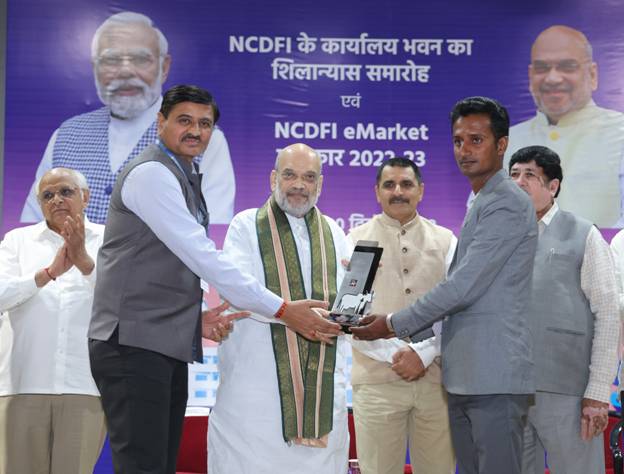
Shri Amit Shah said that he knows about many such dairies including Banaskantha Dairy, which take care of the health of malnourished children by providing them nutritious milk. Many dairies like Ahmedabad Dairy take care of the nutrition of pregnant women and their children by giving them laddus. He said that the entire cooperative sector has joined the fight against malnutrition. The Union Minister of Cooperation said that at one time it was difficult for India to even imagine dairy and dairy technology, but we made such efforts that symmetric milk production started all over India. There are many areas which were not connected with cooperative dairy, even there, through NDDB, the capable diaries of Gujarat are expanding their work in North Indian states like Uttar Pradesh and Haryana and increasing their work in a cooperative manner. He said that if milk is to be produced in a symmetrical manner in every village of the country and every household is to be made self-reliant, then this work is possible only through cooperative dairying.
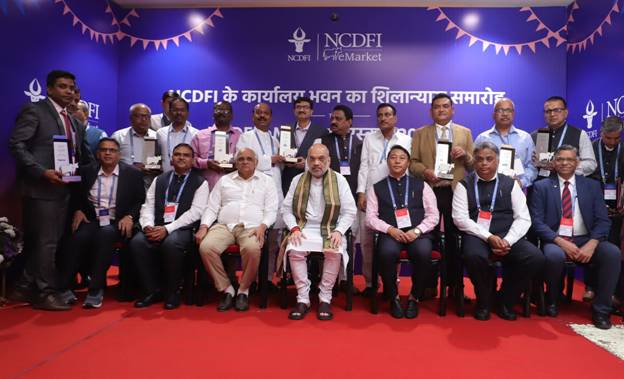
Shri Amit Shah said that Indian dairies have brought laurels to the country in the world in milk production. He said that in 1946, when a dairy in Gujarat started exploitation, Sardar Vallabhbhai Patel inspired Tribhuvan Bhai against it and in 1946, small dairies were started in 15 villages. He said that a small beginning against exploitation in 1946 transformed into a huge movement and from this came the idea of white revolution in the country and the emergence of NDBB. He said that today many cooperative dairies have developed across the country. Amul processes around 40 million liters of milk every day and 36 lakh sisters store the milk and every week they get the price of the milk produced. Shri Shah said that in 2021-22 Amul Federation has a turnover of Rs. 72000 crores.
The Minister of Cooperation said that Prime Minister Shri Narendra Modi has brought about many revolutions in the country, including the digital revolution. Diplomats, politicians, heads of state from all over the world had come here for the G-20 and everyone was surprised as to how online payments and digital transactions could increase so much in a country like India. He said that one feels happy to see when in a small village, a woman takes out her mobile and scans it and makes payment. He said that India is among the fastest growing economies in the field of digital transactions in the entire world and in the next 4-5 years we will reach the top. Nearly 80 countries have sought information about the success of our online payment system and India has happily agreed to provide this information.
Shri Amit Shah said that awards have been given today for promoting e-market in the dairy industry. He urged the members of NCDFI to go towards 100 percent business. The Minister of Cooperation said that we have just started a small experiment in Gujarat, in collaboration with Panchmahal District Dairy, Banaskantha District Dairy and Gujarat State Cooperative Bank. We are giving Rupay cards to every farmer. Every village dairy is being made a ‘Bank Mitra’ and is being provided ATMs, and the accounts of the dairy and every farmer are being transferred to the District Cooperative Bank. He said that deposits of Rs 800 crore have increased in Banaskantha district alone and 193 ATMs are operational. RuPay debit card has reached 96 percent farmers. Now the farmer does not need to go to anyone. The payment for their milk is deposited directly into the account of District Cooperative Bank, Banaskantha. S/he has a RuPay card linked to it. If s/he wants to buy anything from anywhere and needs cash, s/he can take cash from the ATM of the dairy of his/her village. Shri Shah said that by making every dairy in the district a center, this model should be implemented in the entire Gujarat, then the farmer will not have to take out cash from his pocket for any purchase.
The Minister of Cooperation said that cooperatives should play an important role in promoting the formal economy & economy of the country instead of the informal economy. He said that we have envisioned such an economic system where the cooperative plays a role in promoting the cooperatives. All the milk union officials should study this model and send it to every district milk producer union so that it can be known how much the strength of the cooperative sector has increased.
Shri Amit Shah said that NCDFI should take steps towards organic farming. Amul has used it very well. He said that with the inspiration of Prime Minister Shri Narendra Modi, we have formed a multi-state cooperative institution at the national level, which will do the marketing of organic products. People have started connecting with it. Adopting this model, today an organic cooperative is promoting organic products in the country. Along with this, a cooperative has also been formed for export because the world market for organic products is very big and also expensive. If the world wants to consume expensive organic products then there should be no delay in sending them from India.
The Minister of Cooperation said that we have also formed a seed cooperative which will conserve and promote Indian seeds. Today, big seed manufacturing companies remain with the big farmers. Even if someone has two acres of land, it will reach there through PACS and will also connect the farmers with seed cultivation. This will increase the farmer's profit. He urged NCDFI, as a nodal agency, to take the good model that emerged in this regard to every district union. If any district union wants to adopt it, then a team should be formed to guide it and the success achieved in one district should be achieved in every district of India.
Shri Amit Shah said that e-auction platform, reverse auction and forward auction are also now going to be provided and there is also a provision for procurement of one lakh metric tonnes of pulses on the e-market portal of NCDFI. Similarly, NAFED's app is going to be launched on 4th January, in which no matter how much pulses a farmer produces in India, NAFED will buy the entire produce at the rate of one rupee more than the MSP. He said that we want to make India self-reliant in the oilseeds sector, hence this work has been entrusted to NAFED. The farmer will register on NAFED's app and cultivate pulses and all the pulses will be purchased by NAFED at the rate of MSP plus one rupee.
The Minister of Cooperation said that Prime Minister Shri Narendra Modi has formed a global alliance for ethanol, but even before forming the alliance, we have made a policy for making ethanol from maize. According to this policy, if a farmer sows maize, 100 percent of his maize will be purchased by NAFED and sent to the ethanol manufacturing company and the farmer will get a price higher than the MSP. He said that we have set goals like crop diversification, less use of fertilizers, self-reliance in pulses and oilseeds.
Source : Dairynews7x7 Dec 22nd 2025 PIB