Logo
IndianGlobalBlogsPublicationsPodcastsMarketAboutContact
Logo
IndianGlobalBlogsPublicationsPodcasts
7News
Rajahmundry Milk Incident: Accident or Adulteration?Dairy Minister Telangana with Chairman Vijaya visit NDDB AnandScale up India’s dairy cooperative model: Sunita NarainHyderabad Raid Busts ₹18.26 Lakh Fake Ghee UnitNZ Seeks Opposition Support to Advance India Free Trade Agreement

Indian Dairy News

Bitter Milk: Lessons from Rajamahendravaram Case
Mar 10, 2026

Bitter Milk: Lessons from Rajamahendravaram Case

The milk adulteration tragedy in Rajamahendravaram in Andhra Pradesh’s East Godavari district has raised serious concerns about food safety, regulatory oversight and the vulnerability of consumers to...Read More

Sangam Dairy Chief Slams ‘Fake Propaganda’ Claims
Mar 10, 2026

Sangam Dairy Chief Slams ‘Fake Propaganda’ Claims

Dhulipalla Narendra Kumar, who is also a **Sangam Dairy chairman and MLA from Ponnur, strongly criticised leaders of the YSR Congress Party (YSRCP), accusing them of spreading false propaganda and bas...Read More

Nandini Demand Boosts Profits for Dairy Farmers
Mar 10, 2026

Nandini Demand Boosts Profits for Dairy Farmers

Rising demand for Nandini dairy products has significantly increased revenues for the Chikkaballapur District Milk Producers Cooperative Union (CHIMUL) in Karnataka, enabling the cooperative to share...Read More

DairyNews7x7
Advertisement

Latest Blogs

See More
Rajahmundry Milk Incident: Accident or Adulteration?
Mar 10, 2026

Rajahmundry Milk Incident: Accident or Adulteration?

The recent editorial “Bitter Milk” published by The Hindu raises important concerns about food safety in India. The editorial deserves appreciation for attempting to broaden the conversation and under...Read More

Milk Prices Rise in South & West: Is North Next?
Mar 05, 2026

Milk Prices Rise in South & West: Is North Next?

The recent round of retail milk price increases across South India and Maharashtra is no longer an episodic adjustment but a clear signal of structural stress building up in India’s milk economy. Over...Read More

India’s Dairy Climate Paradox: Production Triumph Meets Methane Time-Bomb
Mar 02, 2026

India’s Dairy Climate Paradox: Production Triumph Meets Methane Time-Bomb

India’s rise to the top of the global dairy league board has been one of the most remarkable agricultural success stories of the 21st century. With milk production surpassing 247 million tonnes per ye...Read More

India’s First Cow Culture Museum in Mathura
Feb 16, 2026

India’s First Cow Culture Museum in Mathura

India’s first national “Cow Culture Museum” is set to be established in Mathura, Uttar Pradesh, on the campus of Pandit Deendayal Upadhyaya Veterinary Science University, announced the Uttar Pradesh B...Read More

Global Dairy News

Data Replaces Handshakes in Dairy Lending
Mar 10, 2026

Data Replaces Handshakes in Dairy Lending

The dairy financing landscape is undergoing a major transformation as traditional relationship-based lending gives way to data-driven credit evaluation, according to industry insights. Historically, d...Read More

Rabobank Sees Cautious Dairy Price Recovery
Mar 10, 2026

Rabobank Sees Cautious Dairy Price Recovery

Global dairy commodity prices are showing early signs of recovery in 2026, but the rebound is expected to remain cautious due to abundant global milk supply, according to Rabobank’s Global Dairy Quart...Read More

US-Iran Tensions Raise Indirect Risks for Dairy
Mar 10, 2026

US-Iran Tensions Raise Indirect Risks for Dairy

Escalating tensions between the United States and Iran are creating indirect challenges for the global dairy sector, mainly through higher energy, freight and packaging costs, according to market anal...Read More

DairyNews7x7
Advertisement
Dairy News 7x7

Your trusted source for all the latest dairy industry news, market insights, and trending topics.

FOLLOW US
CATEGORIES
  • Global News
  • Indian News
  • Blogs
  • Publications
  • Podcasts
SUBSCRIBE TO OUR NEWSLETTER

Stay informed with the latest updates and trending news in the dairy industry.

No spam, unsubscribe at any time

GET IN TOUCH
C-49, C Block, Sector 65,
Noida, UP 201307
+91 7827405029dairynews7x7@gmail.com

© 2026 Dairy News 7x7. All Rights Reserved.

Terms of ServicePrivacy Policy
Prefer Us
Prefer Us

India’s dairy farmers face searing heat

By DairyNews7x7•Published on June 23, 2022

India’s dairy farmers face searing heat
Prefer on

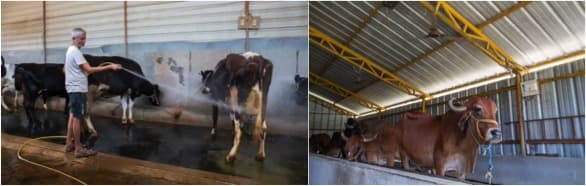
ailas Ramasamy gently guides his cows into a hangar-sized shed, tethers them to their posts, lays out their fodder and cleans the floor. Then, as he steps out, he flips a switch: ceiling fans begin to blow air on the cattle.

Ramasamy’s dairy farm is an hour outside southern India’s Bengaluru city. Usually known for its moderate weather, the region has witnessed a sharp rise in temperature compared with earlier decades. Elsewhere in India, temperatures have reached 50C (122F) this year.

That is bad news for India’s dairy industry, with heat stress leading to reduced appetite, lower weight gain and decreased fertility in cattle. Rising temperatures could reduce milk output by up to 25% in India’s hotter areas by 2085, according to recent research published in the Lancet.

Heat stress is a global problem, with thousands of cattle reported to have died last week in the US state of Kansas as temperatures of more than 37C were compounded by high levels of humidity.

But for India, any significant decline in milk production could be devastating for food security if it ends self-sufficiency in dairy in the world’s second most populous country.

The consequences would also be devastating for 80 million Indians employed across the dairy industry.

Rising temperatures could reduce milk output by up to 25% in the country’s hotter areas by 2085
These are problems that Ranganatha Reddy knows well. Temperatures on his dairy farm in Anantapur, 120 miles (200km) from Bengaluru, hit 43C in May.

“My cows usually have an internal alarm clock and start mooing when it’s meal time because they’re always hungry,” he says. “But during the heatwave I had to almost force-feed them.”

His farm’s milk output dropped by 30% month-on-month. “It felt like I was wringing a dry sponge.”

While climate change is a global phenomenon, the large number of small dairy holdings in India and a growing dependence on breeds that are vulnerable to heat stress could affect the country more than other big dairy producers such as the US or Brazil.

In the 1970s, India began crossbreeding imported, high-yield varieties of cattle with local species, helping turn the country from running a dairy deficit to producing 22% of the world’s milk.

India’s most recent livestock census found that the population of crossbred cattle had increased by 26% since 2012, while indigenous varieties decreased by 6%.


It makes financial sense to switch to crossbred cows as they produce “much more milk”, says Ramendra Das, a veterinary scientist who has studied the impact of warming temperatures on different breeds – but they are more vulnerable to heat stress than indigenous varieties.

Ramasamy, who buys and sells milk from local farmers through the company Vrindavan Dairy, is trying to promote the use of indigenous cows by paying more for milk from Indian cows (42p a litre) than from crossbreeds (32p).

Solutions to ward off heat stress include specially designed sheds with fans and sprinklers to keep cattle cool, but that comes at a high cost. “Only big, intensive dairy farms can afford such infrastructure,” says Girdhari Ramdas Patil, a former joint director at the National Dairy Research Institute. Almost two-thirds of India’s milk is produced by small-scale farmers.

Philip Thornton, a scientist at the Consortium of International Agricultural Research Centers and lead author of the Lancet study on heat stress milk yield losses, says that crossbreeding climate-resilient cattle varieties and higher-yielding cows might help in the long run.

For Ramasamy, the answer has been to seek better indigenous breeds. He has started breeding Gyr cows from northern India that give more milk than other breeds while also consuming less food and water than crossbred varieties.

Does he think the lower maintenance costs and risks of heat stress will persuade more farmers to turn to Indian breeds? “It’s going to be difficult, but I’m convinced that is the future,” he says.

Source : The Guardian : June 22nd 2022 by Charu Sudan Kasturi

Stay Updated

Get the latest dairy industry news directly in your feed.

Prefer Us on Google Search

Swipe to continue reading

Previous Article

Next Article