Latest Blogs
See More
Indian Dairy News

DairyNews7x7
Global Dairy News

DairyNews7x7

Vijender and Narendar, both in their 60s, both neighbours at Kanware village on the outskirts of Faridabad in Haryana, had high hopes when a team of officials visited their village as part of the ongoing 21st livestock Census. They believe that once counted, the number of milking animals in their locality will force the government or a private entrepreneur to start a dairy or a milk collection centre in their locality. “There is no dairy here. Had there been a dairy here, we would not have to go to Faridabad every morning to sell milk,” Narender says.
Vijender has just one buffalo, but Narender has two cows and a buffalo. “I have been cattle farming for 40 years. Lumpy skin disease had impacted our village in 2022. Then doctors had come. We understand that by this Census, we will get more information about rearing cattle,” Vijender says, adding that information like correct medicine dosage for the animals is a challenge for them. “We hope we get proper information after this Census.”
The duo also hopes that the subsidy for a buffalo, which costs ₹1.5 lakh now, would be increased from the present figure of ₹70,000. Sundar Lal, 50, the enumerator in their locality, consoles the farmers by saying that there are about 400 cattle in their locality and the government will surely help them.
India’s 21st Livestock Census will count 16 species — cattle, buffalos, sheep, goats, horses, donkeys, camels, pigs, dogs, chicken, ducks, geese, and yaks — and their 219 breeds. Begun in October 2024, Central government officials hope that the survey results will be brought out in July 2025. The Census will cost ₹419 crore, and has about 1 lakh enumerators like Sundar Lal and 17,000 supervisors deployed across the country. The last human Census took place in 2011.
When the Union Minister for Animal Husbandry and Dairying, Rajiv Ranjan Singh, launched the survey, he said it would play a key role in shaping policies that would ensure the sustainable growth of India’s livestock sector. He acknowledged the sectors as a significant source of nutrition, employment, and income for millions of households. “The 21st Livestock Census will give us updated data on the livestock population, which will allow the government to address key issues like disease control, breed improvement, and rural livelihoods,” he had said.
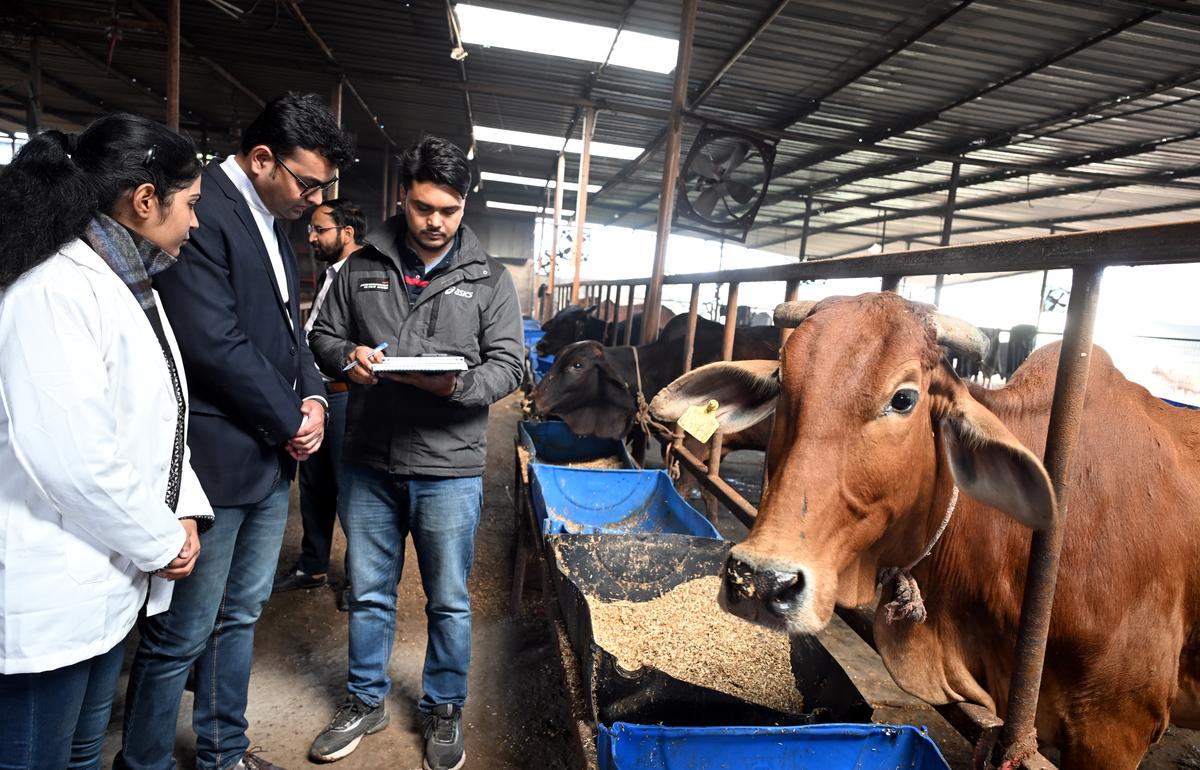
The lumpy skin disease outbreak in 2022 had claimed the lives of thousands of cattle in the country. | Photo Credit: SUSHIL KUMAR VERMA
This time, the Centre expects an increase in the figures, as post-COVID-19 farmers have been investing in animals. Officials say this is for various reasons, including job loss during the lockdown and reverse migration. However, lumpy skin disease that hit the country three years ago had claimed the lives of thousands of cattle. This will also be reflected in the Census.
He also uploads details such as milch or non-milch, the number of calves, and the facilities in cattle sheds. “We identify breeds with the help of farmers,” Kumar says, adding that it is an Android-only app. This updated app has more features than the previous one, with an image upload option and a dashboard to check and verify data and the option to capture the location.
This is the second time stray animals are being recorded. “If I see any animals outside a household, I first check with villagers if they have any owners. If they don’t, we consider them stray. We upload an image and mention the gender too,” he says. Local bodies and farmers are also consulted about stray dogs.
After surveying 60,000 households in Faridabad, the stray dog population is about 8% of the human population. Stray cattle is a big issue in and around Faridabad, particularly troubling for farmers, whose crops become food.
The district has 11 registered gaushalas for which the Haryana government provides subsidies (for fodder and building shelters). There are unregistered gaushalas too, run privately. “All animals in gaushalas are compulsorily tagged,” says veterinarian Dr. Virender Sehrawat, Deputy Director, Animal Husbandry, Faridabad.
Jagat Hazarika, advisor (statistics) with the Union Ministry of Animal Husbandry, often travels with the enumerators to assess the progress of the Census. “At the end of the Census, we can say how many households have at least one animal. In that sense, we are counting the number of households in the country too,” Hazarika says, while at a cattle farm near Faridabad, overseeing the work.
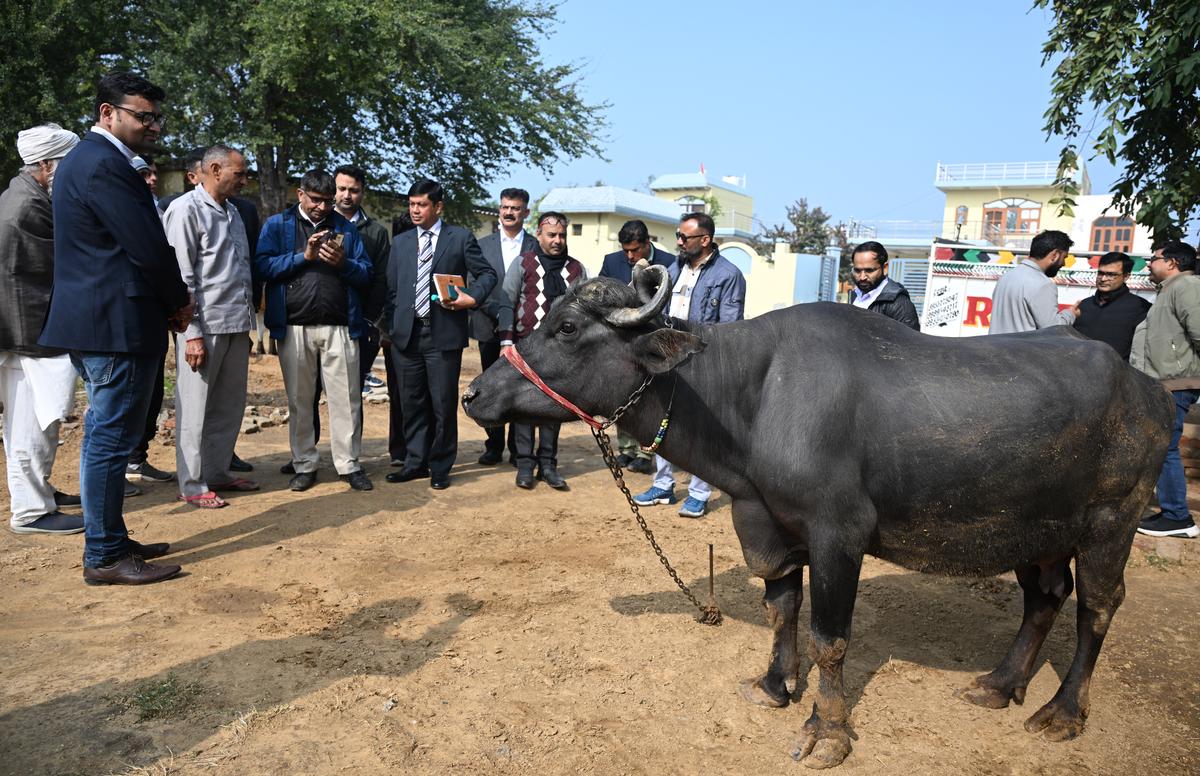
Jagat Hazarika (left), an advisor with the Union Ministry of Animal Husbandry oversee the work. | Photo Credit: SUSHIL KUMAR VERMA
Dr. Monika Singh, a veterinary surgeon, is a supervisor, with four enumerators, including Kumar, working under her. “Enumerators have guidelines to follow to identity breeds. They upload it in the app. I cross check at least 20% of the data uploaded and clear it. I have 80 villages under me,” Dr. Singh says.
The Chaudharys start their day at 3.30 a.m. After cleaning the stable, built across about 2,700 square feet, they feed the buffaloes by 4 a.m. Milking starts at 5 a.m. and goes on until 7 am. Both the sisters milk the buffaloes using their hands as machines do not work in buffaloes. People come to their farm by 7 a.m. to buy milk. In the evening, it’s the same process, with their day ending at 9 p.m. after they have prepared the food for the cattle for the next day. Poonam says her present work is much better, both in terms of peace of mind and income. Once the Census is over, I hope that the government will focus more on ensuring healthcare for animals. Medicines for buffaloes are very costly,” she says, hoping there will be some rebate.
Milan Sharma, 56, was a project manager for one of the German government’s educational projects in India. She also taught German as part of the project. In 2017, her father-in-law passed away. He had four indigenous cows in his house near Faridabad. Milan and her husband Chetan decided to build a farm of indigenous cows in memory of her father-in-law who loved to take care of the breeds Hariyanwi and Sahiwal, popular in Haryana and Punjab. She started with two Sahiwals and at one point had more than 250 cows. Now, she says age is catching up and their farm has about 100 cows. “We donated a lot of our cows to the villagers,” she says.
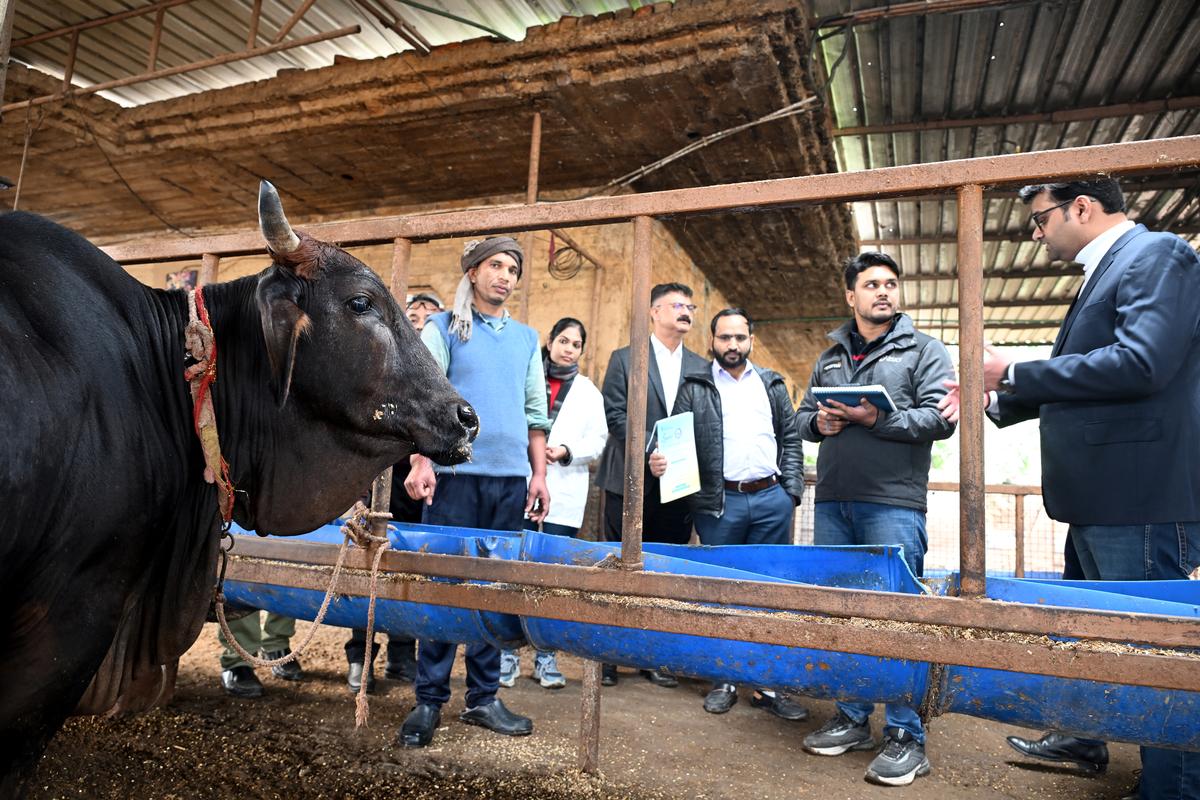
The Census has about 1 lakh enumerators and 17,000 supervisors deployed across the country. | Photo Credit: SUSHIL KUMAR VERMA
Dr. Sehrawat says, “In Faridabad, we have completed the Census in 60,000 households out of 4 lakh. We have 80 enumerators and 18 supervisors. We are trying to complete the process by March 15.” The enumerators were trained by the Union government’s master trainers. “In 2019, there were 1.72 lakh cattle in Faridabad. We expect the number to be more or less the same. We had 34,000 cows last time. This number could increase,” he says, adding that the number of buffaloes may come down in households, but may increase in cattle farms.
One of the possible reasons for the increase in the number of cattle is the restriction on trade and slaughter after the implementation of Haryana Gauvansh Sanrakshan and Gausamvardhan Act, 2015. The Act was further tightened in 2019.
Another pattern enumerators are seeing is the erosion of grasslands in Delhi-NCR, which means farmers now have to buy fodder. In Faridabad, Dr. Sehrawat says the number of pet dogs could increase by thousands. “Most of the breeds kept in Haryana homes are exotic,” he says.
A doctor who wished anonymity, says things are not as smooth as promised by the Centre. “The app logs out very often. It will not work if there is no strong internet connection. So the enumerators often have to upload the data in office or at home where there is a WiFi connection,” they say.