Logo
IndianGlobalBlogsPublicationsPodcastsMarketAboutContact
Logo
IndianGlobalBlogsPublicationsPodcasts
7News
Mandatory Daily Record of Production and Raw Material UtilisationHeritage Foods inaugurates new Ice Cream PlantFSSAI makes registration to all milk vendors in IndiaGujarat Ice Cream Makers Face Cone ShortageSummer Heat to Stress India’s Dairy Cold Chain

Indian Dairy News

FSSAI Licences Get Perpetual Validity
Mar 14, 2026

FSSAI Licences Get Perpetual Validity

India’s food regulator, the Food Safety and Standards Authority of India (FSSAI), has announced a major reform granting perpetual validity to food licences and registration certificates, eliminating t...Read More

Dairy Sector a ‘Safety Net’ for Farmers: NABARD
Mar 14, 2026

Dairy Sector a ‘Safety Net’ for Farmers: NABARD

The Chairman of National Bank for Agriculture and Rural Development, Shaji K V, has highlighted the crucial role of India’s dairy industry in protecting rural livelihoods, describing it as a “safety n...Read More

Bihar Dairy Officer Arrested in ₹30,000 Bribery Case
Mar 14, 2026

Bihar Dairy Officer Arrested in ₹30,000 Bribery Case

A field officer of the district dairy development department in Bihar was arrested by the Vigilance Investigation Bureau (VIB) for allegedly accepting a bribe of ₹30,000 in West Champaran district. Th...Read More

DairyNews7x7
Advertisement

Latest Blogs

See More
Mandatory Daily Record of Production and Raw Material Utilisation
Mar 14, 2026

Mandatory Daily Record of Production and Raw Material Utilisation

I recently reviewed the notification issued by the Food Safety and Standards Authority of India in the context of Schedule IV of the Food Safety and Standards (Licensing and Registration of Food Busin...Read More

FSSAI makes registration to all milk vendors in India
Mar 13, 2026

FSSAI makes registration to all milk vendors in India

The recent advisory issued by Food Safety and Standards Authority of India (FSSAI) mandating registration of milk vendors is a timely and progressive step towards strengthening traceability and accou...Read More

Rajahmundry Milk Incident: Accident or Adulteration?
Mar 10, 2026

Rajahmundry Milk Incident: Accident or Adulteration?

The recent editorial “Bitter Milk” published by The Hindu raises important concerns about food safety in India. The editorial deserves appreciation for attempting to broaden the conversation and under...Read More

Milk Prices Rise in South & West: Is North Next?
Mar 05, 2026

Milk Prices Rise in South & West: Is North Next?

The recent round of retail milk price increases across South India and Maharashtra is no longer an episodic adjustment but a clear signal of structural stress building up in India’s milk economy. Over...Read More

Global Dairy News

Global Dairy Commodity Prices Show Signs of Rally
Mar 14, 2026

Global Dairy Commodity Prices Show Signs of Rally

Global dairy commodity prices have shown a rally in the first quarter of 2026, particularly for products originating from Australia and New Zealand, according to a new Q1 Global Dairy Quarterly report...Read More

How Walmart Keeps Great Value Milk So Affordable
Mar 14, 2026

How Walmart Keeps Great Value Milk So Affordable

Retail giant Walmart has managed to keep the price of its private-label Great Value milk significantly lower than many competing brands through a vertically integrated dairy supply chain and direct co...Read More

Lactose-Free Milk Seen as Growth Driver in Coffee
Mar 13, 2026

Lactose-Free Milk Seen as Growth Driver in Coffee

Lactose-free milk is emerging as a major growth opportunity for the dairy industry, particularly in the rapidly expanding coffee and café segment. A recent US-based study highlighted that lactose-free...Read More

DairyNews7x7
Advertisement
Dairy News 7x7

Your trusted source for all the latest dairy industry news, market insights, and trending topics.

FOLLOW US
CATEGORIES
  • Global News
  • Indian News
  • Blogs
  • Publications
  • Podcasts
SUBSCRIBE TO OUR NEWSLETTER

Stay informed with the latest updates and trending news in the dairy industry.

No spam, unsubscribe at any time

GET IN TOUCH
C-49, C Block, Sector 65,
Noida, UP 201307
+91 7827405029dairynews7x7@gmail.com

© 2026 Dairy News 7x7. All Rights Reserved.

Terms of ServicePrivacy Policy
Prefer Us
Prefer Us

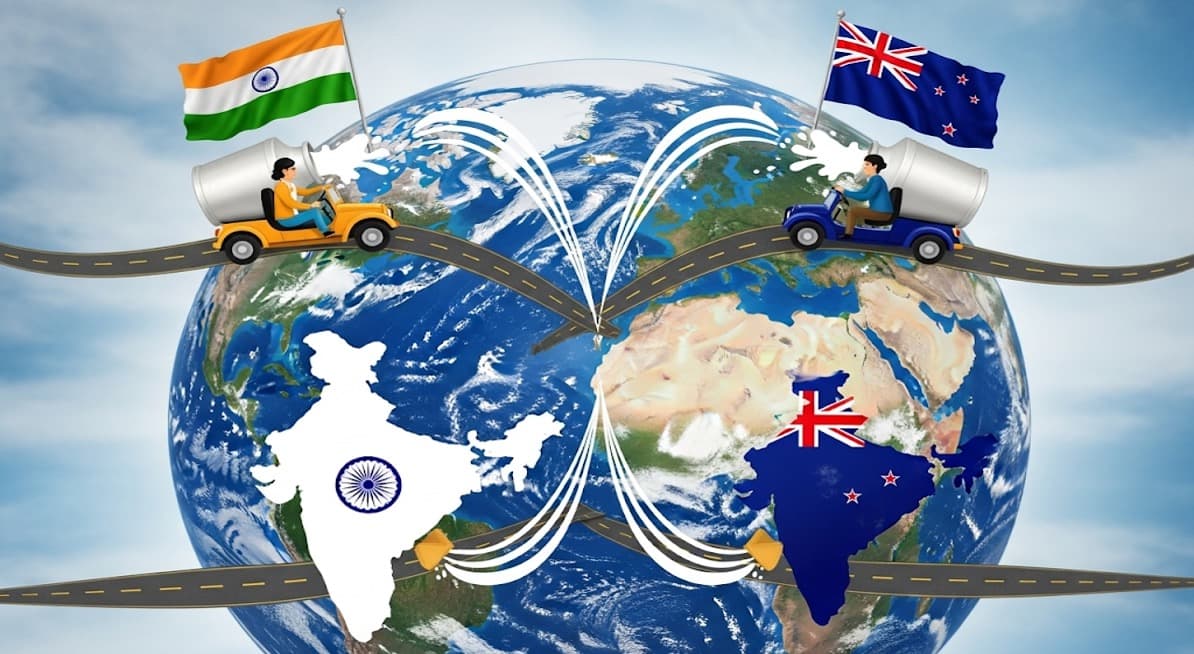
India & NZ: Opposite Forces Steering Global Dairy

By DairyNews7x7•Published on August 19, 2025

India & NZ: Opposite Forces Steering Global Dairy
Prefer on

The global dairy market is not only about commodities — it is a geopolitical chessboard in constant motion, where beyond cows, milk and cheese, economic power, food security and policies come into play, capable of shaking entire nations.
In this arena, India and New Zealand represent polar opposites: the former, a colossal producer that consumes everything internally; the latter, a small island that influences international prices through its exports.

India’s Dairy Workers Fight for Pensions

The paradox is striking: India produces over 239 million tonnes of milk per year and exports almost nothing; New Zealand, with just 5 million inhabitants and 5 million cows, is the world’s largest dairy exporter.

India: staggering production and insatiable consumption

India has long been the undisputed king of milk production. According to official data from India’s Ministry of Fisheries, Animal Husbandry and Dairying, in the 2023/24 fiscal year production reached 239.2 million tonnes, a 63% increase in just one decade (PIB India, 2025).

The National Dairy Development Board (NDDB) estimates that more than 90% of this production is consumed within its borders.

China’s New Dairy Deal Sparks Global Shift

Consumption is both cultural and massive. Milk is not just an ingredient, but a central part of the daily diet: from chai to paneer, to ghee — a product worth over 3.48 trillion rupees in 2024 and set to double by 2033 (Research and Markets, 2024).

During religious festivals such as Diwali and Holi, demand for butter and ghee soars, destabilising domestic prices.

The problem is that cold-chain infrastructure is limited and post-harvest losses remain high. Therefore, when consumption peaks, India must open the door to occasional imports of skimmed milk powder (SMP) and butter oil.

The USDA (2024) notes that India maintains tariffs of between 30% and 60% on these products, except under tariff quota exemptions. This defensive policy explains why, despite its size, India hardly features in global dairy trade.

What is expanding, however, is the value-added segment: yoghurts, ready-to-drink beverages (lassi, flavoured milks) and functional products.

The yoghurt market, for example, was worth 2.9 billion rupees in 2024 and will reach 14.7 billion by 2033, with annual growth of 19.7% (IMARC, 2025). The urban, young, digital middle class seeks convenience and quick nutrition: the ready-to-drink boom is proof of this.

New Zealand: the thermometer of the international market

If India is the production powerhouse, New Zealand is the export thermometer. What happens on its dairy farms resonates in Shanghai, Cairo and São Paulo.

For the 2025/26 season, Fonterra projects 1.49 billion kilos of milk solids (kgMS), similar to the previous season (Fonterra, 2025).

Weather is always a risk factor: heavy July rains cast doubt on early production, but spring’s start will set the pace. The world reference point is the Global Dairy Trade (GDT). In the August 2025 event, the price index rose 0.7% compared to the previous auction (GDT, 2025).

It may seem minor, but these small fluctuations define the income of thousands of farmers in the southern hemisphere and the cost for importers in Africa and Asia.

New Zealand exports more than 95% of its production, mainly to China, Southeast Asia and the Middle East. This level of exposure makes it vulnerable to geopolitical and regulatory shifts.

Here lies the major tension: sustainability. In 2024, Christopher Luxon’s government decided to cancel the agricultural emissions tax, known as the “burp tax”, which targeted methane emissions from cows and sheep (Reuters, 2024).

While celebrated by farmers, it drew international criticism for undermining the country’s “clean & green” image. Agriculture accounts for more than half of New Zealand’s emissions (DairyNZ, 2025).

And even if domestic policies are eased, global buyers — especially Europeans — will continue to press for stricter environmental standards.

Clashes and convergences

India and New Zealand watch each other closely. The former is a potential import giant; the latter, a global-scale supplier. But not everything is complementary.

India seeks to export ghee and value-added derivatives to niche markets — from Hindu diaspora communities to Middle Eastern consumers — while New Zealand defends its dominance in skimmed milk powder, the base of most international contracts.

Politics also plays a role: India shields its small farmers with high tariffs, while New Zealand depends on keeping markets open through free trade agreements.

In practice, India influences the market with its abstinence (when it does not buy, global prices suffer), and New Zealand with its abundance (when it increases production, it floods the market).

Trends and scenarios 2025–2030

The next five years will be decisive:

Asian demand: The Indian and Southeast Asian middle classes will drive dairy demand beyond what New Zealand alone can supply.

Mandatory sustainability: Even if Wellington loosens up, buyers will demand verified carbon footprints. If New Zealand does not adapt, it risks losing competitiveness to emerging countries with laxer regulations.

Indian value-added: With a huge domestic market and growing infrastructure investment, India could begin exporting more premium derivatives, ceasing to be merely a net consumer.

Model clash: India, with millions of small farmers protected by public policies; New Zealand, with highly efficient systems geared to global trade. Tension is inevitable, but it may also open doors to cooperation.

The future of the global dairy market is not decided in Brussels or Washington. It is decided in the villages of Gujarat and the green pastures of Waikato.

India, with its internal voracity and protectionist policy, can tilt the trade balance without selling a drop abroad. New Zealand, with its export efficiency and exposure to climate and geopolitics, is the beacon that sets prices and expectations.

Two opposing models, two extreme realities, yet the same chessboard. Within that tension — between Indian domestic consumption and New Zealand’s exports — lies nothing less than the compass of the global dairy market.

Source : Dairynews7x7 Aug 19th 2025 special article from partner EDAIRYNEWS by Valeria Hamann

With information from India’s Ministry of Fisheries, Animal Husbandry and Dairying (PIB, 2025), National Dairy Development Board (NDDB), USDA FAS (2024), Research and Markets (2024), IMARC Group (2025), Fonterra (2025), Global Dairy Trade (2025), DairyNZ (2025) and Reuters (2024).
Stay Updated

Get the latest dairy industry news directly in your feed.

Prefer Us on Google Search

Swipe to continue reading

Previous Article

Next Article