Logo
IndianGlobalBlogsPublicationsPodcastsMarketAboutContact
Logo
IndianGlobalBlogsPublicationsPodcasts
7News
Summer Heat to Stress India’s Dairy Cold ChainSavencia Profit Drops on Rising Milk CostsTN Milk Output Claim Sparks Data DisputeHormuz Disruption Threatens Dairy Supply ChainUP Approves Dairy Expansion in Bundelkhand

Indian Dairy News

1.5 Lakh Kg Expired Amul Products Destroyed in Jaipur
Mar 11, 2026

1.5 Lakh Kg Expired Amul Products Destroyed in Jaipur

In a major food safety crackdown, authorities in Jaipur destroyed around 1.5 lakh kilograms of expired Amul-branded packaged food products after uncovering an alleged scheme to erase expiry dates and...Read More

Summer Heat to Stress India’s Dairy Cold Chain
Mar 11, 2026

Summer Heat to Stress India’s Dairy Cold Chain

India’s dairy industry could face a major operational test this summer as rising temperatures and growing demand for chilled dairy products put increasing pressure on the country’s cold-chain infrastr...Read More

TN Milk Output Claim Sparks Data Dispute
Mar 11, 2026

TN Milk Output Claim Sparks Data Dispute

A debate has emerged over Tamil Nadu’s milk production after the Tamil Nadu Milk Dealers’ Welfare Association (TNMDWA) challenged claims made by Chief Minister M.K. Stalin that the State produces 3 cr...Read More

DairyNews7x7
Advertisement

Latest Blogs

See More
Rajahmundry Milk Incident: Accident or Adulteration?
Mar 10, 2026

Rajahmundry Milk Incident: Accident or Adulteration?

The recent editorial “Bitter Milk” published by The Hindu raises important concerns about food safety in India. The editorial deserves appreciation for attempting to broaden the conversation and under...Read More

Milk Prices Rise in South & West: Is North Next?
Mar 05, 2026

Milk Prices Rise in South & West: Is North Next?

The recent round of retail milk price increases across South India and Maharashtra is no longer an episodic adjustment but a clear signal of structural stress building up in India’s milk economy. Over...Read More

India’s Dairy Climate Paradox: Production Triumph Meets Methane Time-Bomb
Mar 02, 2026

India’s Dairy Climate Paradox: Production Triumph Meets Methane Time-Bomb

India’s rise to the top of the global dairy league board has been one of the most remarkable agricultural success stories of the 21st century. With milk production surpassing 247 million tonnes per ye...Read More

India’s First Cow Culture Museum in Mathura
Feb 16, 2026

India’s First Cow Culture Museum in Mathura

India’s first national “Cow Culture Museum” is set to be established in Mathura, Uttar Pradesh, on the campus of Pandit Deendayal Upadhyaya Veterinary Science University, announced the Uttar Pradesh B...Read More

Global Dairy News

Savencia Profit Drops on Rising Milk Costs
Mar 11, 2026

Savencia Profit Drops on Rising Milk Costs

Savencia Profit Drops on Rising Milk Costs French dairy major Savencia Fromage & Dairy reported a sharp fall in profitability for 2025, with its net income dropping by €32.2 million to €74.7 million,...Read More

Hormuz Disruption Threatens Dairy Supply Chain
Mar 11, 2026

Hormuz Disruption Threatens Dairy Supply Chain

Escalating geopolitical tensions around the Strait of Hormuz are creating new risks for the global dairy sector by disrupting key inputs such as energy, fertilisers and shipping routes. The strait car...Read More

Data Replaces Handshakes in Dairy Lending
Mar 10, 2026

Data Replaces Handshakes in Dairy Lending

The dairy financing landscape is undergoing a major transformation as traditional relationship-based lending gives way to data-driven credit evaluation, according to industry insights. Historically, d...Read More

DairyNews7x7
Advertisement
Dairy News 7x7

Your trusted source for all the latest dairy industry news, market insights, and trending topics.

FOLLOW US
CATEGORIES
  • Global News
  • Indian News
  • Blogs
  • Publications
  • Podcasts
SUBSCRIBE TO OUR NEWSLETTER

Stay informed with the latest updates and trending news in the dairy industry.

No spam, unsubscribe at any time

GET IN TOUCH
C-49, C Block, Sector 65,
Noida, UP 201307
+91 7827405029dairynews7x7@gmail.com

© 2026 Dairy News 7x7. All Rights Reserved.

Terms of ServicePrivacy Policy
Prefer Us
Prefer Us

How milk tamed the Third Pole-3,500-year history of dairy

By DairyNews7x7•Published on April 14, 2023

How milk tamed the Third Pole-3,500-year history of dairy
Prefer on

It’s not called the Third Pole for nothing. The Tibetan Plateau forms the major portion of a vast upland area of ice and glaciers that covers some 100,000 square kilometres of Earth’s surface.

It is a cold, arid and unforgiving landscape that couldn’t be more different from the warm plains and valleys that gave rise to our species.

Yet, for thousands of years the Tibetan Plateau has been occupied by Homo sapiens. It has seen the establishment of agricultural societies, and the growth of religions, kingdoms and even empire.

How humans managed not just to subsist but to thrive in this high-altitude landscape is a question that has challenged researchers for decades – and one that has captivated us too.

We know part of the answer lies in Tibetan genes, and a unique adaptation that enables people living in the region to use oxygen more efficiently, avoiding the potentially lethal effects of hypoxia (the condition that arises from a lack of oxygen).

But just as important as avoiding hypoxia was finding enough food in the plateau’s unpredictable, freezing and hyper-arid environment.

Our research, published today in Science Advances, set out to look more closely at early Tibetan diets. To do this, we examined ancient dental plaque, a rich source of dietary information.

Our results show one food in particular may have been crucial to sustained human occupation and expansion across the Tibetan Plateau: milk.
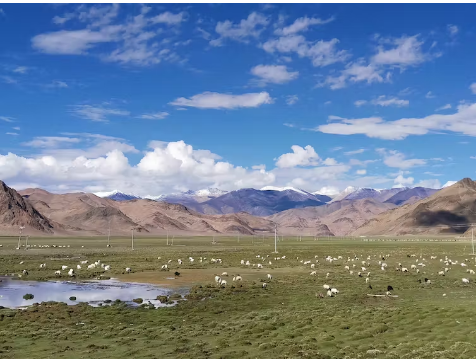
Modern pastures on the highland Tibetan Plateau. Li Tang, Author provided

The benefits of not brushing

Without dentists, ancient people often accumulated thick layers of plaque – also known as calculus – on their teeth. Using a new method called palaeoproteomics, scientists can investigate the food proteins that became trapped and preserved in ancient people’s dental plaque.

Palaeoproteomics allows us to look at types of food, such as milk, that aren’t visible through traditional archaeological approaches, and to identify specific individuals who were consuming them.

Our study analysed all available human skeletal remains on the plateau: a total of 40 individuals, dating to between 3500 and 1200 years ago, from 15 widely dispersed sites.
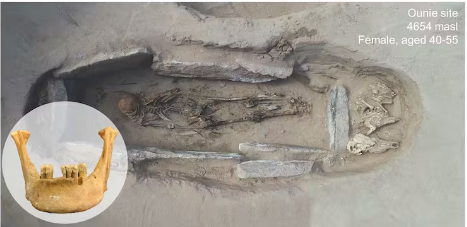
One of the individuals we studied was a woman, aged 40-55, buried at the Ounie site. Hers were the highest altitude (4654 masl) remains studied, dated to around 601-758 CE. Li Tang and Zujun Chen, Author provided
Our work yielded fascinating results. Preserved in the teeth of many of these people were fragments of proteins derived from milk products. The protein sequences showed the milk originated from domestic herd animals: sheep, goat and probably yak.

We could see dairy foods were consumed by a wide swathe of Tibetan Plateau society, including adults and children, elites and everyday people. Dairy was even present in the earliest Tibetan Plateau skeletons we looked at.

In fact, we found dairy was being consumed as far back as 3,500 years ago – pushing evidence for dairying on the plateau back 2,000 years earlier than records in historical sources, such as the 8th- and 9th-century Tongdian encyclopedia.

Evidence for dairying now corresponds with the earliest evidence for domesticated herd animals on the Tibetan Plateau, which suggests dairying and pastoralism spread together in this region.

Pushing beyond the cultivation boundary

Our results showed another interesting pattern: all the milk peptides we identified came from ancient individuals in the highest altitude parts of the plateau. These were the most inhospitable areas, where growing crops was difficult.

In the southern-central and southeastern valleys, where farmable land was available, we did not recover any dairy proteins from people’s calculus.

Dairy, it seems, was vital to human occupation of the parts of the plateau that lay beyond the reach of even frost-tolerant crops. This is a vast area, as less than 1% of the Tibetan Plateau supports crop cultivation.

In the lower-lying areas, long-term habitation has been sustained by cultivating plant foods. But across most of the plateau, the primary mode of subsistence has been pastoralism.
Dairy-free? Not an option

While dairy would eventually become central to Tibetan cuisine and culture, our results suggest it was initially adopted out of necessity. It allowed people in the Tibetan Plateau’s most extreme environments to turn the energy locked inside alpine meadow grasses into a protein-rich, nutritional food that was endlessly renewable – because animals weren’t killed to acquire it.

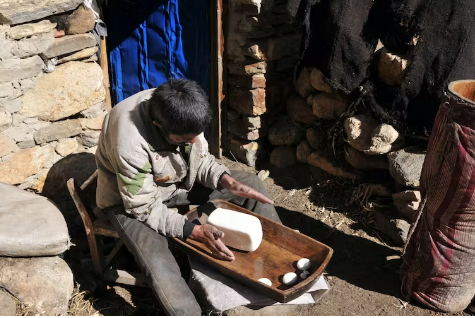
Today, dairy is an important part of modern Tibetan food and culture. Li Tang, Author provided
Dairying opened up the Tibetan Plateau to the spread and sustained growth of human populations, which ultimately enabled the emergence of substantial cultural complexity.

In one of Earth’s most inhospitable environments, then, it would appear dairy-free was not an option.

Future work on the plateau will be vital to understanding how the human adoption of pastoralism and dairying reshaped Tibet’s landscapes. And just as critically, it will shed light on what human-induced climate change means for the future of the ecosystems present-day herders rely on
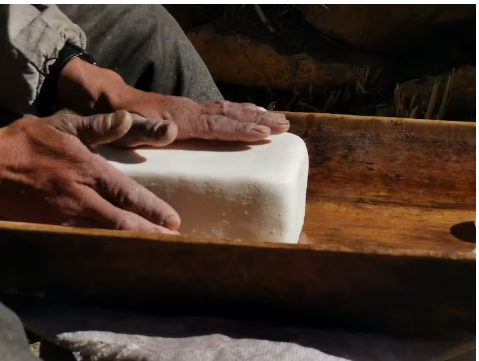
Modern Tibetan pastoralists make butter from yak milk. Li Tang, Author provided

Stay Updated

Get the latest dairy industry news directly in your feed.

Prefer Us on Google Search

Swipe to continue reading

Previous Article

Next Article