Latest Blogs
See More
Indian Dairy News

DairyNews7x7
Global Dairy News

DairyNews7x7
Maeve Williams, VistaMilk, explains how genetic differences and modern breeding techniques, including DNA sequencing, are used to improve traits for economic and environmental sustainability in dairy farming.
Have you ever been sitting around a table with your siblings and wondered why you all look so different? I have two sisters and, although there are similarities between us, we certainly do not look the same. If you consider our parents' appearances, I can see where our different characteristics have come from. My green eyes resemble our father’s, as does my dark hair, whereas my sisters’ hair and eyes are more similar to our mother’s.The reason why siblings don’t look exactly the same as one another is primarily down to differences in the genetic information we inherit from our parents. Every person, or animal, receives half of their genetic information from their mother and half of their genetic information from their father, but the half inherited by one sibling could differ from the half inherited by the other siblings.
When geneticists talk about genetic information, we are generally referring to the DNA that makes up our genes. These genes function as the 'instruction manual' for our bodies, which provide all of the information required to build and maintain our different cells.
From a gene perspective, all living creatures are very similar, from plants to cattle to humans; we all share genes because we all have cells that perform similar functions. In fact, humans share approximately 80% of their genes with cattle and we even share about 60% of our genes with bananas. Given genes are so similar between different species, it is not surprising that within a species, such as human or cattle, it is normal to share more that 99% of your DNA with other members of your species.
In animal breeding, our goal is to exploit the small genetic differences between animals – that less than 1% difference – to breed for more economically, environmentally and socially sustainable animals. For thousands of years, farmers improved the genetic merit of their animals by breeding animals with desirable traits together, assuming that if two parents displayed desirable traits, their offspring would likely display the same desirable characteristics. This approach to breeding resulted in the wide variety of breeds we have within every domesticated species. For example, dogs that range in size from small terriers to Bernese Mountain dogs were all originally bred from wolves.
Modern animal breeding relies on the same principle of breeding animals with desirable traits together to improve the next generation. In addition to evaluating the performance of potential parents, we can now use the performance data of related animals (such as siblings and cousins) to estimate an animal’s genetic merit for key traits, even if the animal itself does not yet have performance records. In Ireland, we have a dairy breeding index, called the Economic Breeding Index (EBI), which applies a single ranking value to each dairy animal in the country. This single figure profit index helps farmers identify the most profitable bulls and cows for breeding dairy animals.
The EBI considers the genetic merit of animals for milk production, fertility, calving performance, beef, health, maintenance, management and carbon emissions. Rather than choosing the parents of the next generation based solely on their appearance or performance, Irish farmers now use the EBI to choose which dairy animals should become the parents of their next generation; similar breeding indexes are available for beef cattle and sheep.
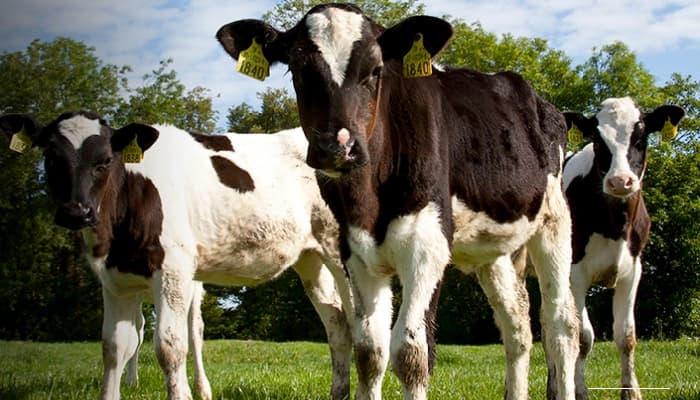
As well as helping farmers to choose which of their animals should be the parents of the next generation, estimates of genetic merit are also generated for newly-born calves and lambs. Farmers can use these estimates of genetic merit as an indication of how an animal is likely to perform for traits such as milk production and fertility long before the calf is old enough to produce milk or have offspring. These estimates were traditionally calculated as simply the average of the genetic merit of both parents. However, in reality, the genetic merit of each offspring differs from the average of the parents.
In recent years, being able to directly examine the DNA of all animals (a process called genotyping or DNA sequencing) has enabled farmers to receive more accurate estimates of an animal’s genetic merit for economically important traits. A large proportion of Irish farmers now collect tissue samples from their newborn calves and send them to a lab for genotyping. After a dairy calf is genotyped, farmers receive more accurate estimate of each calf’s genetic merit, and these more accurate values can be particularly useful for farmers who want to buy or sell young animals.
Animal breeding has changed considerably over the last few decades, and this is likely to continue as we gain more knowledge. However the focus on improving the lives of animals and farmers remains at the centre of these changes.
This article was first published on RTE Brainstorm