Latest Blogs
See More

Indian Dairy News



DairyNews7x7
Global Dairy News

DairyNews7x7

The milk shelves in Israeli supermarkets have been less than full in recent months. While the more expensive milk and dairy products can be found in abundance, regular 3% milk has been available sporadically. The price of this milk is regulated by the state and has become increasingly unprofitable to manufacture, with consumers paying the price .
While the government has taken steps to mitigate the shortage, the situation has not improved.
Last month, Israeli Finance Minister Bezalel Smotrich signed an order to slash the customs duty on imported milk for a period of three months. The goal was to address the shortage of milk in retail stores and supermarket chains. Encouraging milk imports gives hope that consumers will be able to purchase milk without the interruption they are currently experiencing.
“I hope this will be the first and only time the country will do this,” said Jonathan Demri, a dairy farmer from the southern Israeli community of Gilat.
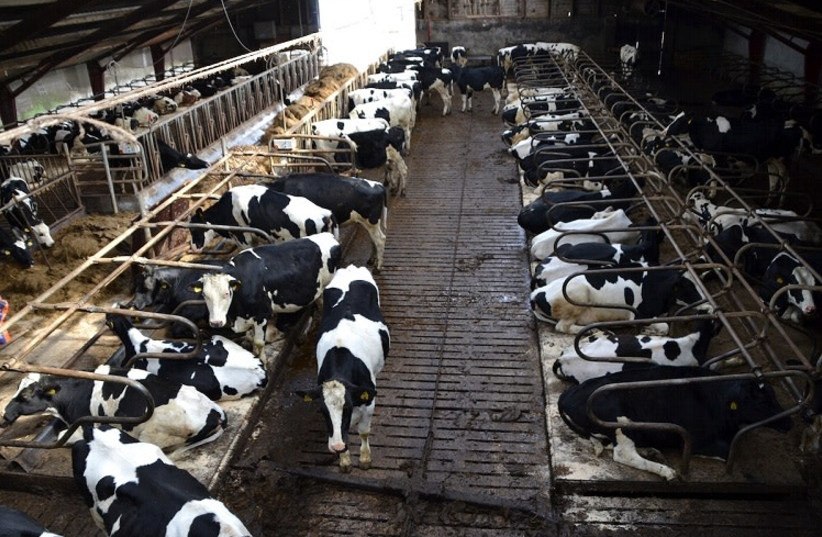
Demri runs a medium-sized dairy farm with 150 cows and three employees, manufacturing 1.5 million liters of milk annually.
“There is no actual shortage in milk,” Demri told The Media Line. “The local production exceeds the local consumption. If the shelves are empty, that is because someone has an interest in that shortage.”
Data from the Israel Dairy Board shows that the average Israeli cow produced about 32 liters of milk a day, with the average consumption of Israelis rising. Most of this consumption is of milk, the rest is consumption of other types of dairy products. The number of dairy farms has declined consistently, which can be attributed to the increased efficiency of farms but also to a reduction in the profitability of maintaining medium and small farms.
Demri implied that the large supermarket chains create a “fictitious” shortage in order to “legitimize imports.”
Farmers such as Demri sell their milk to manufacturers who then sell to retail chains and supermarkets. The dairy market in Israel is dominated by three large milk production plants, whose prices on nonregulated products are often quite similar.
“The supermarket chains have the same interest as the dairy manufacturers—they want consumers to buy the more expensive products,” Dr. Avichai Snir from the Department of Economics at Bar-Ilan University told The Media Line.
According to Snir, the dairy market in Israel is highly concentrated and creates such shortages frequently. It is a market that makes it unprofitable to produce the type of milk whose price is regulated by the state.
The state is involved in almost every part of the process of milk production and price regulation. It determines how much milk each dairy farm can produce, to whom the milk is distributed, and the price dairy farmers receive from manufacturers.
“As soon as the price of regulated milk is not profitable for dairy farms, the dairy farm has to decide what it wants to do with the milk it produces,” said Snir, who believes the dairy market in the country is distorted. “Producing drinking milk is less profitable than producing unregulated cheeses, which consumers pay a higher price for, increasing the profit for the manufacturers and the retailers.”
“As long as there is a lot of milk in the market, it works, but in the summer, cows produce less milk because of the heat, resulting in a shortage,” Snir explained.
In previous summers, there have been shortages of other dairy products such as butter, which is also a regulated item.
Earlier this year, the price of regulated dairy products was set to rise by 16%, due to the significant rise in costs of imported livestock feed following the Russian invasion of Ukraine. Dairy producers say this accounts for a significant part of the rise in costs of Israeli milk.
To avoid public criticism, Smotrich delayed the full increase, raising the price by only 9.28%.
The latest move by Smotrich to allow for the import of milk will hardly solve the problem. Bringing milk to Israel, an island economy, comes with challenges that make it a less ideal solution to the problem. It is a lengthy and costly process and by the time the milk arrives in Israel, its expiration date is close. The issue of Kosher certification is also a consideration.
“In Israel, every cow is sampled once a month and there is quality assurance of one of the highest standards in the world,” Demri said. “We cannot guarantee the same quality in imported milk, and it won’t be fresh.”
Dairy products are a staple in the Israeli kitchen. In 2011, mass demonstrations against the high cost of living began partly due to the rise in the prices of cottage cheese and were coined the “cottage cheese protest.” The result of the protest movement was a series of measures intended to lower the cost of living, including the reduction in the price of the staple item.
Since then, the cost of living in Israel has only risen, with the current government under pressure to take measures to alleviate it.
“The market needs to open regularly for import, especially for cheese,” Snir said. “If the price of cheese goes down, dairy manufacturers will be forced to use more milk for the production of regulated milk.”
Data compiled by the Agricultural Ministry shows that dairy sales in Israeli supermarkets reached almost $2.5 billion in 2022.
Snir also suggested giving subsidies to farmers to use their land as they see fit and to not dictate their purpose. This will remedy the market without exaggerated intervention.
“What needs to change is the government policy, the policy which creates this bottleneck,” Demri said. “We will keep manufacturing milk without dealing with politics. All the factors that go into producing milk, from the water, the labor, the energy, and the price of milk, are all controlled by the government.”
“It can’t be that the state that controls everything complains to us that milk is expensive—they need to reduce the prices,” Demri summarized.