Logo
IndianGlobalBlogsPublicationsPodcastsMarketAboutContact
Logo
IndianGlobalBlogsPublicationsPodcasts
7News
Summer Heat to Stress India’s Dairy Cold ChainSavencia Profit Drops on Rising Milk CostsTN Milk Output Claim Sparks Data DisputeHormuz Disruption Threatens Dairy Supply ChainUP Approves Dairy Expansion in Bundelkhand

Indian Dairy News

Gujarat Ice Cream Makers Face Cone Shortage
Mar 12, 2026

Gujarat Ice Cream Makers Face Cone Shortage

Ice cream manufacturers in Gujarat are bracing for a potential shortage of cones ahead of the peak summer season due to disruptions in natural gas supply triggered by geopolitical tensions in West Asi...Read More

KMF Milk Collection Drops to 95 Lakh Litres
Mar 12, 2026

KMF Milk Collection Drops to 95 Lakh Litres

Milk procurement by the Karnataka Milk Federation (KMF) has declined to around 95 lakh litres per day with the onset of summer, down from nearly 1 crore litres daily earlier, as rising temperatures an...Read More

Old Electronics May Hide 22-Carat Gold
Mar 12, 2026

Old Electronics May Hide 22-Carat Gold

Swiss scientists have discovered that discarded electronic devices—especially computer motherboards and circuit boards—contain valuable amounts of gold that most people unknowingly throw away. Researc...Read More

DairyNews7x7
Advertisement

Latest Blogs

See More
Rajahmundry Milk Incident: Accident or Adulteration?
Mar 10, 2026

Rajahmundry Milk Incident: Accident or Adulteration?

The recent editorial “Bitter Milk” published by The Hindu raises important concerns about food safety in India. The editorial deserves appreciation for attempting to broaden the conversation and under...Read More

Milk Prices Rise in South & West: Is North Next?
Mar 05, 2026

Milk Prices Rise in South & West: Is North Next?

The recent round of retail milk price increases across South India and Maharashtra is no longer an episodic adjustment but a clear signal of structural stress building up in India’s milk economy. Over...Read More

India’s Dairy Climate Paradox: Production Triumph Meets Methane Time-Bomb
Mar 02, 2026

India’s Dairy Climate Paradox: Production Triumph Meets Methane Time-Bomb

India’s rise to the top of the global dairy league board has been one of the most remarkable agricultural success stories of the 21st century. With milk production surpassing 247 million tonnes per ye...Read More

India’s First Cow Culture Museum in Mathura
Feb 16, 2026

India’s First Cow Culture Museum in Mathura

India’s first national “Cow Culture Museum” is set to be established in Mathura, Uttar Pradesh, on the campus of Pandit Deendayal Upadhyaya Veterinary Science University, announced the Uttar Pradesh B...Read More

Global Dairy News

Israel Drops Controversial Dairy Reform From Budget
Mar 12, 2026

Israel Drops Controversial Dairy Reform From Budget

The Israeli government has removed a controversial dairy reform proposed by Finance Minister Bezalel Smotrich from the 2026 Arrangements Law, a key legislative package linked to the country’s state bu...Read More

Savencia Profit Drops on Rising Milk Costs
Mar 11, 2026

Savencia Profit Drops on Rising Milk Costs

Savencia Profit Drops on Rising Milk Costs French dairy major Savencia Fromage & Dairy reported a sharp fall in profitability for 2025, with its net income dropping by €32.2 million to €74.7 million,...Read More

Hormuz Disruption Threatens Dairy Supply Chain
Mar 11, 2026

Hormuz Disruption Threatens Dairy Supply Chain

Escalating geopolitical tensions around the Strait of Hormuz are creating new risks for the global dairy sector by disrupting key inputs such as energy, fertilisers and shipping routes. The strait car...Read More

DairyNews7x7
Advertisement
Dairy News 7x7

Your trusted source for all the latest dairy industry news, market insights, and trending topics.

FOLLOW US
CATEGORIES
  • Global News
  • Indian News
  • Blogs
  • Publications
  • Podcasts
SUBSCRIBE TO OUR NEWSLETTER

Stay informed with the latest updates and trending news in the dairy industry.

No spam, unsubscribe at any time

GET IN TOUCH
C-49, C Block, Sector 65,
Noida, UP 201307
+91 7827405029dairynews7x7@gmail.com

© 2026 Dairy News 7x7. All Rights Reserved.

Terms of ServicePrivacy Policy
Prefer Us
Prefer Us

Do precision fermentation economics stack up for cow less dairy?

By DairyNews7x7•Published on August 31, 2023

Do precision fermentation economics stack up for cow less dairy?
Prefer on

Once upon a time, dairy proteins were made exclusively by lactating mammals. These days, you can produce them in genetically engineered plants or microbes, or even lactating mammary cells grown in a bioreactor.

But is there a market for ‘animal-free’ dairy? Is making whey and casein via precision fermentation—the most advanced of the three methods outlined above—commercially viable? And how do you talk to consumers about dairy… without cows?

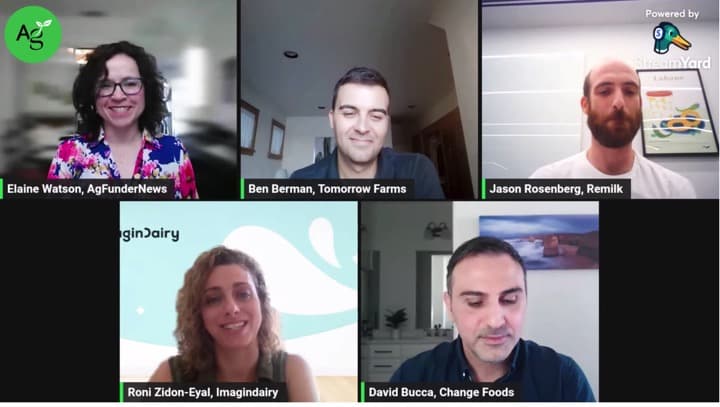
To discuss some of the challenges and opportunities in the nascent space, AgFunderNews caught up with five startups in the field:

  • Roni Zidon-Eyal, VP business development, Imagindairy
  • David Bucca, founder and CEO, Change Foods
  • Christian Poppe, director global public affairs, Formo
  • Jason Rosenberg, head of business development, Remilk 
  • Ben Berman, founder and CEO, Tomorrow Farms
https://youtu.be/bvXPeKd-9uw

In our 45-minute round table event, recorded above, we discussed:

  • Manufacturing and scale up: How are firms addressing capacity challenges?
  • Financing: How tough is it to raise money in the current climate?
  • Economics: Do the economics of precision fermentation stack up for ‘commodity’ dairy proteins?
  • Competitive technologies: Do other approaches such as molecular farming make more sense?
  • Market drivers: Is animal-free dairy going to be driven by cool startups or by big CPG companies under pressure to reduce their carbon footprint?
  • Messaging: What messaging and language resonates with consumers? Do shoppers understand ‘animal-free’ dairy?
  • Sustainability: How sustainable is dairy from fermentation?
  • B2b or b2c? What business models make the most sense for startups in the field?
  • Regulations. How challenging is it to get animal-free dairy products onto the market?

Raising money:

David Bucca, Change Foods: “There’s no denying that this is the most difficult period right now. When you’re talking about venture capital, risk capital, and early-stage finance, that’s where some of the reins have been pulled back. I think the LPs for many of the funds have just been more conservative and have failed to deploy this year, and then a lot of them are punting it to the future.

“And then of course, we had the SVB [Silicon Valley Bank] crash at the start of the year that caused a lot of concern. But it’s cyclic, so in the next 12 to 18 months, I think there’ll be some type of rebound in the markets, which will then change the sentiment, but it’s about survival right now.

“It’s a case of cutting back, extending your runway, and finding investors that are deploying, or finding sources of funding that are driven by different incentives. And then there is government support as well. So for example we’re part of the NextGen FDI initiative​​ [an initiative launched by the United Arab Emirates’ Ministry of Economy designed to help high-tech businesses launch and scale from the UAE].”

Roni Zidon-Eyal, Imagindairy: “If you have to bet on an industry that will prevail, I would say it’s the food tech industry, because this is a necessity. The past years and the pandemic really highlighted the fact that the future is not going to be a walk in the park in terms of supply chain, climate, and we have to do everything to make sure that we have supply of food around the globe.

“That’s why I think we’ll see more funding going into this, [albeit] with more caution, which is actually good, because if companies are built on healthy foundations and deep technology, I hope they will withstand these difficult times. But CPGs definitely have a role to play. You have to put your money where your mouth is if you want to change the world and fix broken food systems. And in terms of government funding, governments subsidize dairy, so why not subsidize green technologies as well?”

Who is the consumer for animal-free dairy milk?

Ben Berman, Tomorrow Farms: “Number one is folks that have already made the switch to plant-based and we believe for those customers, this is a very easy switch. With Bored Cow animal-free dairy milk, we’re already price competitive and for taste, nutrition and functionality, it’s a very easy switch for those customers. Our data shows that once we get people to try it from that group, they’re coming back.

“The second is the customer base that I fall into, which is folks who have not made the switch to plant-based but are searching for better alternatives to the foods they love.

“The final one is the core dairy milk drinker. And transparently… they are not going to switch over to animal free dairy right out of the gate…. but long term we have the promise of being able to replace dairy by continuing to improve these products, getting to price parity, and offering people a more nutritious product.

“People are choosing Bored Cow [now in 1,200 stores in the US] for three main reasons. Number one it tastes a lot better than any milk alternative on the market today. Number two is functionality. It froths and foams and cooks and bakes like real dairy milk. And finally, nutrition [Bored Cow milk has 8g protein, 3g sugar vs 12g in dairy milk, no lactose, plus vitamin A, D2, B12 and B2].”

Market drivers:

Jason Rosenberg, Remilk: “Sustainability is not necessarily the driving factor for the consumer, but we do see that businesses care very much about it. And much of that stems from the fact that they have already made so many commitments either publicly or internally [to reduce carbon emissions] and the ingredients piece is often the hardest piece of the puzzle for many CPGs to fix.

“Another piece of the puzzle is that dairy is an extremely volatile commodity and when we look down the road, there is a huge benefit in [being able to offer] stability over time, without fluctuations based on season, a pandemic, or supply chain problems.”

Regulations:

Roni Zidon-Eyal, Imagindairy: “In Europe there is a clash between great awareness of sustainability… and on the other hand, this aversion from everything that uses genetic engineering, even if it’s GMO-free.”

Christian Poppe, Formo: “If there are residual amounts [of the genetically modified host microorganisms in the final product] at a level that would be relevant, then you would have a [regulatory] problem [in the EU]. Thankfully [companies making animal-free dairy via precision fermentation] will end up in the novel food drawer. There is also the GMO drawer [regulation 1829/2003] that Impossible Foods have found themselves in [with heme proteins made by genetically engineered yeast], so at least to that extent, we will have an easier time [making purified dairy proteins].

“While the EU novel food process should take around 18 months, we’re probably talking about, let’s say three years.”

Resource efficiency:

Jason Rosenberg, Remilk: “[With dairy cows], is 600 or 650 liters of water being converted to one liter of milk an efficient conversion process? I think most of us don’t really know how to assess that. But if you consider that milk is about 90% water, so 90% of that water is going into making 0.9 liters of milk, that’s clearly inefficient, right? Just due to the efficiency of our microorganisms producing very specific molecules, we are extremely resource efficient [by comparison with cows].”

Animal-free messaging:

Ben Berman, Tomorrow Foods: “We use ‘animal-free dairy milk’ as the product identity statement on our package and we do it because we actually think it is the clearest way to describe what’s inside. With [animal-free milk brand] Bored Cow, you’re getting a dairy identical milk protein [beta lactoglobulin, a whey protein], it’s real dairy, and we want people to know that, so we believe that describing it as animal free dairy milk is the best way to do so.

“From a creative standpoint we’re also telling a story that says cows have been working for us for tens of thousands of years and more recently, they’ve been forced into factory farming. What if instead, we let them retire and roam free and pursue their passions, and maybe even be a little bit bored?”

Source: Agfundernews Aug 29th 2023


Stay Updated

Get the latest dairy industry news directly in your feed.

Prefer Us on Google Search

Swipe to continue reading

Previous Article

Next Article