Latest Blogs
See More

Indian Dairy News

DairyNews7x7
Global Dairy News

DairyNews7x7
The world has been experiencing record-breaking and deadly heat over the past decade, with 2024 becoming the hottest year yet. In 2021, scientists declared that, in order to halt this rise in global temperatures, swift action to reduce methane emissions was needed.[i] This is because methane is 80 times more potent than carbon dioxide (CO2) while in the atmosphere, though it stays in the atmosphere for a much shorter time (around 20 years).[ii] Methane reductions across energy, agriculture and waste are critical to achieving the immediate emissions cuts required to stay within the 1.5°C limit.[iii]
Agriculture, in particular livestock, is the largest contributor to man-made methane emissions.[iv] According to recent scientific literature, livestock farming is responsible for up to a fifth of the world’s total greenhouse gas emissions. The majority of methane emissions associated with livestock farming are released as cow burps, a result of cows’ digestive processes (enteric fermentation), along with emissions from manure. The scale of methane emissions generated by the world’s major meat and dairy companies is comparable to major fossil fuel companies.[v]
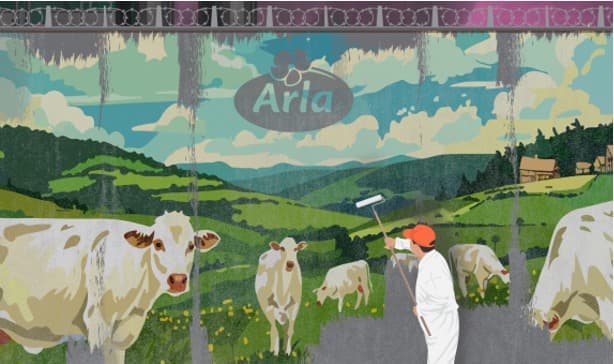
Despite this, Big Meat and Dairy companies have long flown under the radar in the climate debate. They have largely avoided regulations to limit emissions, using a range of tactics to maintain their exceptional status. As the world’s fifth largest dairy producer, Arla has been selling a dairy fairytale of sustainability to continue to escape climate sanctions while prioritising false solutions that further industrialisation. However, the green mirage has begun to crack; while Arla celebrates its own sustainability efforts, the company’s climate work has been criticised for everything from lacking ambition and transparency to being pure greenwashing.
Arla’s smokescreens
In this report, we look at how Arla is putting up smokescreens through lobbying, greenwashing and creative emissions calculations in order to hide its true emissions, increase its political influence, maintain dairy’s privileged position and increase the company’s profits. This provides a textbook example of how Big Meat and Dairy get away with their heavy climate footprint, as outlined in the Changing Markets Foundation report The New Merchants of Doubt.[vi]
For this report, we have examined public documents and other written sources, as well as talking to dairy farmers connected to Arla. This information paints a picture of how Arla is working to increase its already large influence in the industry, and how it lobbies policymakers to advance its agenda. Arla maintains its dairy fairytale by keeping an iron grip on its dairy farmers and sprinkling money on greenwashing campaigns to continue misleading consumers.
Emissions
With 96% of Arla’s emissions coming from methane according to estimates presented in this report – surpassing the reported agricultural emissions of countries like the Netherlands or Ukraine – we look at the company’s pledges to reduce these emissions and progress so far.
Arla positions itself as a climate champion and has pledged to reach net zero by 2050. The company has committed to reduce absolute greenhouse gas emissions in Scopes 1 and 2 by 63% by 2030. For Scope 3 emissions, Arla has an emissions reduction target of 30% per tonne of product by 2030.
To get a clearer picture of how solid these climate targets really are, we analysed Arla’s net-zero commitments against the UN’s recommendations for credible and responsible net-zero targets. Our assessment shows that, of the nine relevant recommendations, Arla fulfils only one, partially fulfils five and does not fulfil three. The analysis found:
Weak initiatives
While Arla promotes technological solutions, like feed additives and biogas, as part of its climate plans, its commitment to rolling these out is questionable. According to our estimates presented in this report, the company is only investing about €200 million a year in ‘sustainability’ against the approximate €240 million it spends on marketing.
One of the technological solutions that Arla is quite vocal and active on is converting methane from manure into biogas,. However, biogas does little to address the company’s main source of emissions; our estimations show only 2.6% of Arla’s emissions per kilo of milk are currently saved through biogas, with a maximum (and unlikely) potential of 15%, compared to 2015 levels. Nevertheless, the company is aggressively pushing for further biogas subsidies and favouring biogas in its own incentive scheme for farmers, both of which risk further intensification and industrialisation of dairy production.
Arla appears to put little effort into transforming its production system and has a very small offering of plant-based products compared to its competitors. As this report shows, its main plant-based brand, Jörd, is worth only £7.9 million, representing just 0.3% of Arla’s total revenue in the UK. Equally, according to the authors estimates, Arla’s share of the plant-based UK market is a mere 2.4%, in contrast to its milk market share of 20-27%.
To reach its climate targets, Arla promotes its FarmAhead Check Tool and FarmAhead Sustainability Incentive initiative. These aim to provide farm-level carbon footprint measurement, and offer financial incentives per litre of milk to farmers for reducing emissions according to Arla’s own point-based system. However, these initiatives have been heavily criticised, especially by small to medium-sized dairy farmers, who argue that the system is unfair and pushes farmers towards intensification.
Lobbying
Arla knows business-as-usual is not guaranteed. To maintain its profitable position, Arla works together with favourable policymakers to secure industry benefits and concessions and maintain the status quo, despite the dairy industry’s huge impact on the environment, biodiversity and climate. Through direct and indirect lobbying, Arla has been involved in derailing climate policy in the EU, including through derailing the inclusion of agriculture in the Methane Strategy and blocking access to school food programmes for alternative drinks. Our report also uncovers lobbying for more subsidies and investment in climate solutions such as regenerative agriculture and biogas that are pushed as ‘silver bullets’ but fail to address the company’s main climate impacts. By scrutinising Access to Information requests, and conducting interviews, we paint a picture of a company that spends huge sums on negatively influencing climate policy for EU citizens.
Greenwashing
Much of what Arla does in the field of environment and climate can be interpreted as greenwashing. In particular, Arla’s Net Zero marketing campaign in Sweden, Denmark and the Netherlands claimed that the carbon footprint of the milk it was advertising had been neutralised, including ‘methane from enteric fermentation, from cow to consumer’. The campaign was heavily criticised by both consumers and authorities, and in Sweden, Arla was taken to court by the Swedish Consumer Ombudsman and lost the case.
This is a crucial decade for climate action, and Arla is so far selling us a fairytale that leads towards climate catastrophe. To put this right, this report calls on Arla to: