Logo
IndianGlobalBlogsPublicationsPodcastsMarketAboutContact
Logo
IndianGlobalBlogsPublicationsPodcasts
7News
Summer Heat to Stress India’s Dairy Cold ChainSavencia Profit Drops on Rising Milk CostsTN Milk Output Claim Sparks Data DisputeHormuz Disruption Threatens Dairy Supply ChainUP Approves Dairy Expansion in Bundelkhand

Indian Dairy News

1.5 Lakh Kg Expired Amul Products Destroyed in Jaipur
Mar 11, 2026

1.5 Lakh Kg Expired Amul Products Destroyed in Jaipur

In a major food safety crackdown, authorities in Jaipur destroyed around 1.5 lakh kilograms of expired Amul-branded packaged food products after uncovering an alleged scheme to erase expiry dates and...Read More

Summer Heat to Stress India’s Dairy Cold Chain
Mar 11, 2026

Summer Heat to Stress India’s Dairy Cold Chain

India’s dairy industry could face a major operational test this summer as rising temperatures and growing demand for chilled dairy products put increasing pressure on the country’s cold-chain infrastr...Read More

TN Milk Output Claim Sparks Data Dispute
Mar 11, 2026

TN Milk Output Claim Sparks Data Dispute

A debate has emerged over Tamil Nadu’s milk production after the Tamil Nadu Milk Dealers’ Welfare Association (TNMDWA) challenged claims made by Chief Minister M.K. Stalin that the State produces 3 cr...Read More

DairyNews7x7
Advertisement

Latest Blogs

See More
Rajahmundry Milk Incident: Accident or Adulteration?
Mar 10, 2026

Rajahmundry Milk Incident: Accident or Adulteration?

The recent editorial “Bitter Milk” published by The Hindu raises important concerns about food safety in India. The editorial deserves appreciation for attempting to broaden the conversation and under...Read More

Milk Prices Rise in South & West: Is North Next?
Mar 05, 2026

Milk Prices Rise in South & West: Is North Next?

The recent round of retail milk price increases across South India and Maharashtra is no longer an episodic adjustment but a clear signal of structural stress building up in India’s milk economy. Over...Read More

India’s Dairy Climate Paradox: Production Triumph Meets Methane Time-Bomb
Mar 02, 2026

India’s Dairy Climate Paradox: Production Triumph Meets Methane Time-Bomb

India’s rise to the top of the global dairy league board has been one of the most remarkable agricultural success stories of the 21st century. With milk production surpassing 247 million tonnes per ye...Read More

India’s First Cow Culture Museum in Mathura
Feb 16, 2026

India’s First Cow Culture Museum in Mathura

India’s first national “Cow Culture Museum” is set to be established in Mathura, Uttar Pradesh, on the campus of Pandit Deendayal Upadhyaya Veterinary Science University, announced the Uttar Pradesh B...Read More

Global Dairy News

Savencia Profit Drops on Rising Milk Costs
Mar 11, 2026

Savencia Profit Drops on Rising Milk Costs

Savencia Profit Drops on Rising Milk Costs French dairy major Savencia Fromage & Dairy reported a sharp fall in profitability for 2025, with its net income dropping by €32.2 million to €74.7 million,...Read More

Hormuz Disruption Threatens Dairy Supply Chain
Mar 11, 2026

Hormuz Disruption Threatens Dairy Supply Chain

Escalating geopolitical tensions around the Strait of Hormuz are creating new risks for the global dairy sector by disrupting key inputs such as energy, fertilisers and shipping routes. The strait car...Read More

Data Replaces Handshakes in Dairy Lending
Mar 10, 2026

Data Replaces Handshakes in Dairy Lending

The dairy financing landscape is undergoing a major transformation as traditional relationship-based lending gives way to data-driven credit evaluation, according to industry insights. Historically, d...Read More

DairyNews7x7
Advertisement
Dairy News 7x7

Your trusted source for all the latest dairy industry news, market insights, and trending topics.

FOLLOW US
CATEGORIES
  • Global News
  • Indian News
  • Blogs
  • Publications
  • Podcasts
SUBSCRIBE TO OUR NEWSLETTER

Stay informed with the latest updates and trending news in the dairy industry.

No spam, unsubscribe at any time

GET IN TOUCH
C-49, C Block, Sector 65,
Noida, UP 201307
+91 7827405029dairynews7x7@gmail.com

© 2026 Dairy News 7x7. All Rights Reserved.

Terms of ServicePrivacy Policy
Prefer Us
Prefer Us

Carbon efficiency the better way to cut dairy farm emissions

By DairyNews7x7•Published on March 21, 2023

Carbon efficiency the better way to cut dairy farm emissions
Prefer on

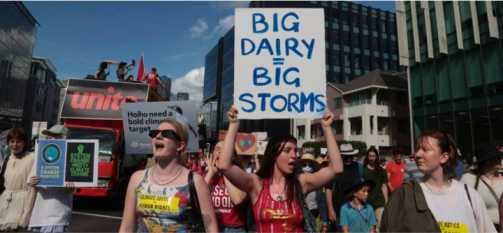
Late last week, Greenpeace New Zealand held a protest outside Fonterra’s head office in Auckland.

According to Greenpeace, the area was being transformed into a flood zone and it was calling for more government action on climate change.

The “flood zone” was a few old sofas and other junk representing flood debris and a handful of people carrying placards proclaiming “big dairy, big torrent”, “climate crisis” and their good old hashtag “too many cows”.

I can only assume it was too difficult to haul several tonnes of forestry slash on Auckland’s less-than-reliable public transport system.

Say what you will about Greenpeace, and trust me I have, its message is very clear and very simple: the answer to New Zealand’s greenhouse gas emissions is to have fewer cows. In fact, just about all of Greenpeace’s agricultural protests have that aim in mind.

Nitrogen fertiliser, palm kernel and irrigation are all in the firing line, not because they are in themselves bad, but because they all support higher stocking rates and more cows. Greenpeace is nothing if not consistent.

Contrast this with Fonterra’s announcement in November that not only was it now focused on addressing Scope 3 emissions, but over 70% of its customers were too.

This announcement didn’t get much of a reaction among dairy farmers, possibly because most – myself included – were not familiar with the jargon.

Scope 3 refers to the emissions profile of the raw material you are buying, and for Fonterra this means the emissions associated with every litre of milk it collects. It means on-farm emissions, and for Fonterra on-farm emissions make up 90% of the co-operative’s greenhouse gas profile.

For Fonterra’s customers, Scope 3 means on-farm emissions plus whatever carbon footprint is added in the manufacturing and global shipping processes.

Both Greenpeace and Fonterra want to address greenhouse gas emissions, but they want to do it in very different ways. Greenpeace’s solution of fewer cows is to aim for an absolute reduction – to lower the total amount of gasses emitted simply by producing less.

An absolute reduction, however, doesn’t help Fonterra and it doesn’t help its customers. Fewer cows producing less milk but with the same carbon footprint per litre would mean the industry is just standing still, which is why milk processors all over the world are focused on intensity targets instead.

Milk processors need farmers to be more carbon efficient, to produce each litre of milk with a lower carbon footprint, or they have no way of meeting their Scope 3 goals.

Who cares, though, when New Zealand already has the most carbon-efficient producers of milk in the world? Well, we are the most efficient, but only by a very slim margin, with some states in the US and other milk-producing countries like Ireland poised to overtake us.

Fonterra’s customers like international conglomerates Mars, purveyors of M&Ms, care very much indeed. Mars is under immense pressure to reduce its Scope 3 emissions too, and with 20% of that coming from the dairy products it buys, it is very serious about sourcing the lowest footprint dairy it possibly can.

If Fonterra and New Zealand can’t meet Mars’ demands, there are many others queueing up to do so.

Mars is so serious that it has identified the most carbon-efficient milk-producing region in New Zealand and would like to source its raw materials from that region exclusively.

If that is happening right now on a regional level, it doesn’t take much imagination to forecast what would happen globally if New Zealand lost the number-one ranking for efficiency.

There are obvious tensions between intensity targets, producing milk more efficiently and absolute targets, but simply cutting production for the sake of lowering total emissions is a fool’s game that would harm our agricultural producers and the broader economy.

It also feels like the lazy way out. Farmers have a history of adaption and innovation and this is just another – albeit significant – challenge to be met.

There’s a reason Greenpeace’s solution can fit on a placard and Fonterra’s requires roadshows, webinars and careful explanation: the answers to complex problems can rarely be found in a hashtag.

Stay Updated

Get the latest dairy industry news directly in your feed.

Prefer Us on Google Search

Swipe to continue reading

Previous Article

Next Article