Logo
IndianGlobalBlogsPublicationsPodcastsMarketAboutContact
Logo
IndianGlobalBlogsPublicationsPodcasts
7News
Mandatory Daily Record of Production and Raw Material UtilisationHeritage Foods inaugurates new Ice Cream PlantFSSAI makes registration to all milk vendors in IndiaGujarat Ice Cream Makers Face Cone ShortageSummer Heat to Stress India’s Dairy Cold Chain

Indian Dairy News

Dairy Sector a ‘Safety Net’ for Farmers: NABARD
Mar 14, 2026

Dairy Sector a ‘Safety Net’ for Farmers: NABARD

The Chairman of National Bank for Agriculture and Rural Development, Shaji K V, has highlighted the crucial role of India’s dairy industry in protecting rural livelihoods, describing it as a “safety n...Read More

Bihar Dairy Officer Arrested in ₹30,000 Bribery Case
Mar 14, 2026

Bihar Dairy Officer Arrested in ₹30,000 Bribery Case

A field officer of the district dairy development department in Bihar was arrested by the Vigilance Investigation Bureau (VIB) for allegedly accepting a bribe of ₹30,000 in West Champaran district. Th...Read More

Hatsun Agro Shares Rise After Milk Mantra Merger
Mar 14, 2026

Hatsun Agro Shares Rise After Milk Mantra Merger

The shares of Hatsun Agro Product Limited gained investor attention after the National Company Law Tribunal (NCLT), Cuttack Bench, approved the merger of its wholly owned subsidiary Milk Mantra Dairy...Read More

DairyNews7x7
Advertisement

Latest Blogs

See More
Mandatory Daily Record of Production and Raw Material Utilisation
Mar 14, 2026

Mandatory Daily Record of Production and Raw Material Utilisation

I recently reviewed the notification issued by the Food Safety and Standards Authority of India in the context of Schedule IV of the Food Safety and Standards (Licensing and Registration of Food Busin...Read More

FSSAI makes registration to all milk vendors in India
Mar 13, 2026

FSSAI makes registration to all milk vendors in India

The recent advisory issued by Food Safety and Standards Authority of India (FSSAI) mandating registration of milk vendors is a timely and progressive step towards strengthening traceability and accou...Read More

Rajahmundry Milk Incident: Accident or Adulteration?
Mar 10, 2026

Rajahmundry Milk Incident: Accident or Adulteration?

The recent editorial “Bitter Milk” published by The Hindu raises important concerns about food safety in India. The editorial deserves appreciation for attempting to broaden the conversation and under...Read More

Milk Prices Rise in South & West: Is North Next?
Mar 05, 2026

Milk Prices Rise in South & West: Is North Next?

The recent round of retail milk price increases across South India and Maharashtra is no longer an episodic adjustment but a clear signal of structural stress building up in India’s milk economy. Over...Read More

Global Dairy News

Global Dairy Commodity Prices Show Signs of Rally
Mar 14, 2026

Global Dairy Commodity Prices Show Signs of Rally

Global dairy commodity prices have shown a rally in the first quarter of 2026, particularly for products originating from Australia and New Zealand, according to a new Q1 Global Dairy Quarterly report...Read More

How Walmart Keeps Great Value Milk So Affordable
Mar 14, 2026

How Walmart Keeps Great Value Milk So Affordable

Retail giant Walmart has managed to keep the price of its private-label Great Value milk significantly lower than many competing brands through a vertically integrated dairy supply chain and direct co...Read More

Lactose-Free Milk Seen as Growth Driver in Coffee
Mar 13, 2026

Lactose-Free Milk Seen as Growth Driver in Coffee

Lactose-free milk is emerging as a major growth opportunity for the dairy industry, particularly in the rapidly expanding coffee and café segment. A recent US-based study highlighted that lactose-free...Read More

DairyNews7x7
Advertisement
Dairy News 7x7

Your trusted source for all the latest dairy industry news, market insights, and trending topics.

FOLLOW US
CATEGORIES
  • Global News
  • Indian News
  • Blogs
  • Publications
  • Podcasts
SUBSCRIBE TO OUR NEWSLETTER

Stay informed with the latest updates and trending news in the dairy industry.

No spam, unsubscribe at any time

GET IN TOUCH
C-49, C Block, Sector 65,
Noida, UP 201307
+91 7827405029dairynews7x7@gmail.com

© 2026 Dairy News 7x7. All Rights Reserved.

Terms of ServicePrivacy Policy
Prefer Us
Prefer Us

Will cattle be the next lab for flu host-switching?

By DairyNews7x7•Published on May 15, 2024

Will cattle be the next lab for flu host-switching?
Prefer on

Cattle have so far not been associated with being infected on large-scale, and as a result, cattle have not been well studied as domestic hosts for influenza A virus species. In contrast to the notion that cattle are considered to be almost resistant to infection with influenza A virus, H5N1 virus, which was first detected in dairy cattle in Texas in late March, has rapidly spread to 37 herds in nine States in the U.S. as of May 7.

On April 24, the U.S. FDA said that in a nationally representative commercial milk sampling study of pasteurised milk, about one in five of the retail samples tested positive for bird flu viral fragments. A greater proportion of positive results were in milk from areas with infected herds. An NIH-funded study had found an absence of infectious virus in milk samples. The April 23 report of the FAO noted that the H5N1 virus was detected in “high concentrations in milk from infected dairy cattle and at levels greater than that seen in respiratory samples”. That the concentration was less in the respiratory samples of the infected cows compared with the milk samples strongly suggests that the pathogenesis of the H5N1 virus in cattle differs from other mammals, says a study posted as a preprint; preprints are yet to be peer-reviewed.

One reason for dairy cattle milk containing high concentrations of H5N1 virus fragments could be the propensity of the virus to infect the mammary glands of cows as a previous study had found. On evaluating the expression of H5N1 receptors in the mammary gland, respiratory tract and cerebrum of cattle, the authors found both the human and the duck receptors to be highly expressed in the mammary glands. In the mammary gland, the human receptors and the duck receptors were found to be widely distributed in the alveoli but not in the ducts. Chicken-type influenza receptors were common in the cow respiratory tract.The high concentration of H5N1 virus fragments in milk from H5N1-infected cows could be due to local viral replication in the mammary glands of cows as H5N1 has a high affinity for the receptor, the authors say.

The study found that the chicken receptor was expressed on the surface of the respiratory epithelium in the upper respiratory tract and upper part of the lower respiratory tract, while human and duck receptors were either lacking or very limited in expression. However, in the lung alveolar cells, the researchers found all the receptors of humans, chickens and ducks being abundantly expressed.

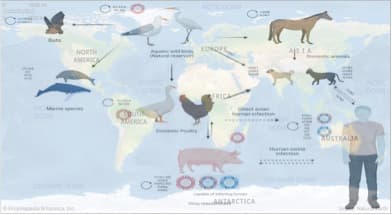
The abundance of human and duck receptors in the mammary glands and the large presence of human, chicken and duck receptors in the lung alveolar cells of cows provides a perfect environment for the evolution of H5N1 viruses that can easily spread from animals to humans. The reason why pigs are called the “evolutionary lab for flu host switching” is precisely due to the presence of both the human-flu and avian-flu host cell receptors in their upper-respiratory tract, says Dr. Sam Scarpino from Northeastern University in a tweet. The latest study has found that cow mammary glands contain the same kind of mixed flu receptors seen in pigs.

“One of the key changes required for avian flu to transmit effectively in humans involves flu’s hemagglutinin (HA) host cell receptor preference,” Dr. Scarpino said in another tweet. “Currently the cell surface receptor that influenza uses in birds is subtly different from the one in the human upper-respiratory tract”. But when pigs get infected with human and avian influenza viruses at the same time, the viruses can potentially undergo reassortment, wherein small segments of their genomes get swapped. The swapping might sometimes help the avian flu viruses to become better adapted to bind to human receptors and hence spread from birds to humans more easily. The H1N1 pandemic of 2009 was due to the reassortment of the virus in pig populations.


Stay Updated

Get the latest dairy industry news directly in your feed.

Prefer Us on Google Search

Swipe to continue reading

Previous Article

Next Article