Logo
IndianGlobalBlogsPublicationsPodcastsMarketAboutContact
Logo
IndianGlobalBlogsPublicationsPodcasts
7News
Mandatory Daily Record of Production and Raw Material UtilisationHeritage Foods inaugurates new Ice Cream PlantFSSAI makes registration to all milk vendors in IndiaGujarat Ice Cream Makers Face Cone ShortageSummer Heat to Stress India’s Dairy Cold Chain

Indian Dairy News

FSSAI Licences Get Perpetual Validity
Mar 14, 2026

FSSAI Licences Get Perpetual Validity

India’s food regulator, the Food Safety and Standards Authority of India (FSSAI), has announced a major reform granting perpetual validity to food licences and registration certificates, eliminating t...Read More

Dairy Sector a ‘Safety Net’ for Farmers: NABARD
Mar 14, 2026

Dairy Sector a ‘Safety Net’ for Farmers: NABARD

The Chairman of National Bank for Agriculture and Rural Development, Shaji K V, has highlighted the crucial role of India’s dairy industry in protecting rural livelihoods, describing it as a “safety n...Read More

Bihar Dairy Officer Arrested in ₹30,000 Bribery Case
Mar 14, 2026

Bihar Dairy Officer Arrested in ₹30,000 Bribery Case

A field officer of the district dairy development department in Bihar was arrested by the Vigilance Investigation Bureau (VIB) for allegedly accepting a bribe of ₹30,000 in West Champaran district. Th...Read More

DairyNews7x7
Advertisement

Latest Blogs

See More
Mandatory Daily Record of Production and Raw Material Utilisation
Mar 14, 2026

Mandatory Daily Record of Production and Raw Material Utilisation

I recently reviewed the notification issued by the Food Safety and Standards Authority of India in the context of Schedule IV of the Food Safety and Standards (Licensing and Registration of Food Busin...Read More

FSSAI makes registration to all milk vendors in India
Mar 13, 2026

FSSAI makes registration to all milk vendors in India

The recent advisory issued by Food Safety and Standards Authority of India (FSSAI) mandating registration of milk vendors is a timely and progressive step towards strengthening traceability and accou...Read More

Rajahmundry Milk Incident: Accident or Adulteration?
Mar 10, 2026

Rajahmundry Milk Incident: Accident or Adulteration?

The recent editorial “Bitter Milk” published by The Hindu raises important concerns about food safety in India. The editorial deserves appreciation for attempting to broaden the conversation and under...Read More

Milk Prices Rise in South & West: Is North Next?
Mar 05, 2026

Milk Prices Rise in South & West: Is North Next?

The recent round of retail milk price increases across South India and Maharashtra is no longer an episodic adjustment but a clear signal of structural stress building up in India’s milk economy. Over...Read More

Global Dairy News

Global Dairy Commodity Prices Show Signs of Rally
Mar 14, 2026

Global Dairy Commodity Prices Show Signs of Rally

Global dairy commodity prices have shown a rally in the first quarter of 2026, particularly for products originating from Australia and New Zealand, according to a new Q1 Global Dairy Quarterly report...Read More

How Walmart Keeps Great Value Milk So Affordable
Mar 14, 2026

How Walmart Keeps Great Value Milk So Affordable

Retail giant Walmart has managed to keep the price of its private-label Great Value milk significantly lower than many competing brands through a vertically integrated dairy supply chain and direct co...Read More

Lactose-Free Milk Seen as Growth Driver in Coffee
Mar 13, 2026

Lactose-Free Milk Seen as Growth Driver in Coffee

Lactose-free milk is emerging as a major growth opportunity for the dairy industry, particularly in the rapidly expanding coffee and café segment. A recent US-based study highlighted that lactose-free...Read More

DairyNews7x7
Advertisement
Dairy News 7x7

Your trusted source for all the latest dairy industry news, market insights, and trending topics.

FOLLOW US
CATEGORIES
  • Global News
  • Indian News
  • Blogs
  • Publications
  • Podcasts
SUBSCRIBE TO OUR NEWSLETTER

Stay informed with the latest updates and trending news in the dairy industry.

No spam, unsubscribe at any time

GET IN TOUCH
C-49, C Block, Sector 65,
Noida, UP 201307
+91 7827405029dairynews7x7@gmail.com

© 2026 Dairy News 7x7. All Rights Reserved.

Terms of ServicePrivacy Policy
Prefer Us
Prefer Us

What vegetarianism means in India ?

By DairyNews7x7•Published on June 17, 2024

What vegetarianism means in India ?
Prefer on

If being vegetarian means having diets loaded with dal (pulses), sabzi (vegetables) and phal (fruits), sans any animal-origin products, most Indians would probably not make the cut.

The latest official Survey on Household Consumption Expenditure for 2022-23 (August-July) shows that the average monthly per capita spending in rural India on vegetables (at Rs 202.86), fresh and dry fruits (Rs 140.16) and pulses (Rs 75.98) was lower than on milk and milk products (Rs 314.22). The value of per capita consumption was similarly higher for milk (Rs 466.01) than vegetables (Rs 245.37), fruits (Rs 245.73) and pulses (Rs 89.99) even in urban India.

No less revealing is the per capita expenditure on dal, sabzi and phal in “vegetarian” Rajasthan being below the national average (both rural and urban) for these items. Or, for that matter, the value of vegetable consumption by the average person in the eight Northeast Indian states being higher than not just the corresponding all-India level, but even of “Vaishnav-Jain” Gujarat.
Vegetarianism in India

Simply put, being vegetarian in India is not being vegan. Indians, if at all, are lacto-vegetarian. Even those who call themselves vegetarian generally don’t abstain from consuming milk and dairy products.

In a monograph titled Key to Health – originally penned in 1942, while he was incarcerated at Pune’s Aga Khan Palace – Mahatma Gandhi made a distinction between “vegetarian” and “flesh” foods. The latter included fowl and fish. Milk, for him, was an “animal food”, like “sterile eggs” that are laid by hens (without being “allowed to see the cock”) and do not develop into chicks.

“Milk is an animal product and cannot by any means be included in a strictly vegetarian diet…But experience has taught me that in order to keep perfectly fit, vegetarian diet must include milk and milk products such as curd, butter, ghee, etc.,” he wrote, while hoping for the discovery by selfless scientists of a “vegetable substitute” that would obviate the “necessity of adding milk to [a] strict vegetarian diet”.

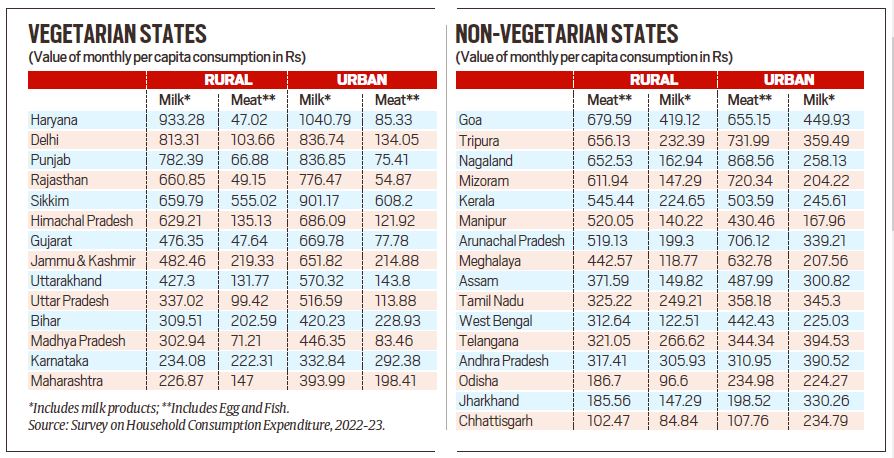
The monthly per capita consumption expenditure on vegetables may be relatively low or even below the all-India average in Gujarat and Rajasthan. But the average rural Gujarati spends Rs 476.35 and her urban counterpart Rs 669.78 per month on milk, with these at Rs 660.85 and Rs 776.47 respectively for Rajasthan. The value of the per capita milk consumption in the two states is way above the corresponding average of Rs 314.22 for rural India and Rs 466.01 for urban India.

There is, perhaps, some nutritional underpinning to milk consumption being high among vegetarians in India. Animal products, including milk, are rich sources of protein. These contain a balanced combination of all essential amino acids that the human body cannot synthesise and have to, therefore, be supplied through one’s diet. Plant proteins, by contrast, are incomplete. Even soyabean, pulses and legumes are deficient in the essential amino acids, methionine and cysteine.

What it means is that the pure vegan route requires a variety of plant protein sources, used in the right combination, to achieve the desired amino acid balance. An easier, more practical, alternative is to be lacto-vegetarian. Not for nothing that milk has traditionally been synonymous with purity and good health in India – even in regions or among communities steeped in anti-meat values,.

Which are the “vegetarian” and “non-vegetarian” states?

The accompanying tables show that the states where the average household monthly per capita expenditure on milk and dairy products is higher than on egg, fish and meat – in other words, “vegetarian” – are primarily in North, West and Central India.

These cover the Vaishnav-Jain-Arya Samaj belt of Gujarat, Rajasthan, Haryana and Punjab, the Hindi heartland of Uttar Pradesh, Madhya Pradesh and Bihar, and, to a lesser extent, Maharashtra and Karnataka.

In all, there are some 14 “vegetarian” states. That includes Sikkim, although the average person’s monthly spend on egg, fish and meat there (Rs 555.02 in rural and Rs 608.20 in urban) is much above the corresponding all-India numbers of Rs 185.16 and Rs 230.66 respectively.


Stay Updated

Get the latest dairy industry news directly in your feed.

Prefer Us on Google Search

Swipe to continue reading

Previous Article

Next Article