Latest Blogs
See More

Indian Dairy News
DairyNews7x7
Global Dairy News

DairyNews7x7
PMFME stands for Prime minister Formalisation of Micro Food processing enterprise Scheme. India has over 2.5 million micro food processing enterprises operating in the unorganised or informal sector. This informal sector has only 7% share in investment and 3% in outstanding credit. However this sector generates 74% of the total employment with one third as women and contributing to 12 % of the total output. The unorganised micro food processing sector contributes to 27% of the total value addition done.
This scheme has an outlay of Rs 10000 Crores. This budgetary allocation is for five years. In most of the states and the UTs the central government will cover 60% of the capital outlay while the states will generate a balance 40%. This scheme targets 200000 micro enterprises in the next five years. This scheme unlike others is focussing on market linkages with established supply chains. The scheme will have provisions for capacity building for both entrepreneurial as well as marketing skills of the micro enterprise.
SHG, cooperatives and FPO with members are also entitled under this scheme. A grant of 35% will be given to these groups. These groups must have a turnover of Rs 1 crore and the project cost may not be more than that. A provision of seed capital of Rs 40000.00 per member is also made for these operational groups in the areas covered under ODOP. The group must have 10% margin for project cost as well as working capital margins.
PMFME is also designed for community based activities. It is something similar to earlier schemes for developing SPVs( Special Purpose Vehicles) for the common use by the micro enterprises. It may have common facilities for Cold storage, warehousing, packing station, processing units, preservation facilities, etc.
Such protection could be given by GI tagging for their products. Peda from Mathura or ghee from Chandausi could always be linked to the place of origin. Anther way to support this micro enterprise is by setting up Community processing and storage centers. At the time of Covid , I saw a group of farmers set up a Khoa processing unit and a local entrepreneur created cold storage for them. In 2008, we recommended GI tag to 180 small farmers in Mathura region for making Mathura’s peda in Brij region. However local pressure by large players hindered the project. Now Mathura’s peda is manufactured at all corners of the world without much restrictions.
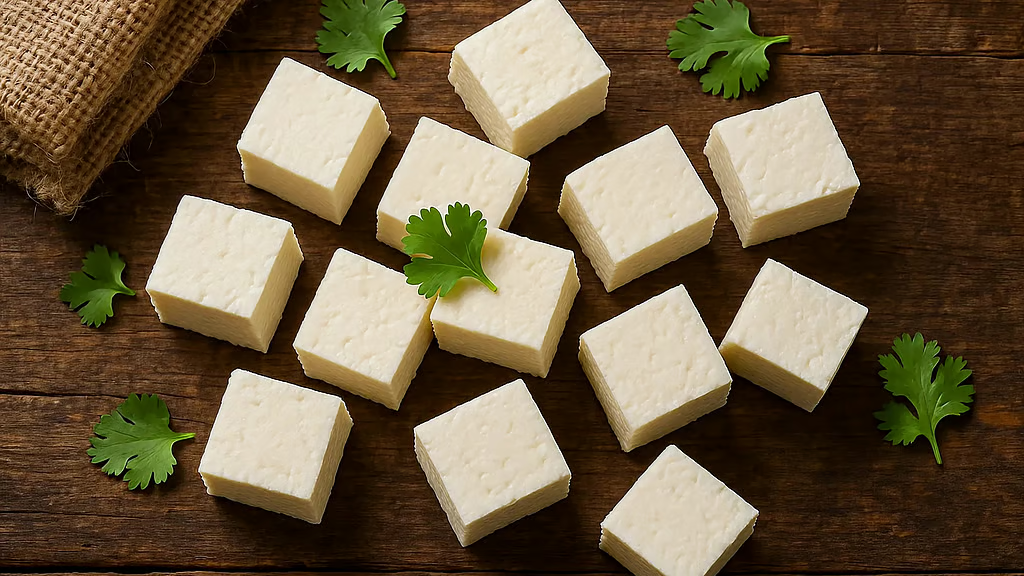
Currently Paneer sold in loose has no gst imposed on it. Such gst benefits may be given to entities registered under FSSAI and PMFMSE only. It will be a big support to the micro enterprises.The capacity building of these micro enterprises may also be extended to food safety , apart from entrepreneurship and marketing.
In the end I have to say that micro means “limited in capacity or scale”. However we have a large number of clusters for micro demands of dairy and food products. A micro enterprise must be developed to work with micro markets through micro planning and using micro finance. We must stop giving them big macro hopes or macro vision. They will only be sustainable by harnessing the huge potential of these micro demand pockets in rural and suburban India. We must not forget that we do not use a telescope to get a micro view and vice versa.