






Logo
IndianGlobalBlogsPublicationsPodcastsMarketAboutContact
Logo
IndianGlobalBlogsPublicationsPodcasts
7News
Mandatory Daily Record of Production and Raw Material UtilisationHeritage Foods inaugurates new Ice Cream PlantFSSAI makes registration to all milk vendors in IndiaGujarat Ice Cream Makers Face Cone ShortageSummer Heat to Stress India’s Dairy Cold Chain

Indian Dairy News

FSSAI Licences Get Perpetual Validity
Mar 14, 2026

FSSAI Licences Get Perpetual Validity

India’s food regulator, the Food Safety and Standards Authority of India (FSSAI), has announced a major reform granting perpetual validity to food licences and registration certificates, eliminating t...Read More

Dairy Sector a ‘Safety Net’ for Farmers: NABARD
Mar 14, 2026

Dairy Sector a ‘Safety Net’ for Farmers: NABARD

The Chairman of National Bank for Agriculture and Rural Development, Shaji K V, has highlighted the crucial role of India’s dairy industry in protecting rural livelihoods, describing it as a “safety n...Read More

Bihar Dairy Officer Arrested in ₹30,000 Bribery Case
Mar 14, 2026

Bihar Dairy Officer Arrested in ₹30,000 Bribery Case

A field officer of the district dairy development department in Bihar was arrested by the Vigilance Investigation Bureau (VIB) for allegedly accepting a bribe of ₹30,000 in West Champaran district. Th...Read More

DairyNews7x7
Advertisement

Latest Blogs

See More
Mandatory Daily Record of Production and Raw Material Utilisation
Mar 14, 2026

Mandatory Daily Record of Production and Raw Material Utilisation

I recently reviewed the notification issued by the Food Safety and Standards Authority of India in the context of Schedule IV of the Food Safety and Standards (Licensing and Registration of Food Busin...Read More

FSSAI makes registration to all milk vendors in India
Mar 13, 2026

FSSAI makes registration to all milk vendors in India

The recent advisory issued by Food Safety and Standards Authority of India (FSSAI) mandating registration of milk vendors is a timely and progressive step towards strengthening traceability and accou...Read More

Rajahmundry Milk Incident: Accident or Adulteration?
Mar 10, 2026

Rajahmundry Milk Incident: Accident or Adulteration?

The recent editorial “Bitter Milk” published by The Hindu raises important concerns about food safety in India. The editorial deserves appreciation for attempting to broaden the conversation and under...Read More

Milk Prices Rise in South & West: Is North Next?
Mar 05, 2026

Milk Prices Rise in South & West: Is North Next?

The recent round of retail milk price increases across South India and Maharashtra is no longer an episodic adjustment but a clear signal of structural stress building up in India’s milk economy. Over...Read More

Global Dairy News

Global Dairy Commodity Prices Show Signs of Rally
Mar 14, 2026

Global Dairy Commodity Prices Show Signs of Rally

Global dairy commodity prices have shown a rally in the first quarter of 2026, particularly for products originating from Australia and New Zealand, according to a new Q1 Global Dairy Quarterly report...Read More

How Walmart Keeps Great Value Milk So Affordable
Mar 14, 2026

How Walmart Keeps Great Value Milk So Affordable

Retail giant Walmart has managed to keep the price of its private-label Great Value milk significantly lower than many competing brands through a vertically integrated dairy supply chain and direct co...Read More

Lactose-Free Milk Seen as Growth Driver in Coffee
Mar 13, 2026

Lactose-Free Milk Seen as Growth Driver in Coffee

Lactose-free milk is emerging as a major growth opportunity for the dairy industry, particularly in the rapidly expanding coffee and café segment. A recent US-based study highlighted that lactose-free...Read More

DairyNews7x7
Advertisement
Dairy News 7x7

Your trusted source for all the latest dairy industry news, market insights, and trending topics.

FOLLOW US
CATEGORIES
  • Global News
  • Indian News
  • Blogs
  • Publications
  • Podcasts
SUBSCRIBE TO OUR NEWSLETTER

Stay informed with the latest updates and trending news in the dairy industry.

No spam, unsubscribe at any time

GET IN TOUCH
C-49, C Block, Sector 65,
Noida, UP 201307
+91 7827405029dairynews7x7@gmail.com

© 2026 Dairy News 7x7. All Rights Reserved.

Terms of ServicePrivacy Policy
Prefer Us
Prefer Us

US dairy cows are tip of the iceberg as bird flu spreads in mammals globally, says ecologist

By DairyNews7x7•Published on May 28, 2024

US dairy cows are tip of the iceberg as bird flu spreads in mammals globally, says ecologist
Prefer on

Health authorities are working to gather information on the spread of the H5N1 virus, or bird flu, in U.S. dairy cows—the first confirmation of the virus in cattle.

"We have moved into new territory," says Thomas Gillespie, professor and chair of Emory University's Department of Environmental Sciences.

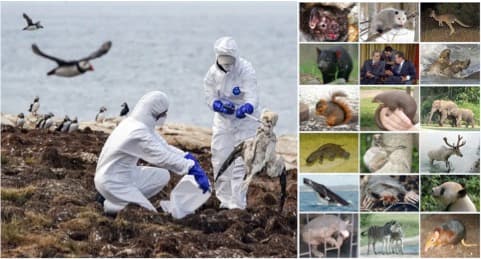
The dairy cow infections are simply the latest twist in a global pattern: since 2022, bird flu has been infecting a wide variety of mammals.

"You can find this trend around the world, almost anywhere you look," Gillespie says. "This virus has an extremely broad range of hosts that it is able to infect."

Gillespie is a disease ecologist, studying how pathogens jump across species in the environment. He is a leader in the "One Health" approach—considering the deep connections between the health of people, domesticated animals, wildlife and ecosystems—to build pandemic control and prevention.

Current risk to people is 'low'

The avian influenza cases in cows have been mild. The U.S. Centers for Disease Control and Prevention (CDC) has confirmed two human cases connected to the outbreak—one in Texas and one in Michigan. Both cases were mild and involved people who worked on a dairy farm.

The pasteurization process kills the H5N1 virus, and the CDC describes the current risk to the general public as "low."

The H5N1 virus is known as avian influenza, or bird flu, because birds are its natural reservoir. Wild, migrating birds can spread H5N1 globally. The current version has been circulating since 2020 and has infected a greater diversity of bird species than past lineages.

The virus has been reported in birds in the United States since 2022. Poultry producers have culled millions of their animals to try to control the spread of the virus.

Massive die-offs of seals and sea lions

It has long been known that mammals can become infected with H5N1 when they eat infected birds or are exposed to environments contaminated with the virus. What is unprecedented is the current scale and variety of mammals that have been infected.

"Most of these are likely dead-end cases, where a predator eats an infected bird and gets sick but doesn't spread the virus," Gillespie says.

He adds, however, that recent die-offs of thousands of elephant seals, sea lions and fur seals in South America caused by bird flu raises concerns about the possibility of mammal-to-mammal transmission.

"Not enough surveillance is done in wildlife to know for sure how the virus is spreading," he says.

H5N1 has also been reported in foxes, otters, lynx, polecats and badgers in Europe and in raccoon dogs and foxes in Japan.

The U.S. Department of Agriculture has recorded detections of H5N1 in 200 mammals in the United States since 2022, including a bottlenose dolphin, foxes, bobcats, mountain lions, coyotes, skunks, harbor and gray seals, opossums, squirrels, minks, otters and black and brown bears.

Last December, a polar bear on Alaska's North Slope became the first of its species known to die of avian influenza. In 2023, the virus was also been detected for the first time in the Antarctic region—in birds, elephant seals and fur seals—raising fears for the health of the fragile ecosystem.

A long-term view of risks

"Some of the species that are at risk for bird flu are already battling the stressors of climate change and loss of habitat," Gillespie says.

And each time H5N1 infects a new animal host, it gives the virus a chance to mix with other flu strains and rearrange its genetic material. Accumulating such mutations can change the virus in ways that make it more easily transmissible and more deadly—including to humans.

Pigs' immune systems share similarities with humans, making swine especially efficient mixing bowls for viruses that can affect humans.

Gillespie cites deforestation and industrialized animal production as major drivers for the risk of pandemics as well as climate change.

Forests in tropical regions are rapidly degrading due to cattle ranching and the clearing of land for agricultural crops such as soybeans—which are mainly used as feed for chickens and pigs on industrial farms.


Stay Updated

Get the latest dairy industry news directly in your feed.

Prefer Us on Google Search

Swipe to continue reading

Previous Article

Next Article