Latest Blogs
See More

Indian Dairy News


DairyNews7x7
Global Dairy News


DairyNews7x7

Butter needed for the coffee shops and regimental messes in the cantonment would be bought from a Parsee dairy in Bombay, before the government dairy farm was set up in Poona in 1890
The foodscape of a city is often a culmination of several events that sometimes take place in parallel or together.

Poona, like several other towns and cities in India, faced a shortage of milk and milk products. Notwithstanding the marked improvement in the methods of milk sterilisation, the continued use of canned milk and butter, to Europeans living in the subcontinent, was unpleasant, and the question of securing fresh dairy products was a most important one for their comfort.
Butter needed for the coffee shops and regimental messes in the cantonment would be bought from a Parsee dairy in Bombay. Special butter boxes had been designed for the purpose. But this was costly and the messmen were always on the lookout for superior quality locally sourced butter.
After Dr EC Ozanne was appointed the director of agriculture in the Bombay Presidency, he decided to work towards improving the supply of milk and milk products in the Presidency. At the suggestion of the Government of Bombay, the London Dairy Supply Company sent Mr HA Howman, an engineer and a farmer, to India in 1889 to “ascertain by trial whether the cream separator was needed in India and whether it could be profitably utilised in the manufacture of ghee”.
But to manufacture butter and ghee, good milk was needed. Under the guidance of Ozanne, Howman had established the government dairy farm in Poona in 1890. The same year, Ozanne bought fifty-four cows and two bulls from Sind and kept them at the farm in Poona.
The cattle of Sind were among the best in India. The finest milch cows were to be found within a radius of 60 to 80 km from Karachi, chiefly in the hilly tracts, wherever there was grazing and water. The owners, many of whom were wealthy, sent the milk to Karachi twice a day by camels. They were particular in the selection of breeding bulls and kept records of pedigree. Bull calves from inferior milkers were castrated and sold for the plough.
Sind cattle were not bred true to any type of form or colour, but were more or less recognisable. A rich red-brown was the commonest colour, with white markings occasionally and a darker shade surrounding the eyes. They were of medium size, with a long, deep, massive frame and short, well-set legs. The tail was long and the best cows showed little droop in the hind quarters. The head was heavy, the neck short and thick.
Both bulls and cows were remarkably placid and tractable even with strangers. As milkers, the cows had a very high reputation: 30 lb of milk a day was said not to be an uncommon quantity for a cow to give. Consequently, there was a great demand for them and large numbers were exported to Poona, Bombay, Mhow, Colombo, Quetta, and even Zanzibar. Another part of Sind noted for its cattle was the desert of Thar and Parkar, from which there was regular exportation to other parts of India, or was until the famine of 1899 almost exterminated the stock. A good Sind cow cost from ₹45 to ₹60 and a pair of bullocks from ₹60 to ₹80.
The Sind cows proved to be an important asset to the Poona dairy farm. The mechanical milk separator was successfully used by Ozanne, Howman, and Edward Keventer at Poona. Butter and ghee began to be regularly supplied to the regimental messes in the cantonment. But the demand for milk and butter in Poona and Kirkee was more than the supply as the government dairy farm also served the hospitals for sick soldiers.
The best breeds of milch cattle, like Jerseys, Guernseys, and Holsteins, when introduced to India and Ceylon, very quickly degenerated. They were not suited to the Indian climate and could not be easily acclimatised. They soon grew thin and sickly and ceased giving milk. Many died.
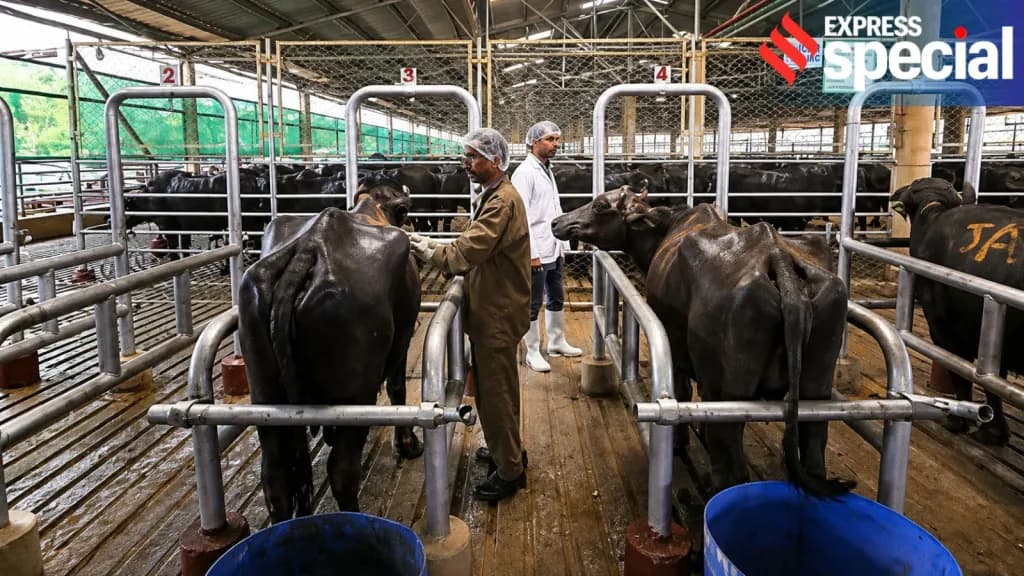
So, Ozanne decided to bring the Delhi buffaloes to Poona. The carabao or water buffalo was not preferred by native herdsmen and little attention had been paid to it as a milk producer. Buffaloes were brought to the government dairy farm from Delhi that gave over 30 pounds of milk per day, while the best Sind cattle in Poona gave only 18. The buffalo milk was so rich in fat that 12 to 13 pounds of it made a pound of butter, whereas 20 pounds of milk from a Sind cow were required.
The Delhi buffaloes were easier to keep, less expensive, and cleaner (having almost no hair) than ordinary cattle. They sold for ₹180 in Poona. Farmers from Satara, Sangli, Kolhapur, and Ahmadnagar would purchase Delhi buffaloes from Poona after applying to Mr JW Mollison, director-general of agriculture for India. In general, the animals were priced according to the amount of milk they gave, ₹10 being added to the price for every two additional pounds of milk given per day.
Mr Vaman Kelkar, the foreman incharge of the herd at the government dairy farm, opined that a dairy should have both buffaloes and Sind cattle. The buffaloes were better for butter production, and the cattle were superior for milk purposes, because the milk fetched a better price, being, in fact, much preferred to that of the buffaloes, which had a bluish colour and a slight, though not disagreeable odour. In Poona, the Sind cow was eventually superseded for butter-making purposes by the milch buffalo.
Soon butter was regularly supplied to regiments in and outside Poona. During summer, some difficulty was experienced in sending butter to a distance by rail. A special box was first tried at Poona which had an ice chamber in it, and butter was dispatched to Karachi, Nainital, Ajmer, and Lucknow during the hot weather in 1892. It was found, however, that it was more economical and practical to send the butter in earthenware jars which had been previously rubbed with salt and soaked in water before dispatch. Butter thus packed reached its destination in good condition after a journey of two days. The same year, Pontins Patent Butter Box Co Ltd came up with novel butter boxes. These boxes for the transport of butter, fruit or other edible substances were lighter in weight, but costlier.
A few years later, breeds from Gir and Aden were brought to Poona for milk. The example of Bombay Agricultural Department did much to advance dairy enterprise throughout India, and many native students were initiated into the practical details of dairying, feeding stock, breeding, and growing fodder crops at the Poona farm and Kirkee dairy.