Logo
IndianGlobalBlogsPublicationsPodcastsMarketAboutContact
Logo
IndianGlobalBlogsPublicationsPodcasts
7News
TN Minister Urges Farmers to Adopt Tech for Value Addition in DairyListen to the Farm, Not the Farmer—The New Productivity LensWhat’s Driving Change In Beverages, FMCG And Dairy in 2025ED begins money laundering probe in dairy investment fraud caseIndo-Brazil pact aims to boost cattle genetics and dairy yield

Indian Dairy News

TN Minister Urges Farmers to Adopt Tech for Value Addition in Dairy
Dec 12, 2025

TN Minister Urges Farmers to Adopt Tech for Value Addition in Dairy

In Coimbatore this week, Tamil Nadu’s Minister for Milk and Dairy Development, Mano Thangaraj, called on dairy farmers to embrace modern technologies to boost productivity and value addition across th...Read More

Listen to the Farm, Not the Farmer—The New Productivity Lens
Dec 12, 2025

Listen to the Farm, Not the Farmer—The New Productivity Lens

India’s dairy sector, valued at nearly $30 billion, has reached a point where incremental changes will not deliver the next breakthrough. For decades, improvement programs have focused on what farmers...Read More

What’s Driving Change In Beverages, FMCG And Dairy in 2025
Dec 12, 2025

What’s Driving Change In Beverages, FMCG And Dairy in 2025

India’s retail landscape in 2025 was marked by a decisive shift in how consumers choose, consume and connect with brands. From beverages to daily nutrition and even the most essential dairy products,...Read More

Latest Blogs

See More
More Milk, Less Money: India’s Dairy Crisis
Dec 01, 2025

More Milk, Less Money: India’s Dairy Crisis

With the release of the BAHS 2025 summary report, I felt compelled to deep dive into its findings and reflect on the real progress and challenges facing India’s dairy sector. Over the last six years,...Read More

India Milk Prices: Cost Shock and Procurement Pressure
Nov 28, 2025

India Milk Prices: Cost Shock and Procurement Pressure

Milk prices in India face upward pressure as rising feed costs and procurement hikes reshape farm economics. Insight on dairy procurement, feed costs, and market outlook. Official government and coope...Read More

Stop Blaming, Start Claiming: Livestock’s Carbon Credit Future
Nov 16, 2025

Stop Blaming, Start Claiming: Livestock’s Carbon Credit Future

This week, I had the opportunity to attend an Agri Carbon Masterclass conducted by CII FACE. The deliberations, case studies, and discussions presented during the session were both insightful and thou...Read More

India Powers the Gulf’s Dairy Revolution -Gulf Food 2025
Oct 31, 2025

India Powers the Gulf’s Dairy Revolution -Gulf Food 2025

As Gulf Food Manufacturing prepares to open its doors from November 4–6 in Dubai, Indian dairy product and equipment manufacturers have a unique opportunity to explore one of the most promising region...Read More

Global Dairy News

Why the global milk business needs a structural shake-up
Dec 08, 2025

Why the global milk business needs a structural shake-up

The New Zealand dairy stalwart Fonterra has sold its consumer dairy-brands (milk, butter, cheese) — including “Anchor” and “Mainland Cheese” — to French agribusiness giant Lactalis in late October 202...Read More

Raw-milk prices in Europe hit 5-yr low; ripple effect looms
Dec 07, 2025

Raw-milk prices in Europe hit 5-yr low; ripple effect looms

European raw-milk prices have plunged to their lowest in five years, as oversupply and weak demand weigh on dairy markets across the region. According to recent data from DCA Market Intelligence B.V.,...Read More

Global food prices ease; FAO dairy index slips — impact looms
Dec 06, 2025

Global food prices ease; FAO dairy index slips — impact looms

The FAO Dairy Price Index averaged 137.5 points in November, down 4.4 points (3.1 percent) from October and 2.4 points (1.7 percent) from its value a year ago. International dairy prices fell for the...Read More

Dairy News 7x7

Your trusted source for all the latest dairy industry news, market insights, and trending topics.

FOLLOW US
CATEGORIES
  • Global News
  • Indian News
  • Blogs
  • Publications
  • Podcasts
SUBSCRIBE TO OUR NEWSLETTER

Stay informed with the latest updates and trending news in the dairy industry.

No spam, unsubscribe at any time

GET IN TOUCH
C-49, C Block, Sector 65,
Noida, UP 201307
+91 7827405029dairynews7x7@gmail.com

© 2025 Dairy News 7x7. All Rights Reserved.

Terms of ServicePrivacy Policy

Political Influence Reshapes Amul Board Elections

By DairyNews7x7•Published on September 13, 2025

Anand — The recent board elections at the Kaira District Cooperative Milk Producers’ Union (Amul Dairy) have reignited long-running concerns about political interference in India’s storied dairy cooperatives. In a decisive outcome this month, BJP-backed candidates won 11 of 13 seats on the Amul board — four uncontested and seven in voting rounds that recorded a striking 97.48% turnout — prompting renewed debate over the changing balance between farmer control and partisan influence in cooperative governance.

The present: a high-stakes sweep

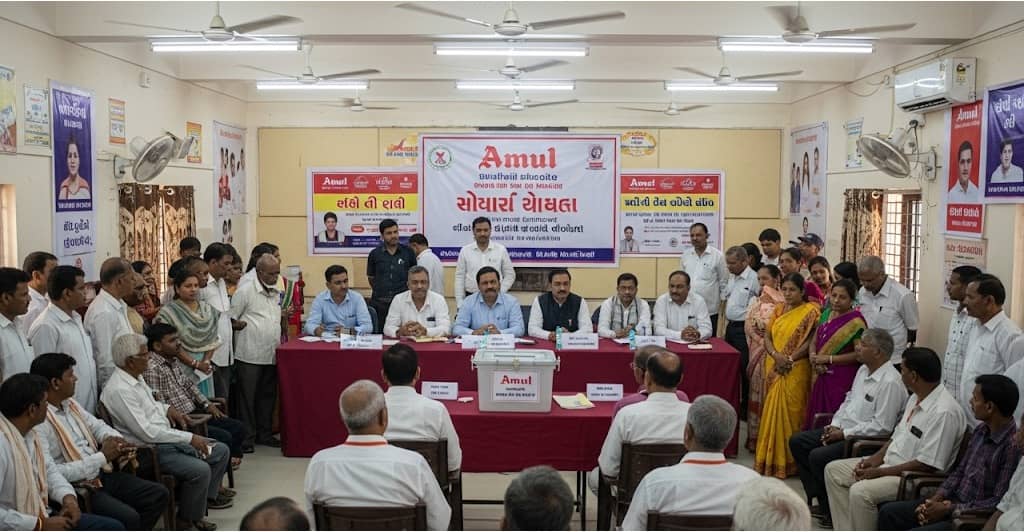
What looked like routine cooperative politics quickly turned into a high-stakes contest. Several candidates withdrew nominations ahead of the polls, handing uncontested victories to BJP-backed contenders in four blocks, while the remaining nine seats were fiercely contested with 24 candidates across blocks. Voting at the Amul premises in Anand was closely watched by party workers and local officials; security was tight amid reports of clashes during the nomination process earlier this month.

Local media framed the outcome as the BJP’s consolidation of influence in a cooperative that was once a traditional stronghold of rival political interests. The Indian Express and Times of India reported the sweep as unprecedented, noting the political implications of controlling a federation that remains a major economic and social force across Gujarat’s villages.

A history of political ties

The Amul story is not new to politics. Scholars and journalists have long documented how cooperatives in Gujarat — prized institutions that underpin rural livelihoods — became important vote banks and sites of political contestation. Analyses going back several years show cycles where political alignment shaped board composition, procurement policies and even management decisions, sometimes to the detriment of operational efficiency and farmer interests. Critics have warned that political capture can shift priorities from farmer welfare and quality to patronage and short-term politics.

Incidents of alleged interference have surfaced periodically: disputed nominations, last-minute withdrawals, accusations of vote-buying, and attempts to influence appointments at the cooperative level. In 2020 there were public allegations that state actors sought to steer board appointments after electoral setbacks — a sign that political parties view cooperative control as strategically valuable.

Why this matters beyond Anand

Amul is not just a brand; it is an institutional architecture that channels rural incomes, procurement practices, and thousands of family livelihoods. Political control of its board can have ripple effects on milk procurement rates, investment decisions, product strategy and farmer relations. When partisan goals override cooperative norms, there’s a real risk of decisions being made for immediate political optics rather than long-term sustainability. That can affect farmer prices, cooperative transparency and the federation’s ability to invest in processing capacity or quality assurance.

Farmers, governance and the credibility challenge

Farmer members and cooperative activists face a dilemma. High voter turnout — nearly 97.5% — suggests strong engagement, but the optics of uncontested seats and last-minute candidate withdrawals raise questions about the openness of the process. For smallholder members, the fear is that political alignment at the board level could redirect resources away from farmer services and into political patronage, undermining the cooperative principle of member control.

What comes next

With the new board in place, stakeholders will watch closely how the federation sets procurement policies, price decisions and commercial strategy. If the board steers Amul toward investments and policy choices that strengthen the cooperative and improve farmer incomes, political influence may be judged benign. But if appointments lead to politicised procurement, contract awards or reduced transparency, farmer trust and brand credibility could take a hit.

Experts suggest a few safeguards: greater transparency in nomination and voting procedures, independent audit of procurement and financial decisions, and stronger member education so farmers can hold directors accountable. For national observers, Amul’s current shuffle is a test case: can India’s cooperative model survive partisan competition without losing its farmer-centric character?

Source : Dairynews7x7 Sep 13th 2025

Swipe to continue reading

Previous Article

Next Article