Logo
IndianGlobalBlogsPublicationsPodcastsMarketAboutContact
Logo
IndianGlobalBlogsPublicationsPodcasts
7News
Meenesh Shah gets extension as Chairman NDDBAbundant Milk Output in US, Argentina, Australia Shapes 2026 Dairy OutlookKerala Raises Minimum Wages, Boosts Pay for Agricultural & Dairy WorkersInside Scoop: The 2,500-Year History of Ice CreamTamil Nadu Milk Producers Urge Local Milk & Butter Procurement

Indian Dairy News

Meenesh Shah gets extension as Chairman NDDB
Jan 02, 2026

Meenesh Shah gets extension as Chairman NDDB

NDDB congratulates Dr. on the extension of his tenure as Chairman, NDDB, for a further period of 3.5 years by the Government of India. This extension is a recognition of his exemplary leadership and...Read More

Kerala Raises Minimum Wages, Boosts Pay for Agricultural & Dairy Workers
Jan 02, 2026

Kerala Raises Minimum Wages, Boosts Pay for Agricultural & Dairy Workers

The Kerala government has significantly revised and increased minimum wages for agricultural and dairy workers, including milkmen and related roles, marking the first update since 2017 and expanding l...Read More

Inside Scoop: The 2,500-Year History of Ice Cream
Jan 02, 2026

Inside Scoop: The 2,500-Year History of Ice Cream

Ice cream — one of the world’s most beloved frozen treats — has an unexpectedly long history stretching back roughly 2,500 years, beginning with ancient innovations in ice storage and evolving into th...Read More

Latest Blogs

See More

From Forecast to Fact: 2025 Lessons, 2026 Dairy Outlook
Jan 01, 2026

From Forecast to Fact: 2025 Lessons, 2026 Dairy Outlook

As we step into 2026, it is worth pausing to reflect on how the Indian dairy sector navigated the challenges of 2025 and how closely reality tracked the forecasts I outlined in the first blog of last...Read More

India–NZ Dairy FTA: Safeguards or Silent Slippages?
Dec 26, 2025

India–NZ Dairy FTA: Safeguards or Silent Slippages?

The recently concluded India–New Zealand Free Trade Agreement (FTA) marks an important milestone in bilateral trade, while carefully ring-fencing India’s sensitive dairy sector. Under the agreement, c...Read More

Vision 2047: India’s Dairy Development Roadmap
Dec 21, 2025

Vision 2047: India’s Dairy Development Roadmap

As India moves steadily toward Vision 2047, the dairy sector stands at a strategic inflection point. From being a food security instrument in the decades following Independence, dairy has evolved into...Read More

Global Dairy Dynamics: Innovation, Sustainability & Inclusion
Dec 18, 2025

Global Dairy Dynamics: Innovation, Sustainability & Inclusion

The International Dairy Processing Conference (IDPC) 2026, organised by the Trade Promotion Council of India (TPCI) at Yashobhoomi Convention Centre, Dwarka, New Delhi on 7 January 2026, will serve as...Read More

Global Dairy News

Abundant Milk Output in US, Argentina, Australia Shapes 2026 Dairy Outlook
Jan 02, 2026

Abundant Milk Output in US, Argentina, Australia Shapes 2026 Dairy Outlook

Milk production across major dairy exporting regions — the United States, Argentina and Australia — is set to remain robust through 2025 and into 2026, underpinning global milk supplies and shaping co...Read More

Global dairy prices under pressure Rabobank Q4 outlook
Jan 01, 2026

Global dairy prices under pressure Rabobank Q4 outlook

Global dairy markets softened through Q3 2025 and fell sharply in Q4 2025. In Oceania, spot prices (in USD) for the dairy commodity complex remain weak. Butter has led the decline, down 9% since the b...Read More

Milk Prices Plunge, Production Set to Weaken in 2026
Dec 31, 2025

Milk Prices Plunge, Production Set to Weaken in 2026

Global milk prices have plummeted to lows not seen since early 2021 amid a pronounced oversupply and softening demand, while dairy producers are signalling caution as milk production momentum is expec...Read More

Dairy News 7x7

Your trusted source for all the latest dairy industry news, market insights, and trending topics.

FOLLOW US
CATEGORIES
  • Global News
  • Indian News
  • Blogs
  • Publications
  • Podcasts
SUBSCRIBE TO OUR NEWSLETTER

Stay informed with the latest updates and trending news in the dairy industry.

No spam, unsubscribe at any time

GET IN TOUCH
C-49, C Block, Sector 65,
Noida, UP 201307
+91 7827405029dairynews7x7@gmail.com

© 2026 Dairy News 7x7. All Rights Reserved.

Terms of ServicePrivacy Policy
IDPC 2026 Advertisement

Planetary Health Diet and Dairy: Choosing More Than Two

By Kuldeep Sharma•Published on October 16, 2025

I remember reading the EAT–Lancet Commission’s Planetary Health Diet report for the first time in 2019. It was being hailed as a global roadmap for feeding 10 billion people sustainably by 2050. At first glance, the concept looked noble—more fruits, more vegetables, more grains, and less of everything that comes from an animal. Then I looked at the numbers. It prescribed roughly 250 grams of milk per person per day—barely one glass—and allowed a range of 0 to 500 grams. I smiled to myself. It felt like another version of the placard I saw years ago at a small motel in the UK that said, “We serve Quality, Service, and Price. Choose any two.”

Read my earlier blog on the same here 

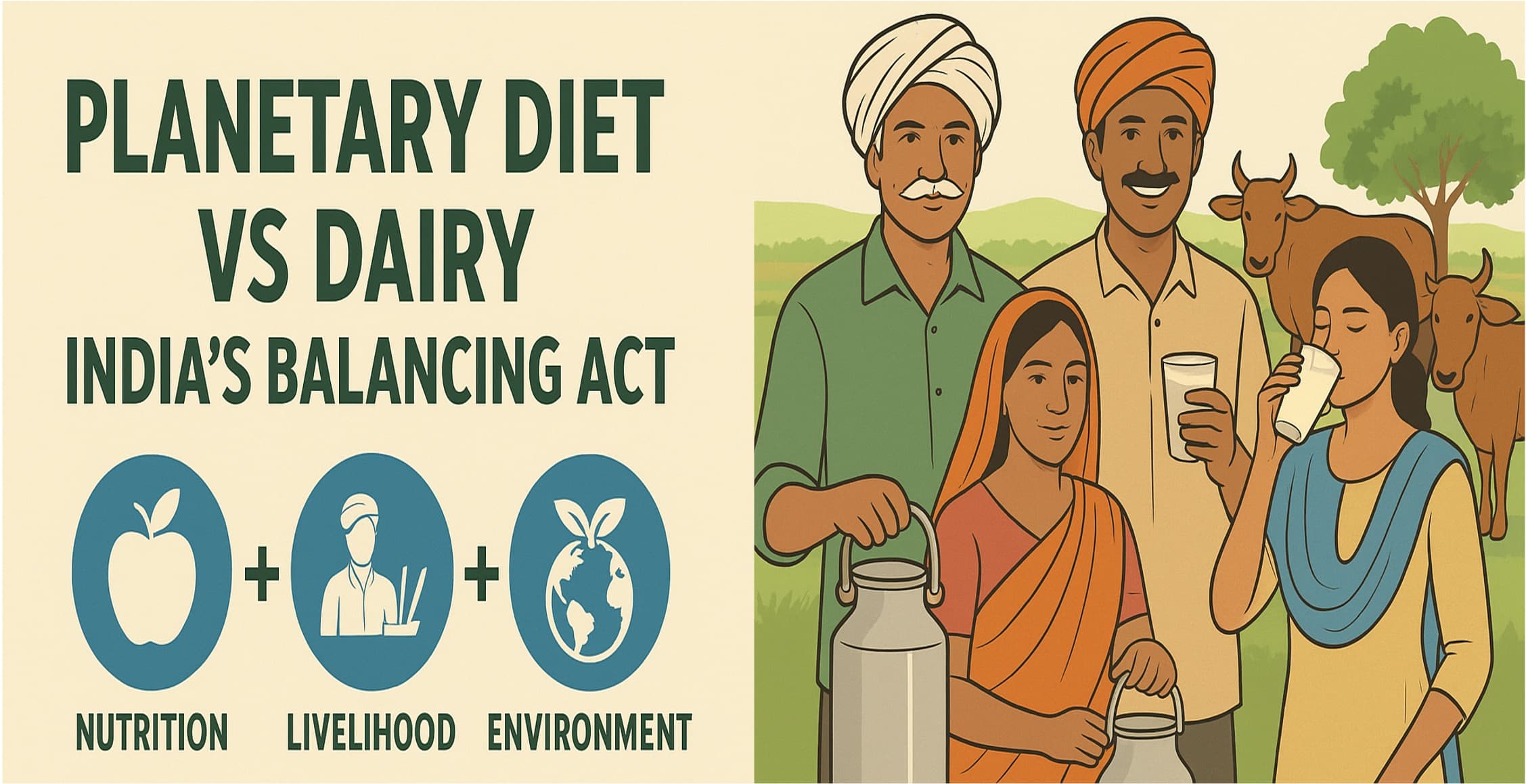
In the case of the Planetary Health Diet, it seems the world is now being asked to choose any two between nutrition, livelihood, and the environment.

A changing narrative

When the first EAT–Lancet report appeared in 2019, dairy was still considered part of a healthy, sustainable diet. It wasn’t demonized—just moderated. The science then emphasized balance, not elimination. But as the years passed and climate politics sharpened, the narrative began to shift. The updates from 2023 to 2025 now carry a tone of correction—not so much in science, but in sentiment. Dairy has moved from being a “moderate” component to being viewed with growing scepticism, especially in high-consumption regions.

The latest re-evaluations of the diet highlight that reducing dairy in wealthy nations could significantly lower emissions and land-use footprints. However, these same models quietly admit that in low- and middle-income countries, a blanket reduction could worsen deficiencies in calcium, vitamin B12, and high-quality protein. The newer 2025 framing of the report finally acknowledges this complexity, calling for “contextual adaptation” rather than uniform targets. But by now, the headlines have already done their damage—many readers remember only that dairy “hurts the planet,” not that it also nourishes half of it.

Global agenda, local realities

Let’s step back to see how this translates in India. We are home to over 100 million dairy households, rearing more than 300 million bovine animals, and producing over 240 million tonnes of milk annually. For us, milk is not a choice; it’s a cultural and nutritional backbone. It’s the first food of life—literally and symbolically.

If we try to apply the EAT–Lancet template here, we face a dilemma far more complex than balancing carbon footprints. The PHD’s plant-heavy approach assumes easy access to fortified foods, dietary supplements, and diverse plant proteins. But in India, milk is often the most affordable and bioavailable source of calcium and B12. Remove that, and we open the door to hidden hunger—micronutrient deficiencies that quietly undermine growth, cognition, and immunity.

The same global model that fits London or Los Angeles simply doesn’t fit Lucknow or Ludhiana.

The triple trade-off: Nutrition, Livelihood, Environment

The nutrition-environment-livelihood triangle in dairy is much like the ESG puzzle I once wrote about—choose any two.

If we strictly follow environmental governance, we may have to cap dairy production and reduce methane emissions aggressively. That looks good on a global carbon spreadsheet, but it means taking away livelihoods from millions of small and marginal farmers whose only sustainable asset is their cattle.

If we choose to protect social sustainability—keeping rural households afloat and ensuring milk for children—we must keep the cows, even the less productive ones. But then we cannot claim to have fully met our environmental goals, as dairy contributes nearly 70% of agricultural emissions, and agriculture itself contributes about 30% of India’s total emissions.

If we opt for governance and ethics, that means protecting the sacred cow and not resorting to mass culling of unproductive animals. In doing so, we accept higher methane emissions as a cost of cultural continuity. Once again, we can choose only two sides of the triangle at a time. The third remains waiting on the other end of the table—unserved.

The evolving evidence

Between 2020 and 2025, multiple modelling studies have tested what would happen if the Planetary Health Diet (PHD) were applied worldwide. The results are revealing.
  • Environmental gains: Global greenhouse gas emissions could drop by up to 30% from food systems if animal-source foods are reduced to PHD levels.
  • Nutritional gaps: Those same models predict micronutrient shortfalls—especially calcium, iron, and B12—in several Asian and African regions.
  • Affordability issues: In low-income countries, the PHD basket would cost up to 60–70% of average household income, making it economically unrealistic.
So the very model that claims to feed the world sustainably might leave large parts of the world both hungry and unemployed if applied without nuance.

India’s dairy paradox

In India, dairy is both a climate challenge and a climate solution. It is a challenge because of methane and manure management. But it’s a solution because of its circular economy—dung used as biofertilizer, farm waste converted to feed, and by-products generating income for women farmers.

India’s dairy ecosystem is not an industrial factory—it’s a living organism powered by smallholders and cooperatives. When the EAT–Lancet model treats all dairy as equal, it ignores this social fabric. Our emissions are not just about cows—they are about communities.

Parameter Global (EAT–Lancet / PHD) India (2025 context) Insight
Recommended Milk Intake 250 g/day (range: 0–500 g) 410 g/day (national avg, NDDB) India exceeds PHD limit due to dietary reliance on milk.
Dairy’s Share in Agri GHGs ~35% globally ~70% of India’s agricultural emissions High share due to large livestock base; mitigation needed through feed & manure management.
Agriculture’s Share in National GHGs ~18% (global avg) ~30% (India) Dairy-linked emissions ≈ 20% of India’s total GHGs.
Livelihood Dependency <5% in most developed countries >100 million rural households India’s dairy is a social safety net, not just a business.
Nutritional Role Moderate in PHD High — 60% of animal protein for vegetarians Removing dairy may worsen calcium & B12 deficiencies.
Cost of PHD Diet Affordable in OECD nations ~60–70% of average Indian household income Economically unrealistic for low-income populations.
Carbon-Neutral Strategies Shift to plant proteins Carbon insetting, feed efficiency, renewable energy Context-specific solutions needed, not global uniformity.

The right response: Adapt, not abandon

Instead of choosing between milk and the planet, India needs to choose the middle path—to produce milk responsibly and consume it wisely.

That means:

  • Investing in low-emission technologies: improved feed, manure management, enteric methane reduction, and renewable energy in dairy processing.
  • Supporting sustainable intensification: increasing milk yield per animal to reduce the total herd size without reducing output.
  • Encouraging research and fortification: balancing nutrition security with environmental performance.
  • Educating consumers: not to over consume, but also not to abandon a food that has been central to Indian nutrition for 8,000 years.

A call for equitable responsibility

The developed world, having reached nutrition security long ago, now calls for dietary restraint in the name of climate action. But if India were to mimic Western diets, we would indeed risk both health and sustainability. Conversely, if we mimic Western climate targets without resources, we risk deepening poverty. The way forward lies in carbon insetting and offsetting, funded through global climate finance. Developed countries that urge us to reduce dairy must also help fund the transition to low-carbon dairy systems here.

Beyond the binary

The EAT–Lancet report is not our enemy; it’s a useful mirror. It shows what must change—but not who should change first. India’s dairy sector must acknowledge its emissions footprint, but the world must acknowledge India’s nutritional realities. Environmental virtue cannot come at the cost of social justice.

The conversation needs to move from “eliminate dairy” to “elevate dairy responsibly.” From “less milk, more plants” to “better milk, balanced diets.” From “planet vs people” to “planet with people.”

The Indian lens

For India, milk is not just a food; it’s a force multiplier—of nutrition, rural income, women’s empowerment, and social stability. Every litre of milk collected sustains not just a cow, but an entire ecosystem of small farmers, traders, veterinarians, and women’s self-help groups.

Before we reduce milk to a carbon number, let us remember that emissions can be mitigated—but malnutrition cannot wait.

Conclusion: Choose wisely

In 2006, that little signboard in the UK told me: “Choose any two.”

Today, as the world debates dairy’s place on the planetary plate, I see the same conundrum returning—only this time, the choices are nutrition, livelihood, and environment. India’s answer cannot be to pick any two. We must aim for all three—through science, innovation, and global cooperation.

Because milk, after all, is not just a drink—it’s a bridge. Between hunger and health, between tradition and technology, between the farmer and the planet.

Source : Dairy blog by Kuldeep Sharma Chief Editor Dairynews7x7

Swipe to continue reading

Previous Article

Next Article