PACS-DCCB Network Seen as Driver of Rural Dairy Growth
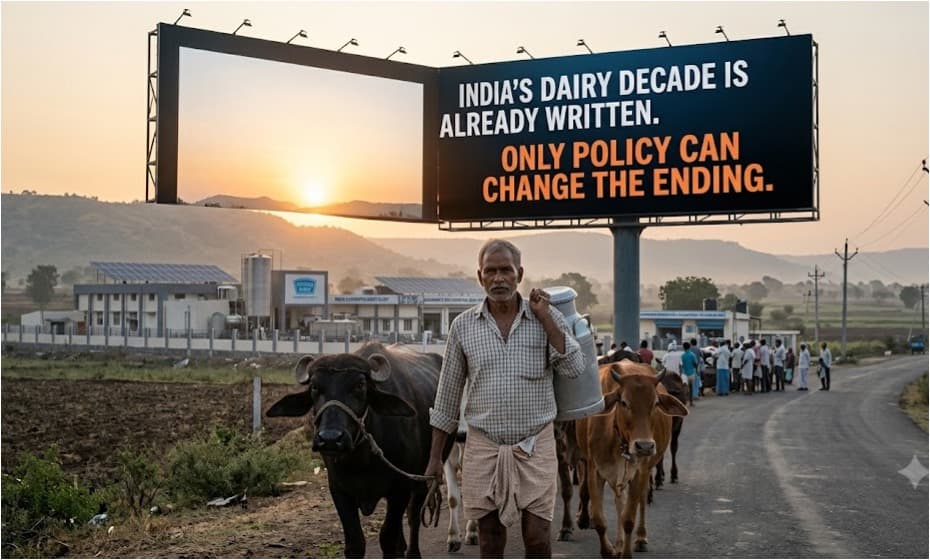
Strengthening the linkages between Primary Agricultural Credit Societies (PACS), District Central Cooperative Banks (DCCBs), dairy cooperatives, women’s Self-Help Groups (SHGs) and other rural institutions could create a broader cooperative-based rural economy, according to an analysis published by Hindu Dayashankar.
The article presents Karimnagar and Telangana as a potential model for integrating agricultural credit, dairy, livestock, warehousing, renewable energy, transport, processing and other rural economic activities through cooperative institutions.
India already has a large cooperative network. The Ministry of Cooperation’s National Cooperative Database provides information on more than 8.5 lakh cooperatives across sectors, while current Ministry data lists 99,359 PACS and 143,500 dairy cooperatives.
The Ministry has also identified PACS, dairy and fisheries cooperatives as important components of rural economic development. Its programme for establishing new multipurpose cooperatives aims to expand access to credit, infrastructure, markets and services, with PACS supported through the cooperative banking structure involving DCCBs and State Cooperative Banks.
The analysis argues that PACS can evolve beyond their traditional role in agricultural credit and input services by supporting activities such as milk collection, dairy processing, storage, transport, retail and other local enterprises. Dairy cooperatives could similarly move beyond milk collection towards value-added products such as curd, ghee, paneer, butter and sweets.
Women and SHG groups are identified as another important component of the proposed cooperative chain. The article suggests that women-led groups could participate in milk collection, food processing, packaging, marketing and other rural enterprises, with cooperative finance and market linkages supporting their expansion.
The proposed model also places DCCBs at the centre of district-level cooperative finance. Under the existing cooperative credit structure, DCCBs provide an important link between grassroots institutions and State Cooperative Banks, with NABARD supporting the cooperative banking system.
Karimnagar is presented in the article as a possible pilot area, with the proposed model connecting PACS and other societies involved in dairy, handlooms, livestock, labour and agricultural activities. The article refers to 131 PACS in the united Karimnagar district and suggests integrating these institutions with district-level finance and productive assets.
The proposed cooperative-chain approach extends beyond dairy to warehouses, cold storage, solar energy, rice and pulse processing, livestock, fisheries, transport, retail outlets and other rural infrastructure. The objective would be to retain more value within producer-owned institutions rather than limiting cooperatives to credit and primary collection functions.
Dairy could have a particular role because milk provides a regular source of cash flow for rural households compared with seasonal agricultural production. The article suggests that stronger links between milk producers, dairy cooperatives, women’s groups, processing facilities and cooperative retail outlets could support greater value addition.
The Ministry of Cooperation is already pursuing the computerisation of PACS. Under the central scheme, functional PACS are being brought onto an ERP-based common software platform, with linkages to NABARD through State Cooperative Banks and DCCBs, aimed at improving operational efficiency, accounting and transparency.
Recent Ministry data also shows the continuing expansion of cooperative infrastructure. As of January 20, 2026, 32,802 new PACS, dairy and fishery cooperative societies had been registered under the government's expansion plan, while 15,793 dairy and fishery cooperatives had been strengthened.
The analysis argues that the next stage should focus not only on creating or digitising societies but also on strengthening their commercial viability, professional management, market access and infrastructure. It proposes that cooperative institutions explore multiple revenue streams, including credit services, input supplies, storage and processing, logistics, retail and other locally viable services.
For the dairy industry, such an integrated structure could connect milk producers with finance, collection, testing, processing, cold-chain infrastructure and consumer markets. However, the viability of individual projects would depend on local milk volumes, investment requirements, management capability, market demand, regulatory approvals and financial sustainability.
The broader proposal reflects an ongoing policy emphasis on expanding cooperatives as grassroots economic institutions. Its implementation at district or State level would require coordination among cooperatives, governments, financial institutions, regulators and member-producers, along with appropriate governance and financial safeguards.
SEO Keywords: PACS dairy cooperatives, DCCB dairy development, cooperative dairy India, dairy cooperatives Telangana, Karimnagar dairy sector, women SHG dairy, rural cooperative economy, dairy value chain
Source: Dairynews7x7 18 Sep, 2026 Read full article here
#DairyIndustry #DairyCooperatives #PACS #DCCB #DairyFarming #TelanganaDairy #CooperativeSector