Logo
IndianGlobalBlogsPublicationsPodcastsMarketAboutContact
Logo
IndianGlobalBlogsPublicationsPodcasts
7News
Rajahmundry Milk Incident: Accident or Adulteration?Dairy Minister Telangana with Chairman Vijaya visit NDDB AnandScale up India’s dairy cooperative model: Sunita NarainHyderabad Raid Busts ₹18.26 Lakh Fake Ghee UnitNZ Seeks Opposition Support to Advance India Free Trade Agreement

Indian Dairy News

TN Milk Output Claim Sparks Data Dispute
Mar 11, 2026

TN Milk Output Claim Sparks Data Dispute

A debate has emerged over Tamil Nadu’s milk production after the Tamil Nadu Milk Dealers’ Welfare Association (TNMDWA) challenged claims made by Chief Minister M.K. Stalin that the State produces 3 cr...Read More

UP Approves Dairy Expansion in Bundelkhand
Mar 11, 2026

UP Approves Dairy Expansion in Bundelkhand

The Uttar Pradesh government has approved a proposal to expand dairy processing capacity in the Bundelkhand region by setting up a new dairy plant and upgrading an existing facility to strengthen the...Read More

Bitter Milk: Lessons from Rajamahendravaram Case
Mar 10, 2026

Bitter Milk: Lessons from Rajamahendravaram Case

The milk adulteration tragedy in Rajamahendravaram in Andhra Pradesh’s East Godavari district has raised serious concerns about food safety, regulatory oversight and the vulnerability of consumers to...Read More

DairyNews7x7
Advertisement

Latest Blogs

See More
Rajahmundry Milk Incident: Accident or Adulteration?
Mar 10, 2026

Rajahmundry Milk Incident: Accident or Adulteration?

The recent editorial “Bitter Milk” published by The Hindu raises important concerns about food safety in India. The editorial deserves appreciation for attempting to broaden the conversation and under...Read More

Milk Prices Rise in South & West: Is North Next?
Mar 05, 2026

Milk Prices Rise in South & West: Is North Next?

The recent round of retail milk price increases across South India and Maharashtra is no longer an episodic adjustment but a clear signal of structural stress building up in India’s milk economy. Over...Read More

India’s Dairy Climate Paradox: Production Triumph Meets Methane Time-Bomb
Mar 02, 2026

India’s Dairy Climate Paradox: Production Triumph Meets Methane Time-Bomb

India’s rise to the top of the global dairy league board has been one of the most remarkable agricultural success stories of the 21st century. With milk production surpassing 247 million tonnes per ye...Read More

India’s First Cow Culture Museum in Mathura
Feb 16, 2026

India’s First Cow Culture Museum in Mathura

India’s first national “Cow Culture Museum” is set to be established in Mathura, Uttar Pradesh, on the campus of Pandit Deendayal Upadhyaya Veterinary Science University, announced the Uttar Pradesh B...Read More

Global Dairy News

Savencia Profit Drops on Rising Milk Costs
Mar 11, 2026

Savencia Profit Drops on Rising Milk Costs

Savencia Profit Drops on Rising Milk Costs French dairy major Savencia Fromage & Dairy reported a sharp fall in profitability for 2025, with its net income dropping by €32.2 million to €74.7 million,...Read More

Hormuz Disruption Threatens Dairy Supply Chain
Mar 11, 2026

Hormuz Disruption Threatens Dairy Supply Chain

Escalating geopolitical tensions around the Strait of Hormuz are creating new risks for the global dairy sector by disrupting key inputs such as energy, fertilisers and shipping routes. The strait car...Read More

Data Replaces Handshakes in Dairy Lending
Mar 10, 2026

Data Replaces Handshakes in Dairy Lending

The dairy financing landscape is undergoing a major transformation as traditional relationship-based lending gives way to data-driven credit evaluation, according to industry insights. Historically, d...Read More

DairyNews7x7
Advertisement
Dairy News 7x7

Your trusted source for all the latest dairy industry news, market insights, and trending topics.

FOLLOW US
CATEGORIES
  • Global News
  • Indian News
  • Blogs
  • Publications
  • Podcasts
SUBSCRIBE TO OUR NEWSLETTER

Stay informed with the latest updates and trending news in the dairy industry.

No spam, unsubscribe at any time

GET IN TOUCH
C-49, C Block, Sector 65,
Noida, UP 201307
+91 7827405029dairynews7x7@gmail.com

© 2026 Dairy News 7x7. All Rights Reserved.

Terms of ServicePrivacy Policy
Prefer Us
Prefer Us

November saw moderation in inflation but not in all the states

By DairyNews7x7•Published on December 24, 2022

November saw moderation in inflation but not in all the states
Prefer on

Retail inflation measured by the year-on-year change in Consumer Price Index (CPI) moderated sharply to 5.88 percent in November from 6.7 percent in October. This is the first print below 6 per cent, the upper threshold since January this year.

The decline was due to moderation in food prices. Food prices eased on account of lower vegetable prices though the prices of cereals and milk continue to remain elevated. Fuel inflation reversed the trend of moderation seen in the last few months. It inched higher to 10.6 per cent in November from 9.9 per cent in the previous month. Core inflation remained elevated at above 6 per cent.

The softening of inflation in November was also driven by the base effect with the CPI number for November last year being on the higher side. This advantage of the favourable base effect may not be available in the coming months.

Moderation in food inflation but cereals inflation inched up and core inflation remained persistent

Vegetables inflation contracted to 8 per cent in November. With winter arrivals, there is typically an easing of prices of vegetables. However, inflation in cereals rose to touch almost 13 per cent in November from 12 per cent in October, owing to increase in prices of wheat and rice. While inflation in wheat rose to 19.7 per cent in November from 17.64 per cent in October, it went up to 10.5 per cent from 10.2 per cent for rice.

Production of both the cereals has been impacted due to adverse weather conditions. According to the first advance estimates, rice production in the kharif season is expected to be at 104.99 million tonnes, 2 million tonnes lower than the first advance estimate last year. Wheat output also dropped due to the rise in temperatures ahead of the harvesting stage.

Inflation in milk and its products rose to 8.2 per cent in November from 7.7 per cent in October. Rise in feed and fodder costs have contributed to a surge in milk prices. Crop damage due to heavy and late monsoon has led to deficit and consequent rise in prices of feed and fodder for livestock. Feed and fodder account for 60-70 per cent of the production cost of milk.

Core inflation remained sticky at above 6 per cent for the third consecutive month. While inflation in components such as household goods and services, health, and transport and communication registered an increase, recreation and amusement, clothing and footwear witnessed some moderation.

Sticky core inflation can be attributable to the pass-through of input cost to consumers amid a revival in demand. Stickiness in core inflation is also reflected in high inflation expectations of households. Median inflation expectation for one year ahead stood at 10.8 in November. Though it has slightly moderated, it is higher than the median inflation expectation in the pre-Covid period.
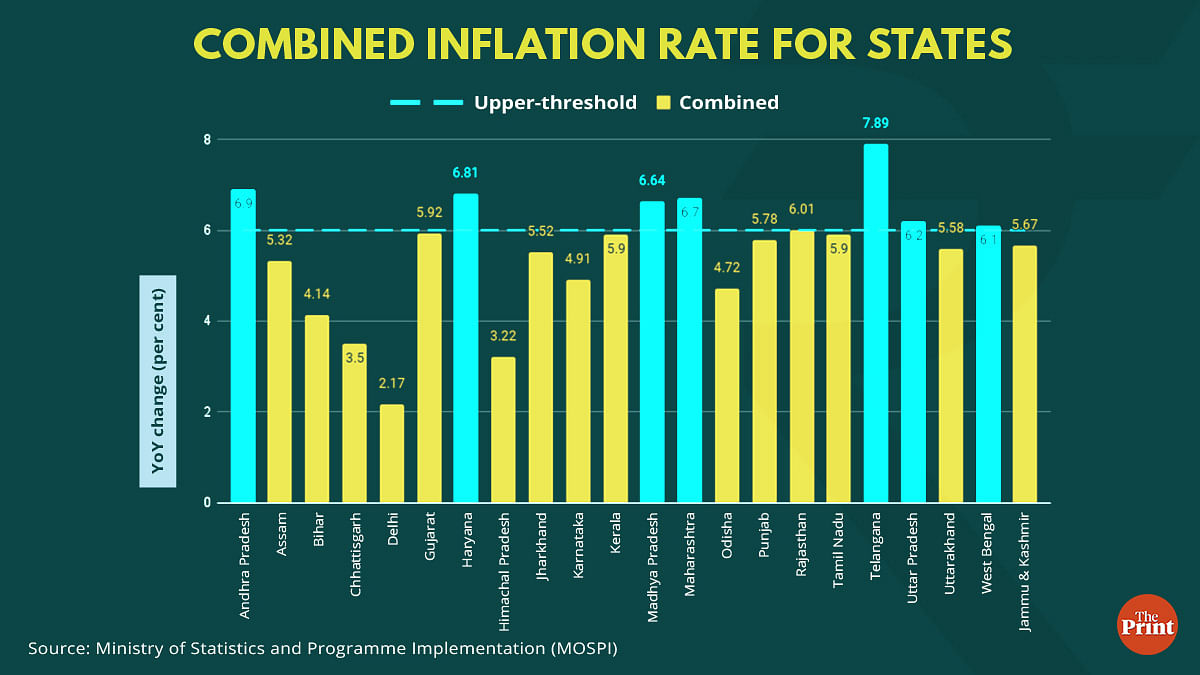
Do we see moderation in States inflation?

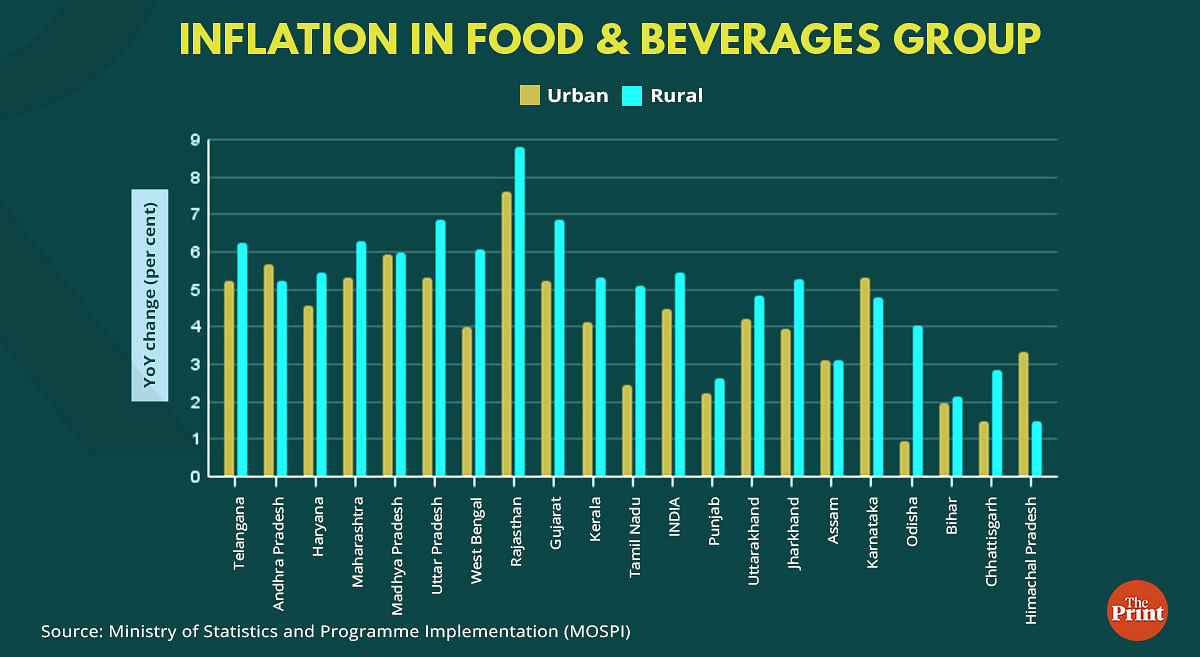
While the all-India CPI inflation moderated to below 6 per cent, seven major states (Andhra Pradesh, Haryana, Madhya Pradesh, Maharashtra, Telangana, Uttar Pradesh and West Bengal) saw inflation above the upper threshold of 6 per cent. For most of the states, rural inflation exceeded urban inflation. Telangana clocked the highest inflation at 7.9 per cent, but this was lower than 8.82 per cent in October.
Graphic by Ramandeep Kaur, ThePrint
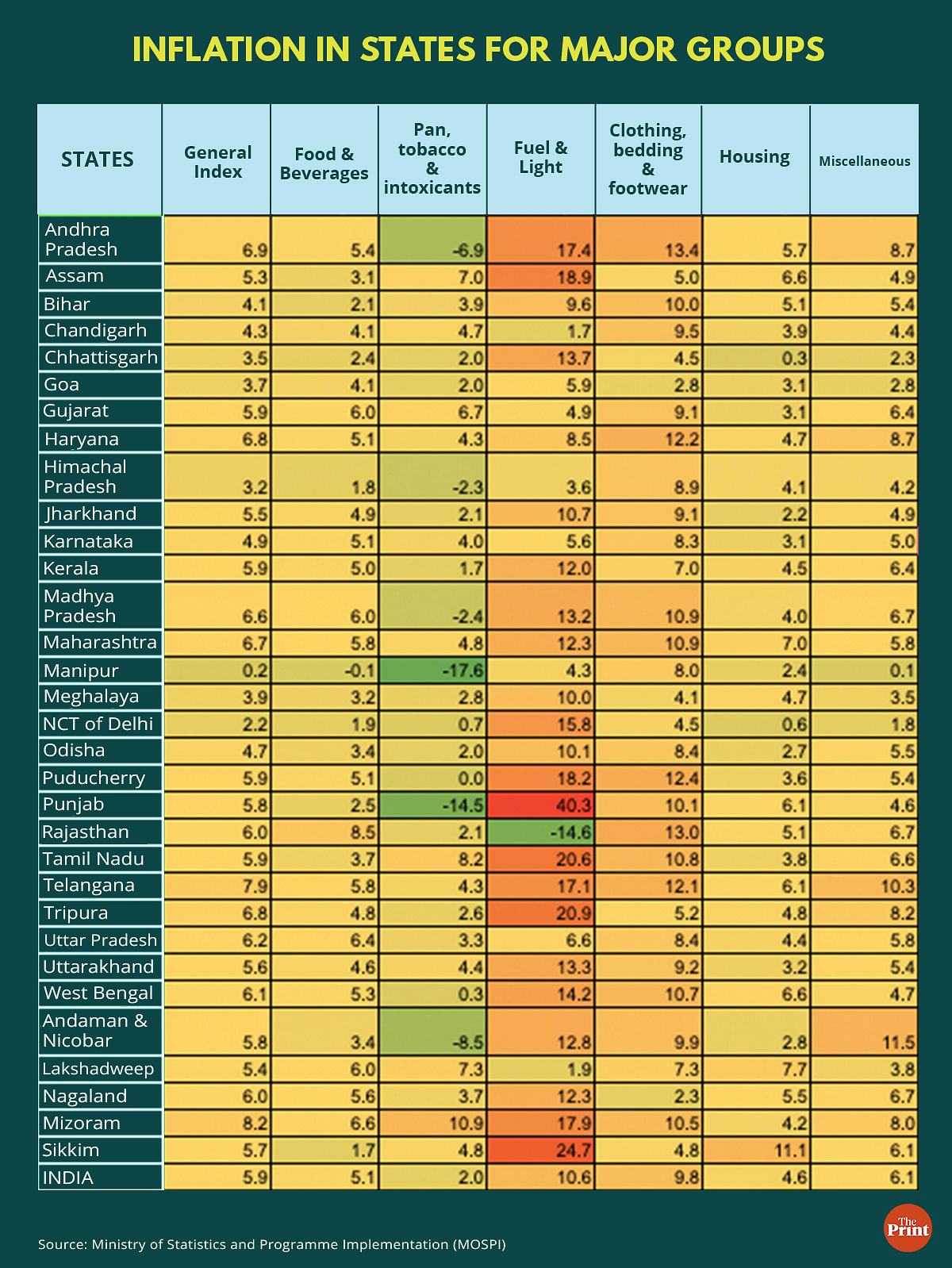
Similar to the all-India level, the moderation in inflation in Telangana was due to decline in food prices. The core inflation components of ‘clothing, bedding and footwear’ and ‘Miscellaneous’ remained in double digits. Similar to the national figure, the decline in food inflation was due to contraction in vegetable prices. Other key components of food inflation such as milk, oils and fats and spices saw a rise in November. Inflation in spices touched almost 22 per cent.

Rajasthan features as the state with the highest food inflation at 8.45 per cent. While contraction is seen in vegetable prices, cereals, milk and milk products and spices saw double-digit inflation. Mandi prices of spices such as cumin, coriander and black pepper have sky-rocketed due to decline in production as well as strong global and domestic demand. Production has been hit as some of the key producing states of spices have shifted to other crops.
Graphic by Ramandeep Kaur, ThePrint
At a broader level, core inflation pressures are evident in the inflation data of states. Table below shows that inflation in ‘clothing, bedding and footwear’ is in double-digits for some of the states.
Graphic by Ramandeep Kaur, ThePrint

Understanding variation in states inflation numbers

A key component of CPI is the consumption basket of households. The weights for the various items in the CPI are arrived at based on Consumer Expenditure Survey (CES) conducted by the National Sample Survey Organisation. The survey is designed to collect information on the consumption spending patterns of households, both urban and rural,  across the country. The weights for the current CPI series are based on the CES conducted in 2011-12, with a reference period of July 2011 to June 2012.

Data are collected on expenditures incurred for frequently purchased items — edible oil, eggs, fish, meat, vegetables, fruits, spices, beverages, processed foods, pan, tobacco and intoxicants — during the last seven days; for clothing, bedding, footwear, education, medical (institutional), durable goods, during the last 365 days; and for all other food, fuel and light, miscellaneous goods and services including non-institutional medical services, rents and taxes, data relate to the last 30 days. This data is used to arrive at the consumption expenditure of states for both rural and urbal areas.

Weights to each state are assigned on the basis of its consumption expenditure as a share of the overall consumption expenditure of the country. Maharashtra has the maximum weight at 13.18 per cent followed by Uttar Pradesh. Similar assignment of weight is done for rural and urban areas across each state. These weights and the prices of items collected from the designated markets across the country are then used to arrive at the national inflation figure.

Source : The Print Dec 23rd 2022

Stay Updated

Get the latest dairy industry news directly in your feed.

Prefer Us on Google Search

Swipe to continue reading

Previous Article

Next Article