Logo
IndianGlobalBlogsPublicationsPodcastsMarketAboutContact
Logo
IndianGlobalBlogsPublicationsPodcasts
7News
Summer Heat to Stress India’s Dairy Cold ChainSavencia Profit Drops on Rising Milk CostsTN Milk Output Claim Sparks Data DisputeHormuz Disruption Threatens Dairy Supply ChainUP Approves Dairy Expansion in Bundelkhand

Indian Dairy News

Gujarat Ice Cream Makers Face Cone Shortage
Mar 12, 2026

Gujarat Ice Cream Makers Face Cone Shortage

Ice cream manufacturers in Gujarat are bracing for a potential shortage of cones ahead of the peak summer season due to disruptions in natural gas supply triggered by geopolitical tensions in West Asi...Read More

KMF Milk Collection Drops to 95 Lakh Litres
Mar 12, 2026

KMF Milk Collection Drops to 95 Lakh Litres

Milk procurement by the Karnataka Milk Federation (KMF) has declined to around 95 lakh litres per day with the onset of summer, down from nearly 1 crore litres daily earlier, as rising temperatures an...Read More

Old Electronics May Hide 22-Carat Gold
Mar 12, 2026

Old Electronics May Hide 22-Carat Gold

Swiss scientists have discovered that discarded electronic devices—especially computer motherboards and circuit boards—contain valuable amounts of gold that most people unknowingly throw away. Researc...Read More

DairyNews7x7
Advertisement

Latest Blogs

See More
Rajahmundry Milk Incident: Accident or Adulteration?
Mar 10, 2026

Rajahmundry Milk Incident: Accident or Adulteration?

The recent editorial “Bitter Milk” published by The Hindu raises important concerns about food safety in India. The editorial deserves appreciation for attempting to broaden the conversation and under...Read More

Milk Prices Rise in South & West: Is North Next?
Mar 05, 2026

Milk Prices Rise in South & West: Is North Next?

The recent round of retail milk price increases across South India and Maharashtra is no longer an episodic adjustment but a clear signal of structural stress building up in India’s milk economy. Over...Read More

India’s Dairy Climate Paradox: Production Triumph Meets Methane Time-Bomb
Mar 02, 2026

India’s Dairy Climate Paradox: Production Triumph Meets Methane Time-Bomb

India’s rise to the top of the global dairy league board has been one of the most remarkable agricultural success stories of the 21st century. With milk production surpassing 247 million tonnes per ye...Read More

India’s First Cow Culture Museum in Mathura
Feb 16, 2026

India’s First Cow Culture Museum in Mathura

India’s first national “Cow Culture Museum” is set to be established in Mathura, Uttar Pradesh, on the campus of Pandit Deendayal Upadhyaya Veterinary Science University, announced the Uttar Pradesh B...Read More

Global Dairy News

Israel Drops Controversial Dairy Reform From Budget
Mar 12, 2026

Israel Drops Controversial Dairy Reform From Budget

The Israeli government has removed a controversial dairy reform proposed by Finance Minister Bezalel Smotrich from the 2026 Arrangements Law, a key legislative package linked to the country’s state bu...Read More

Savencia Profit Drops on Rising Milk Costs
Mar 11, 2026

Savencia Profit Drops on Rising Milk Costs

Savencia Profit Drops on Rising Milk Costs French dairy major Savencia Fromage & Dairy reported a sharp fall in profitability for 2025, with its net income dropping by €32.2 million to €74.7 million,...Read More

Hormuz Disruption Threatens Dairy Supply Chain
Mar 11, 2026

Hormuz Disruption Threatens Dairy Supply Chain

Escalating geopolitical tensions around the Strait of Hormuz are creating new risks for the global dairy sector by disrupting key inputs such as energy, fertilisers and shipping routes. The strait car...Read More

DairyNews7x7
Advertisement
Dairy News 7x7

Your trusted source for all the latest dairy industry news, market insights, and trending topics.

FOLLOW US
CATEGORIES
  • Global News
  • Indian News
  • Blogs
  • Publications
  • Podcasts
SUBSCRIBE TO OUR NEWSLETTER

Stay informed with the latest updates and trending news in the dairy industry.

No spam, unsubscribe at any time

GET IN TOUCH
C-49, C Block, Sector 65,
Noida, UP 201307
+91 7827405029dairynews7x7@gmail.com

© 2026 Dairy News 7x7. All Rights Reserved.

Terms of ServicePrivacy Policy
Prefer Us
Prefer Us

Milking the cash cow with carbon credits

By DairyNews7x7•Published on August 14, 2023

Milking the cash cow with carbon credits
Prefer on

INDIA is making strides towards achieving the target of net zero carbon emissions by 2070 through a variety of initiatives. These include endeavours in solar energy, Lifestyle for Environment (LiFE), green hydrogen, electric vehicles (EVs), waste-to-wealth, organic and natural farming. India is also launching a domestic compliance carbon market to facilitate trading of carbon credits.

Dairy farming
India has experience in carbon trading, particularly in wind energy, biogas production, clean cooking stoves and agricultural land management. While carbon projects in agriculture have been less frequent, their number has increased of late. India is implementing sustainable agriculture practices, including zero tillage, alternative wetting and drying, direct seeding of rice, and integrated nutrient and residue management. While this progress is encouraging in terms of reducing carbon emissions and addressing climate change, it is crucial to assess whether these efforts are adequately targeting the highest greenhouse gas emitters in the agriculture sector or merely focusing on readily available solutions? This is a critical question that needs to be addressed to ensure that we effectively combat climate change.
Animal husbandry significantly contributes to global warming due to the emission of potent greenhouse gases like methane (CH4) and nitrous oxide (N2O). Methane, produced through enteric fermentation and animal waste storage, has a global warming potential 28 times higher than that of carbon dioxide. Nitrous oxide, released from manure storage and the use of fertilisers, has a global warming potential 265 times greater than that of carbon dioxide. The Intergovernmental Panel on Climate Change (IPCC) has stated that in order to limit global warming to below the target of 1.5°C (above pre-industrial levels), “rapid, far-reaching, and unprecedented changes”, including ‘deep reductions’ in non-CO2 emissions (e.g. methane), are necessary. Addressing methane emissions from livestock is thus a crucial component of any comprehensive strategy to combat climate change.
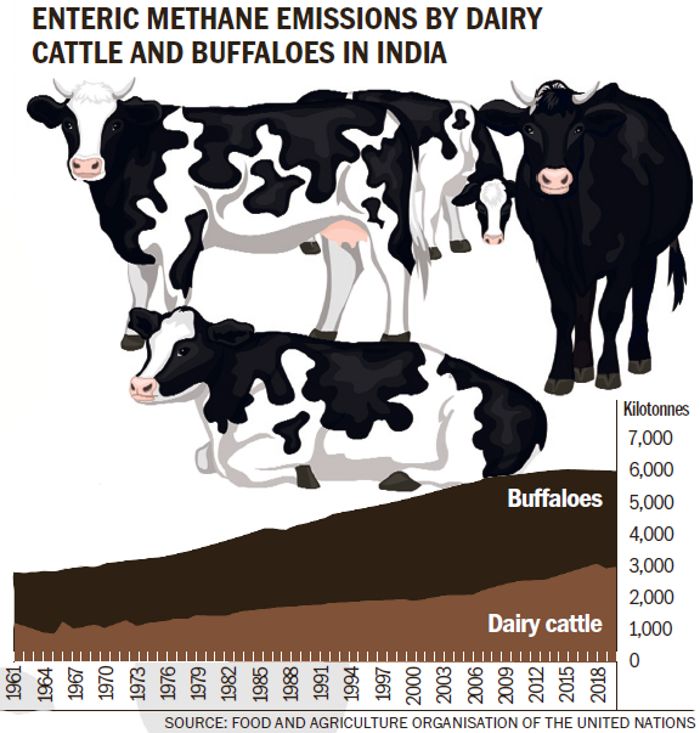
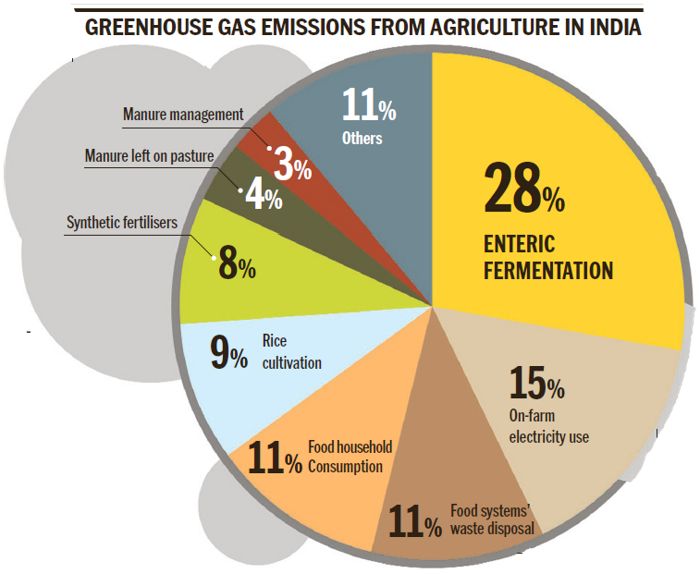
In India, enteric fermentation accounts for 28% of the total food system emissions. Despite efforts towards achieving net zero emissions, enteric methane emissions are increasing. Large-scale reduction of enteric emissions does not appear to be a top priority. India’s role in global emission reduction is crucial, with dairy cattle responsible for a significant 16% of the world’s enteric emissions. While some attribute this to the large livestock population, a comparison of emission intensities reveals the worrying reality. Indian crossbred cattle emit 4.8 times more greenhouse gases per kg of milk than US Holstein cows, and indigenous cows emit a staggering 11.8 times more.

Given the expected increase in the bovine population due to the rising demand for milk and milk products, these emissions are expected to continue increasing. According to an article published in the Proceedings of the National Academy of Sciences, enteric methane emissions must be reduced by 11-30% by 2030 and 24-47% by 2050 compared to the 2010 levels to meet the 1.5°C target.

To effectively curb emissions, India must prioritise producing more milk per unit of methane emitted. Achieving this goal necessitates providing animals with high-quality and abundant feed and implementing methane emission mitigation strategies. However, the challenge lies in the widespread adoption of these strategies, as the traditional practice of subsidising them through government schemes may prove ineffective in the Indian dairy sector. Two potential solutions can be explored: leveraging the large cooperative network to implement emission reduction strategies through village-level dairy cooperative societies and utilising carbon markets to incentivise farmers through carbon credits.

A recent report of the Consultative Group on International Agricultural Research (CGIAR) highlights two potential game-changers in combating enteric emissions: 3-Nitrooxypropanol (3-NOP) and Asparagopsis taxiformis (red seaweed). 3-NOP has been found effective in ensuring animal welfare and food safety. According to a meta-analysis, including 3-NOP in livestock feed could reduce enteric methane emissions by 30%. Additionally, a study in India suggests that providing a balanced feed can lead to 15% reduction in emissions.

It seems logical that if there are solutions available and there is a demand for carbon credits, the livestock sector, being the highest emitter, should have the highest number of carbon farming projects. After all, greater reductions can be achieved when emissions are high due to the high base effect. However, it is astonishing that no project in India is currently aimed at reducing enteric methane emissions.

There are registered biogas projects with 4 million-plus carbon credits already issued. However, livestock manure accounts for only 10% of livestock emissions, while the potential for generating carbon credits through reducing enteric emissions is much higher. Some argue that the challenge lies in measuring and monitoring enteric emissions, particularly those involving smallholder farmers.

To address this issue, a simple digital MRV (measurement, reporting and verification) system should be developed, either standardised or tailored to specific locations, and made available in the public forum for project developers to implement. Research organisations such as the International Livestock Research Institute and the Indian Council of Agricultural Research, with their expertise and experience in dealing with enteric emissions, should take up this task.

Globally, the Verified Carbon Standard Registry currently lists only two registered projects (in the UK and Switzerland), with three more in the pipeline — all in the USA. It is high time we redirected our attention towards enteric methane reduction. By doing so, we can make a substantial positive impact on both the environment and the livelihoods of smallholder farmers.

Stay Updated

Get the latest dairy industry news directly in your feed.

Prefer Us on Google Search

Swipe to continue reading

Previous Article

Next Article