Logo
IndianGlobalBlogsPublicationsPodcastsMarketAboutContact
Logo
IndianGlobalBlogsPublicationsPodcasts
7News
Mandatory Daily Record of Production and Raw Material UtilisationHeritage Foods inaugurates new Ice Cream PlantFSSAI makes registration to all milk vendors in IndiaGujarat Ice Cream Makers Face Cone ShortageSummer Heat to Stress India’s Dairy Cold Chain

Indian Dairy News

Dairy Sector a ‘Safety Net’ for Farmers: NABARD
Mar 14, 2026

Dairy Sector a ‘Safety Net’ for Farmers: NABARD

The Chairman of National Bank for Agriculture and Rural Development, Shaji K V, has highlighted the crucial role of India’s dairy industry in protecting rural livelihoods, describing it as a “safety n...Read More

Bihar Dairy Officer Arrested in ₹30,000 Bribery Case
Mar 14, 2026

Bihar Dairy Officer Arrested in ₹30,000 Bribery Case

A field officer of the district dairy development department in Bihar was arrested by the Vigilance Investigation Bureau (VIB) for allegedly accepting a bribe of ₹30,000 in West Champaran district. Th...Read More

Hatsun Agro Shares Rise After Milk Mantra Merger
Mar 14, 2026

Hatsun Agro Shares Rise After Milk Mantra Merger

The shares of Hatsun Agro Product Limited gained investor attention after the National Company Law Tribunal (NCLT), Cuttack Bench, approved the merger of its wholly owned subsidiary Milk Mantra Dairy...Read More

DairyNews7x7
Advertisement

Latest Blogs

See More
Mandatory Daily Record of Production and Raw Material Utilisation
Mar 14, 2026

Mandatory Daily Record of Production and Raw Material Utilisation

I recently reviewed the notification issued by the Food Safety and Standards Authority of India in the context of Schedule IV of the Food Safety and Standards (Licensing and Registration of Food Busin...Read More

FSSAI makes registration to all milk vendors in India
Mar 13, 2026

FSSAI makes registration to all milk vendors in India

The recent advisory issued by Food Safety and Standards Authority of India (FSSAI) mandating registration of milk vendors is a timely and progressive step towards strengthening traceability and accou...Read More

Rajahmundry Milk Incident: Accident or Adulteration?
Mar 10, 2026

Rajahmundry Milk Incident: Accident or Adulteration?

The recent editorial “Bitter Milk” published by The Hindu raises important concerns about food safety in India. The editorial deserves appreciation for attempting to broaden the conversation and under...Read More

Milk Prices Rise in South & West: Is North Next?
Mar 05, 2026

Milk Prices Rise in South & West: Is North Next?

The recent round of retail milk price increases across South India and Maharashtra is no longer an episodic adjustment but a clear signal of structural stress building up in India’s milk economy. Over...Read More

Global Dairy News

Global Dairy Commodity Prices Show Signs of Rally
Mar 14, 2026

Global Dairy Commodity Prices Show Signs of Rally

Global dairy commodity prices have shown a rally in the first quarter of 2026, particularly for products originating from Australia and New Zealand, according to a new Q1 Global Dairy Quarterly report...Read More

How Walmart Keeps Great Value Milk So Affordable
Mar 14, 2026

How Walmart Keeps Great Value Milk So Affordable

Retail giant Walmart has managed to keep the price of its private-label Great Value milk significantly lower than many competing brands through a vertically integrated dairy supply chain and direct co...Read More

Lactose-Free Milk Seen as Growth Driver in Coffee
Mar 13, 2026

Lactose-Free Milk Seen as Growth Driver in Coffee

Lactose-free milk is emerging as a major growth opportunity for the dairy industry, particularly in the rapidly expanding coffee and café segment. A recent US-based study highlighted that lactose-free...Read More

DairyNews7x7
Advertisement
Dairy News 7x7

Your trusted source for all the latest dairy industry news, market insights, and trending topics.

FOLLOW US
CATEGORIES
  • Global News
  • Indian News
  • Blogs
  • Publications
  • Podcasts
SUBSCRIBE TO OUR NEWSLETTER

Stay informed with the latest updates and trending news in the dairy industry.

No spam, unsubscribe at any time

GET IN TOUCH
C-49, C Block, Sector 65,
Noida, UP 201307
+91 7827405029dairynews7x7@gmail.com

© 2026 Dairy News 7x7. All Rights Reserved.

Terms of ServicePrivacy Policy
Prefer Us
Prefer Us

Microbes, not fossil fuels, produced most new methane

By DairyNews7x7•Published on May 02, 2024

Microbes, not fossil fuels, produced most new methane
Prefer on

A modelling study has found methane emissions from fossil fuels declined between 1990 and the 2000s and have been stable since, whereas microbes have been producing more methane of late. One reason could be an increase in cattle-rearing in Latin America and more emissions from waste in South and Southeast Asia

For the last three years, Naveen Chandra has been spending most of his days running simulations at the Research Institute for Global Change in Japan. He is trying to recreate the last 50 years of the earth’s atmosphere on a supercomputer roughly the size of an auditorium.

Mr. Chandra has been trying to answer a question that came out of his team’s research. During 2019-2020, these researchers examined the concentration of methane in the atmosphere and how it changed with time. Until the 1990s, the concentration increased, then stabilised for a bit, and then started to increase again around 2007. According to recent estimates, the atmospheric concentration of methane today is three-times what it was 300 years ago.

Where is this methane coming from? That’s what they wanted to know.

Evolving understanding

Methane is the second most abundant anthropogenic greenhouse gas after carbon dioxide (CO2) but it warms the planet more. Over a century, methane has a global warming potential 28-times greater than CO2, and even higher over shorter periods like two decades.

It wasn’t until recently that policymakers began to focus on methane vis-a-vis addressing global warming. At the U.N. climate talks in 2021, member countries launched the ‘Global Methane Pledge’ to cut the gas’s emissions and slow the planet’s warming. Yet our understanding of methane also continues to evolve.

For instance,Mr. Chandra and his team recently reported that microbes have been the biggest sources of methane in the atmosphere, not the burning of fossil fuels.

The sources of methane

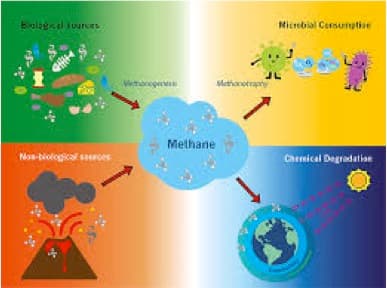
Scientists are increasingly recognising various sources of methane, most of which fit in two categories: biogenic and thermogenic. When fossil fuels such as natural gas or oil are extracted from deep within the earth’s crust, thermogenic methane is released. Biogenic methane comes from microbial action.

The microbes that produce methane are archaea — single-celled microorganisms distinct from bacteria and eukaryotes — and are called methanogens. They thrive in oxygen-deficient environments, such as the digestive tracts of animals, wetlands, rice paddies, landfills, and the sediments of lakes and oceans.

Methanogens play a crucial role in the global carbon cycle by converting organic matter into methane. While methane is a potent greenhouse gas, its production by methanogens is an essential part of natural ecosystems. But human activities like agriculture, dairy farming, and fossil fuel production have further increased methane emissions.

Both biogenic and thermogenic activities produce different isotopes of methane. Tracking the isotopes is a way to track which sources are the most active.

Modelling with a supercomputer

According to Prabir Patra, principal scientist at the Japan Agency for Marine-Earth Science and Technology (JAMSTEC) and one of the lead authors of the study, carbon-13 is key. (Atoms of this carbon isotope have 13 nucleons: 6 protons + 7 neutrons.)

If there are fewer carbon-13 atoms than a certain level in a group of 1,000 methane molecules, the methane is from a biological source. If the methane is from thermogenic sources, such as trapped fossil fuels or geological activities, there will be more carbon-13 atoms in 1,000 molecules.

Mr. Chandra and Mr. Patra worked with scientists from Austria, Japan, the Netherlands, and the U.S. to collect data from the 12 monitoring sites worldwide tracking atmospheric parameters since the 1990s. Then they sorted the methane isotope data by year and ran it through a program they had developed to recreate the atmosphere from 1980 to 2020 on a supercomputer.

“One year of data analysis takes about four to five hours,” Mr. Chandra said.

Data mismatch

Finally, the team compared their own results with two emissions inventories, called EDGAR and GAINS, and found some discrepancies. EDGAR had reported that methane emissions from oil and natural gas exploration had increased between 1990 and 2020. GAINS had recorded a large “unconventional” rise in emissions since 2006. Their findings disagreed with both inventories.

Mr. Patra said combining the numbers for all biogenic and thermogenic isotopes should match the total emissions in a year. They also took insights from other available data like, number of rice fields, wetlands, dairy farms, biomass burning and likewise sources of methane emissions, and estimated the emissions from those sources. But when they ran their atmosphere models with this data, the year-wise total methane emissions overshot the total production.

In fact, the models said methane emissions from fossil fuels declined between 1990 and the 2000s and that they’ve been stable since. They also found microbes were producing more methane than fossil fuels.

Need for local data

One possible reason could be an increase in cattle-rearing in Latin America and more emissions from waste in South and Southeast Asia, Latin America, and Africa, the study’s authors wrote in their paper. They added that the number of wetlands worldwide had increased as well.


Stay Updated

Get the latest dairy industry news directly in your feed.

Prefer Us on Google Search

Swipe to continue reading

Previous Article

Next Article