Uptake by Canadian dairy producers of a new breeding tool aimed at decreasing their herd’s methane emissions hasn’t been overwhelming, representatives of Semex Alliance admitted recently. Uptake has been slow among producers, but the discussion on methane efficiency has begun
However, given the potential long-term interest, neither Semex nor the organization with which it partnered on developing the tool is concerned.
Why it matters: The Canadian dairy sector’s commitments to climate change action include goals for decreasing methane emissions from cattle but individual producers must weigh these goals against farm sustainability.
Semex, which markets semen as well as genetic services, joined nationwide dairy genetic data and milk sampling organization Lactanet to research and develop an index predicting the methane emissions of offspring from bulls. It was released in April.
At its Dairy Innovation Centre display during Canada’s Outdoor Farm Show, Semex Alliance’s Ontario-based member EastGen had numerous signs promoting the methane efficiency index. But uptake has been slow, said sales director Jamie Howard.
However, he remains optimistic and believes producers are taking time to decide if methane efficiency fits into their breeding programs, and what level of priority they should assign to it.
In a separate interview, Lactanet chief services officer Brian Van Doormaal said the methane efficiency index is still fairly new and there was never an expectation that producers would quickly alter their genetic programs to consider emission reduction.
“The real intent here was to create discussion; to put methane efficiency and feed efficiency as it relates to methane emissions on the radar for dairy farmers,” Van Doormaal said.
Howard says EastGen is happy to facilitate this discussion.
“That’s something that’s front-of-mind for us when we’re talking to producers about the methane efficiency index,” he said, adding it’s important to promote the message that the industry is working toward climate action goals.
“Our poor old cows have been beaten up more than they deserve, considering the percentage of (greenhouse gas) emissions tied to the agriculture sector that actually comes from cows,” he added. He believes consumers will be appreciative if made aware that efforts are underway to tackle those emissions.
Van Doormaal stresses that, at this point, no producers in Canada are compensated for advancing their farms toward reduced emissions and nobody is penalized for losing ground on their farm’s position. But that has started to happen in other parts of the world and there’s a good chance, given the federal government’s climate change commitments, that it will eventually happen here.
“We’re not there yet in this country but it is being talked about,” Howard agreed.
In the short term, Van Doormaal encourages producers to consider the strong correlation between methane efficiency and the previously released feed efficiency genetic index.
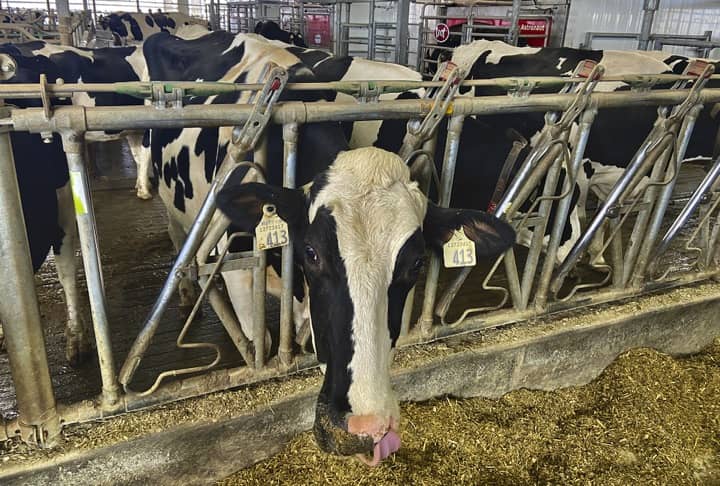
Cows that are more efficient at turning feed into milk also emit less methane per litre of milk produced, he explained. So even if the focus is on building a herd that’s more feed-efficient, the methane efficiency index should be part of the breeding strategy.
“I think the most progressive people will be looking at (methane efficiency)” as part of their breeding strategy, he said.
Lactanet is leading three methane-focused research projects that have received government funding approval.
The first is simply collecting more Canadian data to support and potentially expand the methane efficiency index. The current index is based on data from two research herds – one in Alberta and one at the University of Guelph. There is work underway to gather more data from herds in Alberta, B.C., Ontario and Quebec.
The second is exploring a new way to collect emissions samples. So far, all Canadian data has come from the GreenFeed system, an automated feed stall with an attached emission collection apparatus. In the University of Guelph dairy research farm example, it’s placed at one cow’s stall for five days, then moved to the next stall.
“There are a limited number of cows that can be sampled within a reasonable time frame. It’s time-consuming and it’s very expensive,” Van Doormaal said.
Through different partnerships, however, Lactanet recently purchased 30 Spanish-developed “sniffers” for attachment to robotic milkers. Ten are being installed in Alberta over four herds, including commercial herds. A still-in-the-development project in Quebec will use the other 20 units.
Because they’re installed on the milking robot, the sniffers can sample all lactating animals every time they’re milked.
“We’re very excited about being able to feed that data into a genetic analysis because we always want that data to be as complete as possible.”
That feeds into the third project that has received funding – a study into the variations in methane efficiency as a dairy animal ages and grows.
Source : Farmtario Nov 1 2023 by Stew Slater
Never miss an important dairy update
Follow DairyNews7x7 on Google to get live milk prices, policy alerts, and daily headlines directly in your feed.