Latest Blogs
See More


Indian Dairy News



DairyNews7x7
Global Dairy News



DairyNews7x7
A stable livelihood under the Amul model coupled with an increased income over the past five years is a big pro-incumbency factor for over 36 lakh dairy producers, whose vote will decide the outcome in at least 88 seats out of the Municipal corporation areas in Gujarat polls.
Dairy leaders believe that notwithstanding the issues of high cattle-feed prices and the deadly viral infection of Lumpy Skin Disease, the dairy producers across 33 districts of Gujarat are set to give a verdict favourable to the ruling Bhartiya Janata Party (BJP), unlike in 2017. Out of the 88 seats under cooperative dairies’ influence, BJP had scored only 42, while Congress got 40 and 6 went to others including independents during the last polls.
For example, in Amreli district in Saurashtra, Congress won all five seats in 2017 polls, but dairy leaders expect a reversal this time. “It was a strong Patidar factor against the government that overrode all other considerations then. This time, there is no such factor. On the contrary, dairy producers have benefitted from increased incomes due to dairy cooperatives. This will benefit the BJP,” Ashvinbhai Savaliya, Chairman of Amar dairy (Amreli District Cooperative Milk Union) told businessline.
Saurashtra and south Gujarat regions will vote in the first phase on December 1.
The largest dairy concentration is in North Gujarat, where Banaskantha, Sabarkantha and Mehsana district dairy unions collectively have over 16 lakh members with milk procurement of about 145 lakh litres per day. The incomes generated by the three district unions exceed ₹28,000 crore annually. The milk procurement prices have increased in the range of 18-30 per cent during the past five years from about ₹650/kg fat in November 2017 to ₹860/kg fat now across different unions.
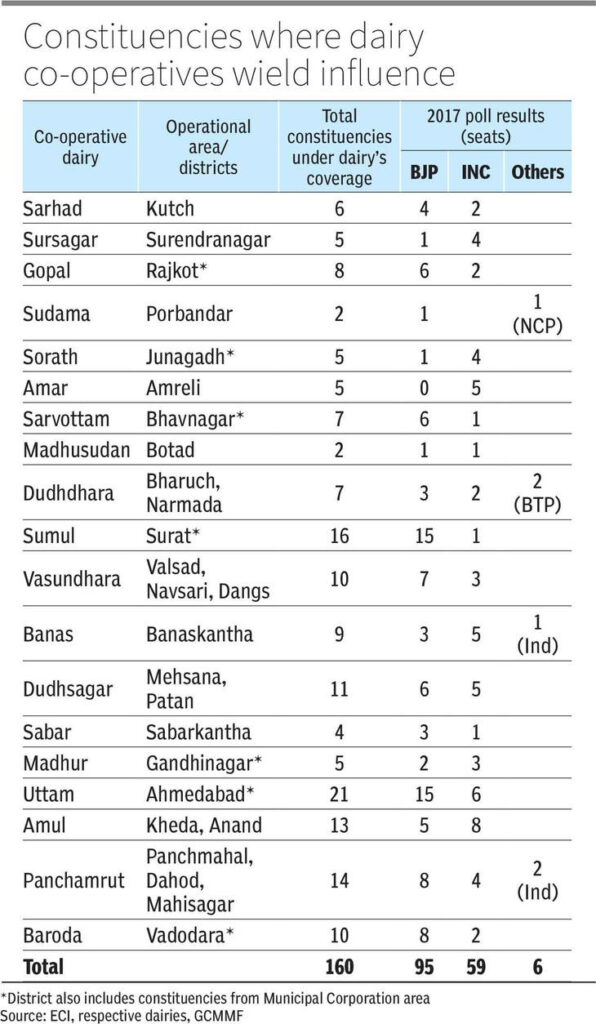
However, in the milk capital of India — Anand and Kaira districts — BJP could manage only five out of 13 seats in 2017. The poll outcome this time will be something to watch out for in these districts, where Congress has retained its stronghold for the past two elections. Central and north Gujarat regions will vote on December 5. The counting will take place on December 8.
On the other hand, the districts with high urban populations such as Ahmedabad, Vadodara, Surat, Rajkot, Bhavnagar have shown BJP having advantage compared with the situation in 2017, but cooperative leaders attribute that more to committed urban voters of the saffron party than the influence of dairy producers.