Latest Blogs
See More

Indian Dairy News


DairyNews7x7
Global Dairy News


DairyNews7x7
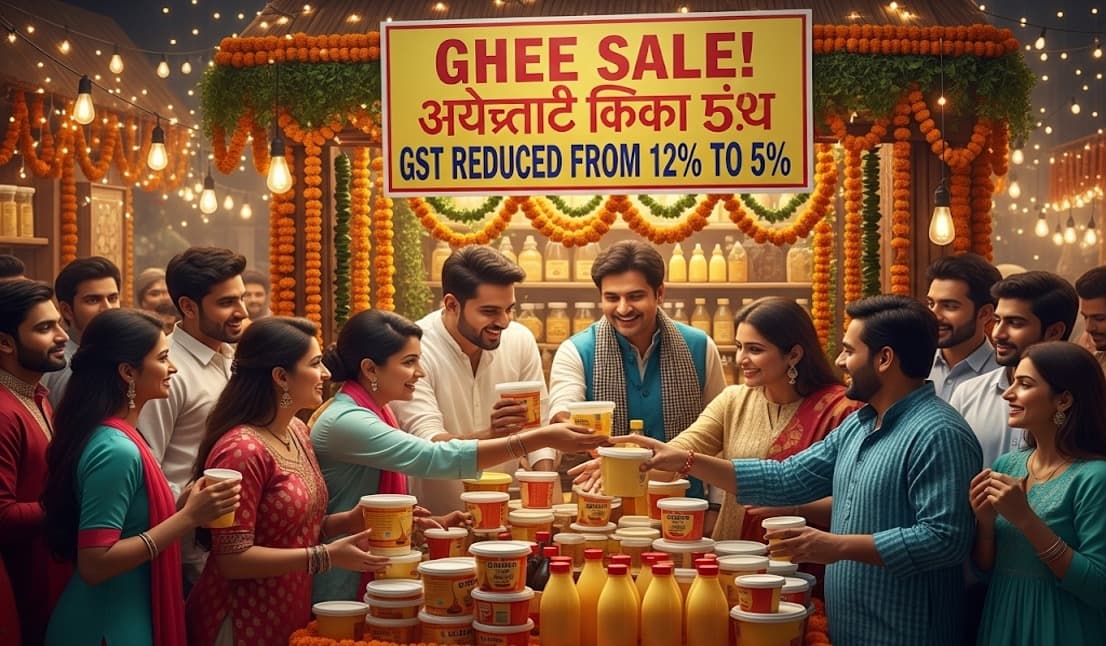
The Government of India is actively considering reducing GST on consumer goods including ghee from 12% to 5%, a move that has the potential to bring relief to households and boost demand for one of the most widely consumed dairy products in the country. As a policy intervention, this signals the government’s commitment to making essential commodities more affordable while supporting the dairy ecosystem that spans millions of farmers, cooperatives, and traders.
Yet, as with any tax policy change, the real test lies in its implementation. A thoughtful, trader-friendly approach could not only maximize the benefits of the GST reduction but also strengthen trust across the dairy value chain—particularly at a time when the country is facing an acute shortage of butter fat during the festive season.
The immediate concern for traders lies in the treatment of existing ghee stocks that were procured when GST stood at 12%. If the rate is reduced to 5%, these traders may end up with excess input tax credit (ITC), particularly in channels where the margins are as low as 10%. A simple calculation shows that under such conditions, traders might need to sell nearly 13 times their current volumes before their credits balance out. This artificially prolongs the adjustment process and risks straining liquidity in a sector already grappling with supply shortages.
From the tax department’s perspective, such an anomaly raises red flags. Officers are trained to interpret high ITC claims with low tax outflow as potential tax evasion. This could trigger enquiries, notices, and compliance burdens on otherwise legitimate traders. The rational response from traders would be to liquidate existing stocks quickly, often at distressed margins, to avoid accumulating problematic ITC.
Instead of leaving traders to navigate this credit mismatch, the government could explore mechanisms to directly refund or adjust credits for existing stock. Considering that the total stock currently circulating in the market may not exceed 5,000–10,000 MT, the fiscal outlay required would be relatively modest—perhaps in the range of ₹30–100 crore. In exchange, such a measure would free traders from compliance anxiety, ensure uninterrupted supply during peak festival demand, and allow the GST rate cut to achieve its intended impact.
The timing of this policy move could not be more significant. Festivals are synonymous with high consumption of ghee and butter, whether in traditional sweets, festive meals, or temple offerings. At the same time, India is experiencing an acute shortage of butter fat. Cooperative data shows that stocks with federations are running at historically low levels, while private traders are struggling to source sufficient quantities.
In such a scenario, allowing traders to clear existing stock smoothly will help stabilize supply lines and avoid sudden disruptions. More importantly, it will enable consumers to experience the benefit of the GST cut right when demand is at its peak.
One of the strengths of India’s dairy sector is the robust data available through the cooperative structure under the National Dairy Development Board (NDDB). At any given moment, NDDB and state federations have visibility into stock levels of butter, ghee, and related commodities. This data can provide valuable insights to policymakers when designing and implementing trader-friendly measures.
By leveraging cooperative sector intelligence, the government can calibrate its GST implementation in a way that balances consumer affordability with trader liquidity. For instance, if data shows a tight stock position—as it does now—the government could opt for transitional measures like refunding credits or creating a temporary adjustment window for traders.
The government is also considering reintroducing the anti-profiteering framework, which ensures that the benefits of tax cuts are passed on to consumers. While the principle is sound, its application in the current context requires nuance. Prices of ghee and butter are under pressure not just because of tax rates but also due to supply shortages in butter fat. If prices rise despite a GST reduction, this may not necessarily reflect profiteering but rather the natural consequence of demand outstripping supply.
Here again, cooperative data can play a critical role. By comparing trends in procurement prices, production costs, and stock levels, regulators can distinguish between genuine market-driven price stability and excessive profiteering. This would prevent undue penalization of traders and ensure that the law serves its intended purpose of consumer protection without dampening market confidence.
Policy works best when it is predictable, fair, and sensitive to on-ground realities. The proposed GST reduction on ghee is an excellent opportunity for the government to showcase how tax reforms can be implemented in a trader-friendly and consumer-centric manner.
Some potential steps include:
Credit Refund Mechanism: Create a one-time refund or credit adjustment mechanism for traders holding ghee stock purchased at 12% GST. This would free liquidity and encourage faster stock rotation.
Festival-Friendly Transition: Time the GST rollout with measures to ensure traders can liquidate stock seamlessly during the festive demand peak, preventing shortages and stabilizing consumer prices.
Data-Driven Oversight: Use NDDB cooperative data to track stock levels and market trends, ensuring that policies reflect ground realities rather than assumptions.
Nuanced Anti-Profiteering Implementation: Apply the framework in a way that distinguishes between supply-driven price movements and actual profiteering, thus safeguarding both consumers and traders.
Engagement with Trade Associations: Involve dairy trade bodies , Indian Dairy Association, and cooperatives in consultations to ensure that implementation challenges are identified early and resolved collaboratively.
India is the world’s largest producer and consumer of dairy products, and ghee holds a special cultural and economic significance. A tax policy that makes ghee more affordable has the potential to boost consumption, support dairy farmers through stronger demand, and reinforce India’s position as a dairy powerhouse.
At the same time, the acute shortage of butter fat is a reminder of the need for longer-term strategies to stabilize production and supply. These could include incentivizing higher milk procurement, investing in processing capacity, and supporting value-added product development. The GST cut on ghee should therefore be seen not just as a tax change but as part of a broader policy push to strengthen India’s dairy value chain.
This GST reduction is not just a relief measure—it has the potential to reshape the ghee market. By lowering the tax rate, the incentive to evade taxes is sharply reduced, fostering better compliance and widening the formal market base. The move will also help curb adulteration and fake ghee, which often proliferate when there is a large price disparity between branded and unregulated products. This will, in turn, expand the ghee business exponentially—driving growth not only in scale but also in a more transparent and ethical manner.
In fact, with reduced disparity, the prevalence of spurious products is expected to shrink to a minimum. Consumers will benefit from safer and more authentic ghee, while genuine producers—especially farmer cooperatives—will be able to expand their reach. The market size could expand exponentially as both urban and rural demand rises, creating a win–win scenario for farmers, traders, and consumers alike.
The government’s move to reduce GST on ghee is timely, consumer-friendly, and potentially transformative. But for it to deliver maximum impact, the transition must be handled with sensitivity toward traders who are the lifeline of the distribution system. By refunding credits, leveraging cooperative data, and applying anti-profiteering laws with nuance, the government can create a win-win scenario—ensuring affordable ghee for consumers, liquidity for traders, and stability for the dairy sector at large.
More importantly, it will strengthen the formal dairy economy, enhance consumer trust, and support the cooperative movement during a crucial festive season. In the long run, this reform could serve as a template for making taxation more responsive, market-aligned, and inclusive.
Handled well, this reform could become a model for how India designs tax policies that are not only fiscally sound but also empathetic, market-savvy, and growth-oriented.
Source : A blog by Kuldeep Sharma Chief editor Dairynews7x7 Aug 31st 2025