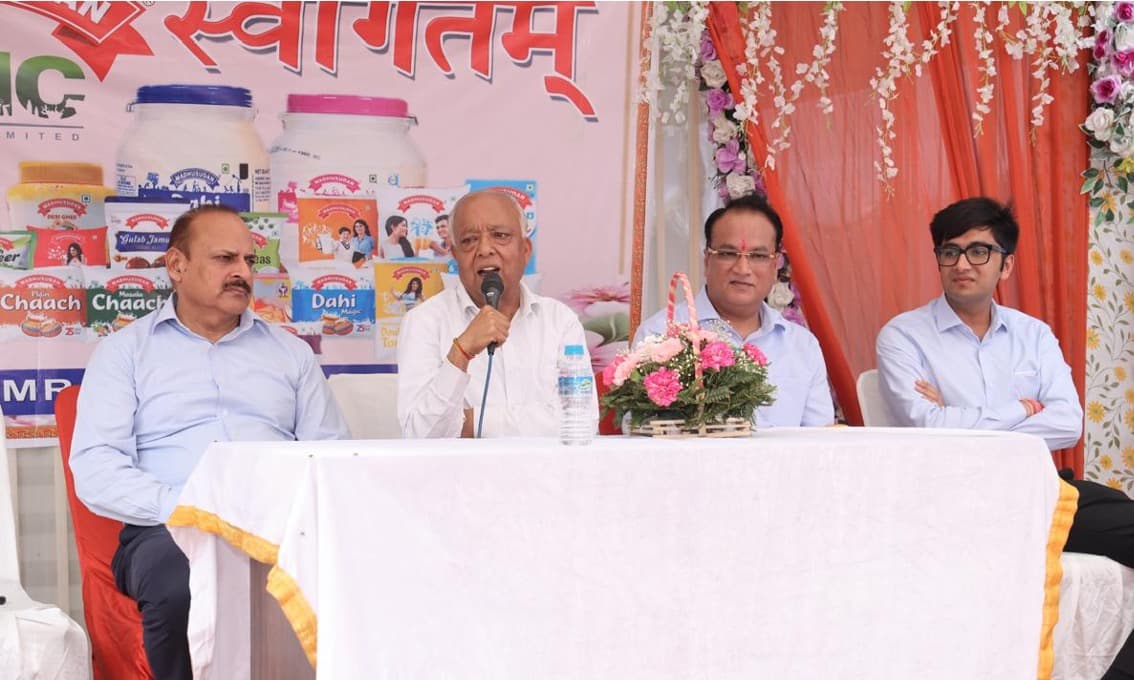
Trade Promotion Council of India organised a webinar on 17th June on the following topic ;”Leveraging PLI scheme for optimal push to large- scale manufacturing in India “. Please find below my sharing in the webinar.
Let us look at the salient features of this scheme from dairy sector perspectives. We shall be examining its guidelines in a pointed way in order to make it relevant to existing dairy players. This scheme is the best bet for the tax payers money because it is 100% result oriented. Nothing is going to reach anyone’s pocket till the applicant has attained the targets.
How the dairy industry will benefit from the PLI scheme ?
As the scheme has an export focussed orientation so let us look at the status of Indian dairy exports.
India’s Export of
Dairy products was 51,421.85 MT to the world for the worth of Rs. 1,341.03 Crores or 186.71 USD Millions during the year
2019-20. It showed a 44% decline over the exports in 2018-19 . Just to set the context ; the dairy imports of our neighbouring country Sri Lanka was almost double of that in the same period.
During the pandemic with all its constraints; India managed to export dairy products worth Rs 554 crore to more than 110 countries and till Nov 2020 . UAE remained as the biggest market for Indian dairy products during that period.
Milk from Uttar Pradesh (30 Mill MT), Rajasthan (23 Mill MT), Andhra Pradesh (15 Mill MT) , Maharashtra ( 12 Mill MT) and Gujarat (14 Mill MT) have largely contributed to these exports. India’s dairy exports from FY16 to FY 19 touched Rs 5,500 crore .
The top exported products in that period were ; ghee (Rs 1,521 crore). followed by Butter (Rs 1,486 crore), farm cheese (Rs 435 crore) and milk cream (Rs 230 crore). There’s also been a small market for buttermilk (Rs 20 crore). Whole milk carton export has been worth just Rs 0.5 lakh.
Domestic growth of selected dairy products under PLI
Milk beverages, Mozzarella cheese , Ice creams and sweets are showing a promising double digit growth. Global markets are not as growing as fast as Indian market ; except South east Asian region where we are not exporting. Indian dairy products have market access issues with most developed countries in the world. So without resolving those bilateral or multilateral issues exports of our dairy products globally might be a challenge.
How this scheme will lead to the development of ancillary units and growth of connected service sectors leading to job creation and expansion of manufacturing capacity
Dairy is a single raw material industry and is highly inclusive thus the key beneficiaries are going to be the farmers. In terms of ancilliary or allied sector the next big beneficiary is the packaging material. Supply chain and logistics players have also got a room to expand under the scheme. Plant and machineries and Utilities suppliers along with civil infrastructure players will also be benefited.
What are the major challenges and ways to address it
1. The first issue is the baseline year.
If 2019-2020 is being used as a reference year then most of the players are still struggling to catch up with the same level of demand even in current year FY 22 . FY 21 went off very bad for all of the dairy products considered under PLI scheme. Ice creams, frozen desserts and beverages took a bad hit due to impulsive nature of these products and in the absence of opening up of schools and people going out the demand got impacted drastically. Sweets could neither be exported much nor had a great demand due to limitation on gathering during festivals and marriages.
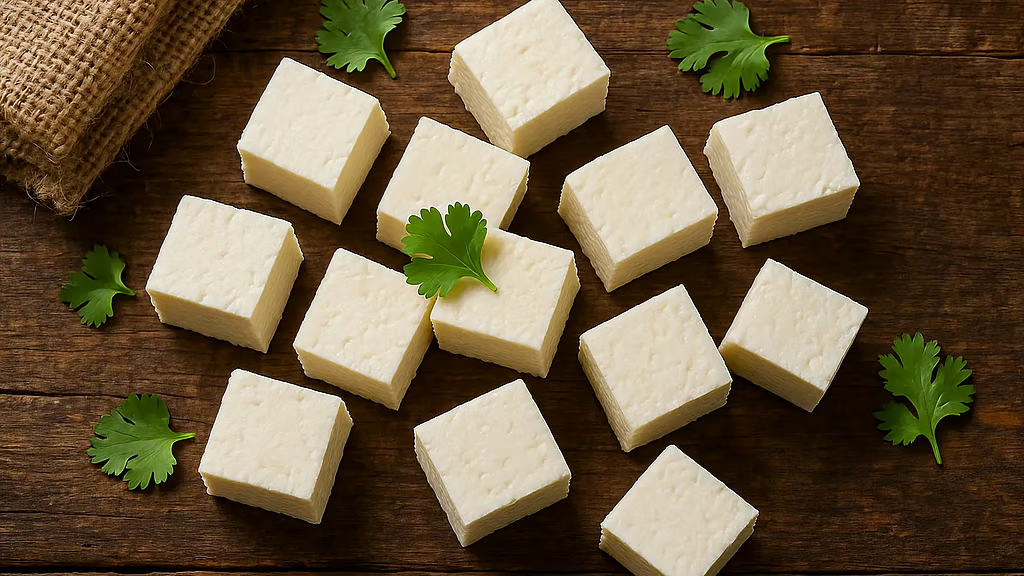
Mozzarella cheese with a major share of demand in HORECA segment nose dived in demand. The slight respite was increase in cheese in retail segment with increased consumption at home. The changed consumer behavior towards healthy and immunity boosting products led to slight increase in consumption of cheese and paneer as a protein supplement. Even the demand of meat and meat products got converted to cheese and panir demand. This trend was not repeated during the second wave of Covid due to poor purchasing power in target segment at large.
So, if the base year is shifted to FY 21 then it would set a level playing field for all the applicant to start their journey well.
2. Limits on investment
The investment requirements for Mozzarella cheese has been defined very well as Rs 23 crores for 10 MTPD. However for other segments of dairy products like ice cream, beverages and dairy bases sweets these were not defined specifically and thus a requirement of Rs 100 Crores in the minimum commitment for investment in those categories is a challenge. A rider of Rs 100 crores and Rs 500 Crores in turnover for these categories of product will leave this scheme valid only for 4-5 large players in the country. These limits must be rationally evaluated and must be brought down to more realistic levels.
3.Asset Turnover ratio in dairy sector
In general the Asset turnover ratio is considered at around 1:5 or more under this scheme. Research shows that even the listed established companies with a similar product mix profile this ratio of asset turnover is swell below 1:5.Even by following the guidelines, for a Mozzarella plant of 10 TPD at 23 crores the turnover will not be more than Rs 90 crores even at 100% cap utilisation for 300 days . This makes the Asset to turnover ratio as 1:3.9 only. It is thus a challenge for someone having green field to achieve such targets right from the beginning.
4. Getting investments is difficult
Bringing in investments currently is a tough task. The financial institutions are not so open to release funds. However the incentive commitment on incremental sales under the scheme may provide some brownie points to the applicant but still arranging for equivalent collaterals at a crashed rates of real estate may always be challenge for the small players.
5. Let schemes and ministries do not act in silos
There are some very good ongoing schemes like Animal husbandry infrastructure fund which is supporting new investments in value added dairy segments through 3% interest subvention and 25% credit guaranty. It’s the right time to not to run different schemes in silos rather synergies need to be created by the policy makers by bringing all sector specific schemes under single window. All the ministries may collaborate at the backend for smooth implementation of the schemes.
6. Consider Byproducts also under the scheme
Butter and ghee are the main byproducts while making all the dairy products except ice creams or frozen desserts. Under those circumstances adding Ghee as a mandated product under the scheme may help the applicant to achieve the targets in more pragmatic manner. In the initial drafts of this scheme I was that desi ghee was one of the considered product under dairy category.
7. Be empathetic to applicant’s cashflow
A bank guaranty of 3% of total investments for small players means a cash block of 35. The banks are as stringent in issuing bank guaranty as in term loan or working capital. As the applicant has to actual fund his cash flows and the government is not paying anything upfront so some relaxation in this area is desirable.
8. Financial year considerations for techncial civil costs and plant and machineries must be aligned
From Apr-Nov 2019 almost 2.6% of total imports was that of dairy machineries which was also amongst the top 10 imports at that time . Similarly dairy machineries must have arrived in FY 21 also. But the technical civil cost for food processing sector is being considered from FY 22 while machineries are considered from FY 21 onwards. A slight adjustment here may make a few more companies eligible for the scheme.
9. Category III may also cover industry specific needed expenditures
Lastly for category III in our dairy and food sector, certain country specific voluntary quality certifications like BRC etc, selective sampling at modern trade and consumer tasting panels for products in diverse market is a big cost. It is as important as having fashion shows for the textiles sector. Inclusion of these costs under category III for branding may also be considered if not done so far.
Last but not the least that this scheme has some precedence in mobile phone segment. That segment has an all together different eco system and requirements. For dairy and food sector where in millions of farmers are involved, I would like the scheme to have more flexibility and quicker windows for reviews and adjustments.
A blog by Kuldeep Sharma, Chief editor Dairynews7x7.com