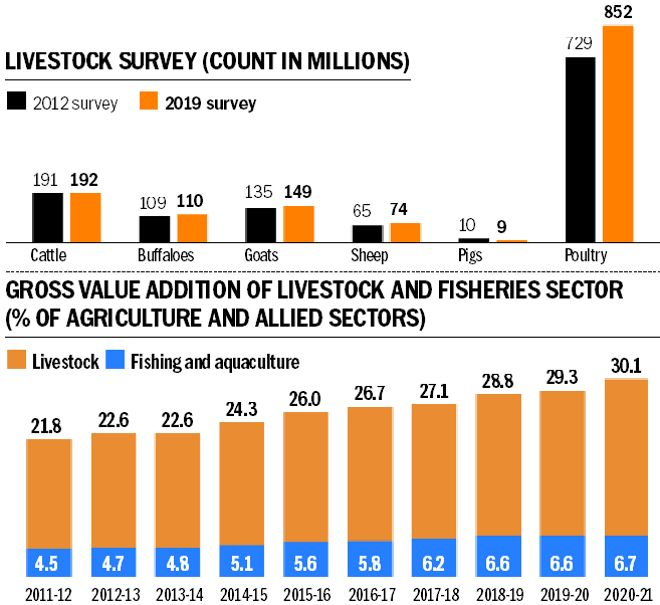
ANIMAL husbandry, the practice of breeding and nurturing domesticated animals, has been an essential part of agriculture since ancient times. It played a crucial role in the development of human societies by providing milk, meat, wool and leather. Now its role in the production and export of dairy-based products (cheese, butter, ice cream etc.), meat and meat products, eggs and leather is increasing. As a result, its share in agricultural gross value-added products increased from about 20% in earlier periods to 30.1% in 2020-21. Although the livestock sector is growing faster than the crop sector, the growth is much faster in the case of goat and sheep for meat, buffalo for milk, and poultry for meat and eggs. Now, with rising incomes, people are consuming more meat and milk even at higher prices.
Despite an increased share (30%) of livestock in the agricultural GDP, most of the big-ticket budget items in agriculture, such as food subsidy and fertiliser subsidy, cater to the crop sector. There is scope for improvement, especially in steps for wider adoption of high-yielding breeds, providing easy and timely credit and insurance, livestock veterinary services for small farmers, development of feed and fodder markets in dryland areas, and the creation of export infrastructure such as food safety testing labs recognised by importing countries.
Poverty alleviation
The livestock sector has a huge potential for poverty alleviation. The income is land-neutral — both marginal and large landholders have equal opportunity to grow livestock. As per the Situation Assessment of Agricultural Households and Land and Livestock Holdings of Households in Rural India, 2019, the income from livestock-rearing activities is higher than the crop income among the marginal farmers who possess less than one acre of land. Livestock-rearing is less risky, and it is antifragile as livestock can feed on leaves and stems of failed crops in case of drought. Livestock-rearing also requires less capital. Livestock provides a regular income, unlike the crop sector. Amid crop failure, livestock fetches income from the sale of milk, meat and eggs for the survival of the household.
Recycling economy
Livestock also contributes to the recycling agricultural economy, wherein the animals/birds feed on the crop residue and byproducts, and, in return, provide draught power and dung manure for crop production, besides milk, meat and eggs for human consumption, and hides, bones and hairs for industrial use. With the government’s emphasis on organic agriculture and natural farming and the need to reduce chemical fertiliser consumption to limit India’s dependence on imported fertilisers, livestock-rearing helps in the production of bio-fertilisers such as vermicompost, farm yard manure, Jeevamrutha, Beejamrutha and Panchagavya and reduces the use of costly chemical fertilisers by farmers.
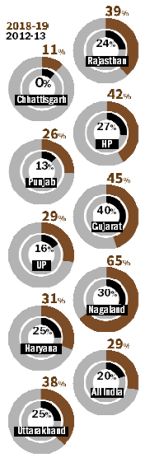
Income from animal husbandry as % of total farm income
The sector needs renewed emphasis on providing the best veterinary services. The milk yields are relatively low in India; the national average milk yield of cows in India in 2019-20 was 1,463 kg/lactation, as compared to the world average of 2,200 kg/lactation. As India is entering surplus production of milk and other animal products, it must increase productivity and competitiveness. There is a need for replacing low-yielding breeds with high-yielding ones, irrespective of whether they are local or cross-bred, if they give higher milk yields and increase farmers’ incomes.
Given that the dairy sector is dominated by small and marginal farmers, it is inevitable that all farmers need to relate to some aggregation model. India’s milk revolution started with a very successful cooperative model in the 1970s and 1980s and expanded rapidly until the late 1990s; now, almost one-third of all villages in India have cooperatives. However, from the early 2000s, a model led by the private sector has been competing directly with mega cooperatives. Such competition between cooperatives and private companies will enhance the efficiency of the whole dairy value chain, benefiting farmers with higher prices, modern technological backstopping and benefiting the consumers with better quality and variety of products at lower prices. The dairy market in India was valued at Rs 14.89 lakh crore in 2022. The IMARC Group expects the market to reach Rs 31.18 lakh crore by 2028.
As per a report of the National Institute of Agricultural Economics and Policy Research, New Delhi, India’s egg production increased from a mere 0.6 million tonnes in 1982-83 to 5.3 million tonnes by 2018-19, mostly driven by the private sector with contract farming. Approximately 75% of the broilers, as well as eggs, are produced through contracts.
Although the driving forces in the livestock sector are cooperatives and private companies, small farmers still need handholding and support from the government in various respects.
Despite an increased share (30%) of livestock in the agricultural GDP, the sector has not received much-needed priority in agricultural support from the government. For example, most of the big-ticket budget items in agriculture, such as food subsidy (Rs 2.94 lakh crore) and fertiliser subsidy (Rs 2.25 lakh crore), are targeted at the crop sector, with almost negligible share of livestock-rearing. Similarly, the entire subsidy on the crop insurance scheme, Rs 16,000 crore, is again exclusively for the crop sector. Similar huge budget allocation is done for the crop sector in the 2023-24 fiscal. The budgetary allocation for the Department of Animal Husbandry and Dairying is just Rs 4,328 crore this time, up from Rs 3,105 crore in 2022-23 revised estimates. This is negligible (not even 1% of the allocation for food and fertiliser subsidies).
There is scope for improvement, especially in steps for wider adoption of high-yielding breeds, providing easy and timely credit and insurance, livestock veterinary services for small farmers, development of feed and fodder markets in dryland areas, and the creation of export infrastructure such as food safety testing labs recognised by importing countries.
Stay Updated
Get the latest dairy industry news directly in your feed.





 The sector needs renewed emphasis on providing the best veterinary services. The milk yields are relatively low in India; the national average milk yield of cows in India in 2019-20 was 1,463 kg/lactation, as compared to the world average of 2,200 kg/lactation. As India is entering surplus production of milk and other animal products, it must increase productivity and competitiveness. There is a need for replacing low-yielding breeds with high-yielding ones, irrespective of whether they are local or cross-bred, if they give higher milk yields and increase farmers’ incomes.