CRISIL Validates Our Concerns: Is 6% Milk Production Growth in FY27 Realistic?
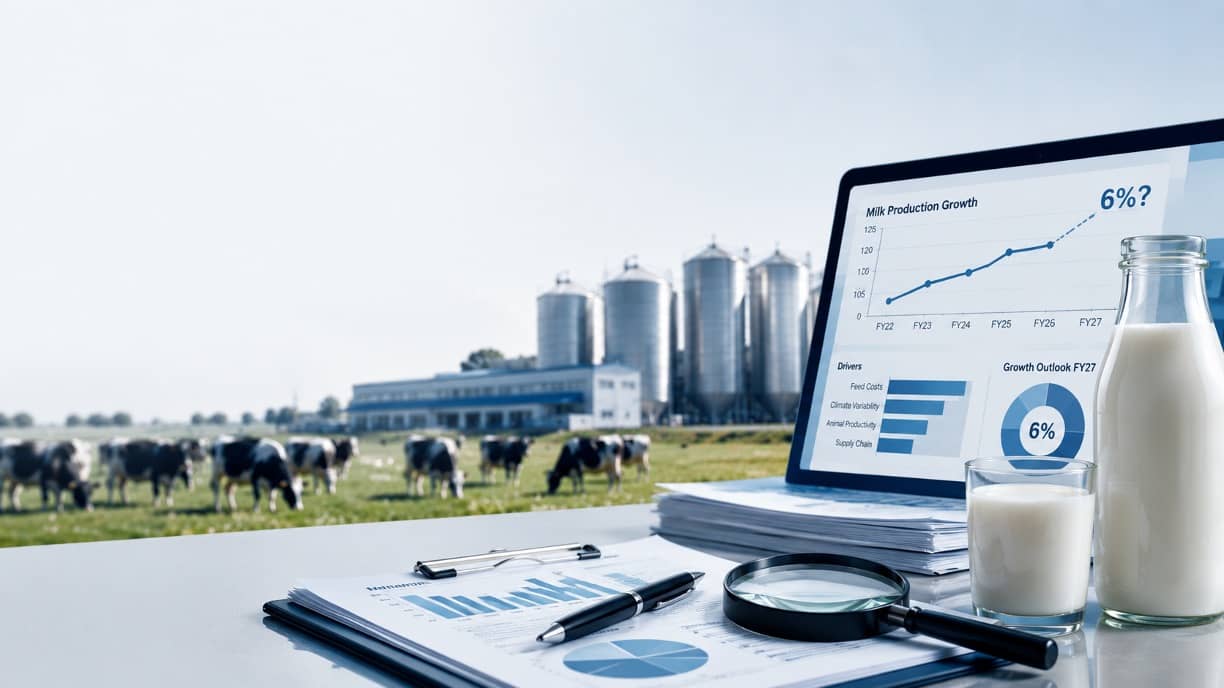
For several months, DairyNews7x7 has consistently questioned the optimism surrounding the official projection of 6% growth in India's milk production during FY27. Our concern was simple: can milk output accelerate at a time when the sector is grappling with rising feed costs, climatic stress, heat waves, and structural challenges affecting productivity?
A recent report by CRISIL Ratings now lends strong analytical support to these concerns.
In its latest assessment of the organised dairy sector, covering 37 dairy companies accounting for nearly 60% of the organised market's revenue, CRISIL expects raw milk production growth to slow to just 4% in FY27, significantly below the government's projection of 6% and lower than the approximately 5% compound annual growth rate recorded between FY20 and FY25.
This finding is particularly noteworthy because it echoes the concerns repeatedly highlighted in our earlier DairyNews7x7 analyses, where we argued that the industry's ground realities do not support an accelerated growth trajectory in milk production without substantial improvements in animal productivity, feed availability, climate resilience and farmer economics.
Also Read : India’s Dairy Industry Faces Its Biggest Economic Stress in Decades
According to CRISIL, the manifestation of El Niño conditions, resulting in a harsh summer and a below-average monsoon, is expected to adversely impact cattle yields during the current fiscal. The situation is further aggravated by rising fodder costs, increasing the cost of milk production at the farm level.
Commenting on the outlook, Shounak Chakravarty, Director, CRISIL Ratings, said that raw milk production growth is expected to moderate to 4% on-year in FY27. Consequently, milk procurement prices are likely to increase by 4-5%, with organised dairy companies passing on these higher costs to consumers in a phased manner. Overall retail prices across dairy product segments are expected to rise by 5-6% during the fiscal.
At the same time, CRISIL expects the organised dairy sector to witness strong revenue growth. Revenues are projected to accelerate by 200-400 basis points over the healthy growth of around 11% estimated in the previous fiscal thus making it to reach 13-14% growth this fiscal. This expansion will be supported by robust volume growth of 8-10% and staggered price increases across product categories.
The report attributes this volume growth to the non-discretionary nature of milk and traditional dairy products such as butter and ghee, coupled with increasing demand for value-added offerings.
The value-added dairy segment, in particular, continues to emerge as a major growth engine. CRISIL notes that products such as protein-rich and probiotic dairy offerings are witnessing growing consumer acceptance, driven by increasing health consciousness. Although these categories currently account for less than 5% of the market, they are expected to register growth exceeding 20% in the coming years. Simultaneously, rising consumer awareness regarding quality and safety is accelerating the shift from unbranded to branded dairy products, further strengthening organised players.
However, strong top-line growth is not translating into significantly higher profitability. CRISIL expects the industry's operating margins to remain range-bound at around 4%, similar to the previous fiscal, as companies use calibrated price increases primarily to offset rising milk procurement costs rather than expand margins.
On the financial front, healthy growth prospects and higher accruals are expected to sustain investment momentum. According to Rucha Narkar, Associate Director, CRISIL Ratings, capital expenditure by dairy companies is likely to remain in line with the average levels seen during the past four years. Importantly, despite debt-funded expansion, balance sheets are expected to remain healthy. Debt-to-EBITDA is projected to improve to around 2.3 times in FY27 from 2.5 times in FY26, while interest coverage is expected to remain strong at above 6 times compared with 5.6 times in the previous year.
CRISIL also cautions that the extent of weather-related disruptions to milk supply and the timely commissioning and ramp-up of new capacities will remain critical variables to monitor in the coming months.
The larger message from this analysis is significant. While India's organised dairy industry continues to demonstrate remarkable resilience and strong demand fundamentals, milk production growth itself may not be as robust as official estimates suggest. The challenge before policymakers is not merely to target higher production numbers but to address the underlying issues of animal productivity, fodder economics, climate resilience and sustainable farmer incomes.
As DairyNews7x7 has consistently maintained, achieving 6% annual growth in milk production cannot be taken for granted. The latest CRISIL assessment reinforces the need for a more realistic and evidence-based discussion on India's milk production outlook and the interventions required to sustain the country's dairy growth story in the years ahead.
Source : Editorial by Kuldeep Sharma Chief editor Dairynews7x7 on Crisil press release on Indian dairy sector