Latest Blogs
See More



Indian Dairy News
DairyNews7x7
Global Dairy News



DairyNews7x7
For the first time in many years, India’s cows — infamous for their low productivity — have left buffaloes behind, while also pushing India’s total milk production to record levels.
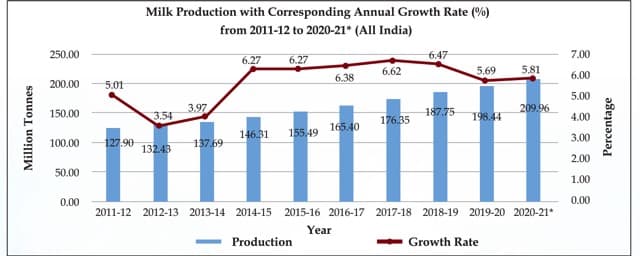
According to the latest statistics provided by the Department of Animal Husbandry and Dairying (DAHD), in the year 2020-21, India recorded an all-time high milk production of 209 million tonnes (provisional data), more than half of which came from cows.
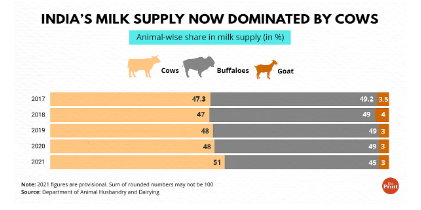
Buffaloes had been the leading producer until this point. For example, in 2016-17, they accounted for about 49.2 per cent India’s milk production, while cows yielded 47.3 per cent and goats 3.5 per cent of the total 165.4 million tonnes.
But data now shows that by 2020-21, cows accounted for 51 per cent, buffaloes 45 per cent, and goats 3 per cent of the total milk produced in the country — 209.96 million tonnes, which is 27 per cent higher than it was five years ago.
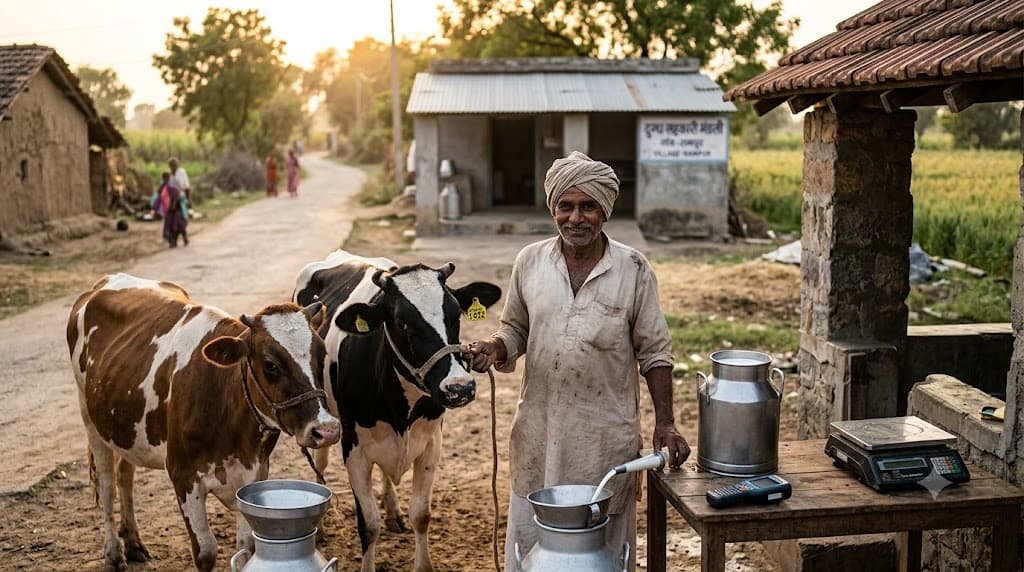
From a dairy farmer’s point of view, cows are now becoming a more lucrative option, thanks to crossbreeding.
There are, broadly speaking, four types of cows in India: indigenous, nondescript, crossbred and exotic.
Of the milk supplied by cows in 2020-21 (51 per cent of the total) indigenous and nondescript cows accounted for only 20 per cent, while the remaining 31 per cent was yielded by crossbred cows (28 per cent) and exotic cows (3 per cent). And it’s the latter two that are fuelling the rise in yield.
In 2016-17, these cows fulfilled 26.5 per cent of the country’s total milk demand. By 2020-21, this number had jumped to 31 per cent.
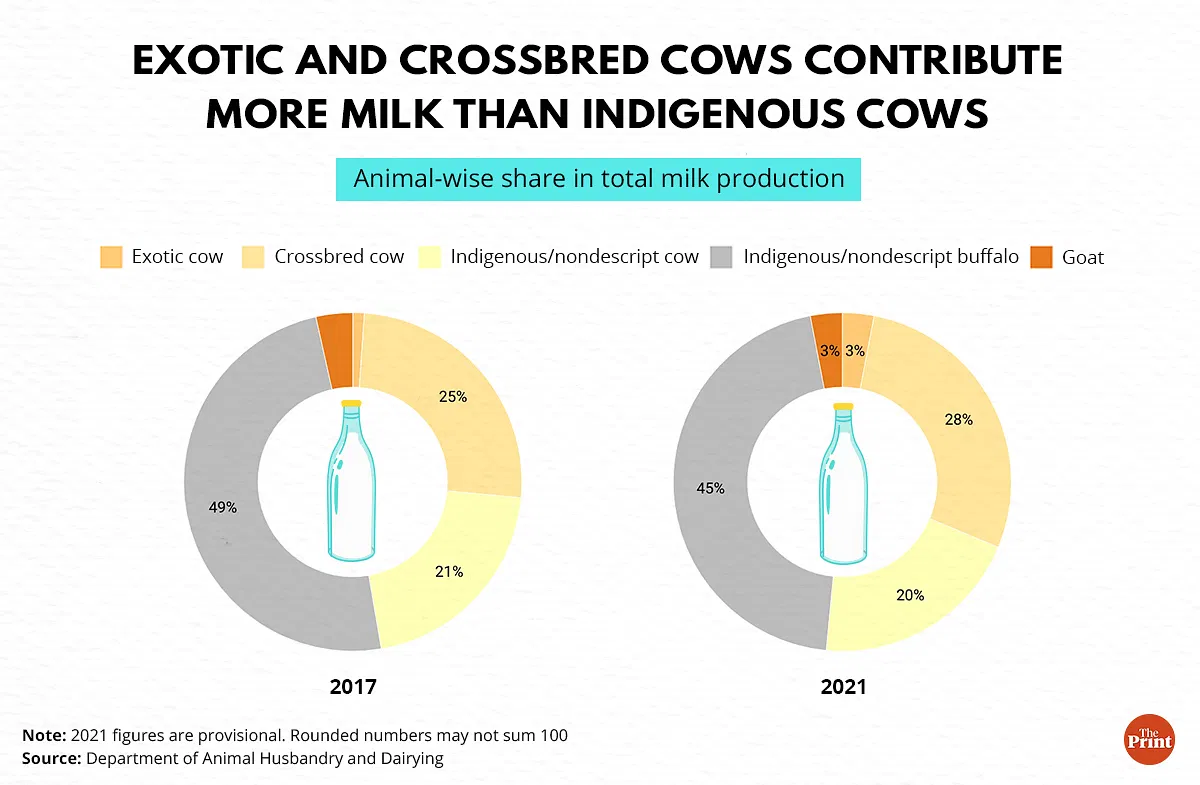
But the share of indigenous and nondescript cows has remained more or less the same (20 per cent throughout), which means that with respect to their population, exotic and crossbred cows account for a higher share of milk production.
According to data provided by the National Dairy Research Institute (NDRI), Karnal, exotic and crossbred cows make up about 20.5 per cent of India’s milch cattle population, despite which they provide 28 per cent of the milk.
Desi indigenous and nondescript cows, on the other hand, make up 38 per cent of the total milch population and fulfil only 20 per cent of the milk supply.
In 2014, the Government of India launched the Rashtriya Gokul Mission to help increase the productivity of indigenous cattle by giving farmers a subsidy of Rs 5,000 for in vitro fertilisation (IVF), along with sex-sorted semen that produces only female bovine animals, making investments in cattle less risky.
“Sex-sorted semen production technology in India has been developed for indigenous breeds of cattle such as Red Sindhi, Tharparkar, Sahiwal, Gir etc.,” said the DAHD’s annual report for 2020-21, hinting at how some high-quality indigenous breeds do give better yields.
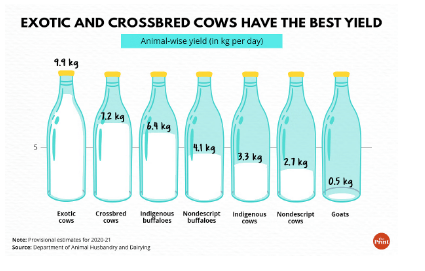
The reason the contribution of exotic cows is limited to single digits is that these international varieties of cows also need special treatments, and are more vulnerable to disease and the effects of climate change. But as the name suggests, these cows are the source of the highest milk yield, providing more than 9 kg a day, on average.
Hence, crossbred cows have the best of both worlds — they offer better yield than desi cows, and are easier to maintain in comparison to exotic cows.
“The increased share of the crossbred population and its milk production has been both because of better economics and the emphasis the government has put behind propagating this technology,” Professor B.S. Chandel, principal scientist at the Division of Dairy Economics, Statistics & Management, NDRI, told ThePrint.
“From the point of view of milk production, the returns per rupee invested in crossbred is the highest, especially during the first five lactations,” he added.
The growth in the population of bovine animals is further proof of these welcome changes in the dairy business. Between 2012 and 2019, when the 19th and 20th rounds of livestock census were held, the overall cattle population (cows, buffaloes, yaks and mithuns) has grown by only 1 per cent, with the population of exotic and crossbred cows growing by 26 per cent and that of indigenous and nondescript cows by 10 per cent.
According to the DAHD statistics, both indigenous and nondescript buffaloes yield about 4-6 kg of milk per day, which is higher than what indigenous and nondescript cows offer — about 2.4 to 3 kg per day.
This tectonic shift in the milk industry towards cow’s milk is mostly from the producer’s side, as consumers continue to crave buffalo’s milk more, ThePrint has learnt.
“We are observing a rising trend of farmers opting for crossbred cows, since their yield is better. Farmers value quantity. However, if you look at the total supply of milk solids, the overall supply from buffaloes is much higher than the cows,” said R.S. Sodhi, managing director of Amul, India’s biggest dairy supplier.
Sodhi underlined that from the consumer’s perspective, buffaloes are a preferred option.
“We do not observe a significant change in the demand for buffalo’s milk. Consumers still prefer buffalo’s milk over that of the cow due to its versatility. Buffalo’s milk is creamier and whiter,” he told ThePrint.
“There is hardly any preference of consumers towards drinking of crossbred milk. Mostly, milk produced from crossbred is sold for processing, to halwais, and other eateries. Consumption of liquid milk is mostly from the indigenous cow and buffalo. The quality of buffalo milk in terms of fat and SNF (solids not fat) is considerably better,” said Professor Chandel, concurring with the view that buffalo’s milk is more popular.
Professor Chandel also has a word of caution for policymakers — don’t get blinded by the productivity of crossbred cows, buffaloes are equally important.
“The planners should not be complacent with the increased share of milk production from crossbred cows, and should shift more emphasis to production of milk and milk products from buffaloes, keeping in view the strength of this species in Indian conditions and the quality of its milk in terms of how it is processed into products. The returns from buffalo milk for every one rupee invested is second-highest after crossbred (cows). This profitability continues even in late lactations,” he told ThePrint.