Logo
IndianGlobalBlogsPublicationsPodcastsMarketAboutContact
Logo
IndianGlobalBlogsPublicationsPodcasts
7News
Mandatory Daily Record of Production and Raw Material UtilisationHeritage Foods inaugurates new Ice Cream PlantFSSAI makes registration to all milk vendors in IndiaGujarat Ice Cream Makers Face Cone ShortageSummer Heat to Stress India’s Dairy Cold Chain

Indian Dairy News

FSSAI Licences Get Perpetual Validity
Mar 14, 2026

FSSAI Licences Get Perpetual Validity

India’s food regulator, the Food Safety and Standards Authority of India (FSSAI), has announced a major reform granting perpetual validity to food licences and registration certificates, eliminating t...Read More

Dairy Sector a ‘Safety Net’ for Farmers: NABARD
Mar 14, 2026

Dairy Sector a ‘Safety Net’ for Farmers: NABARD

The Chairman of National Bank for Agriculture and Rural Development, Shaji K V, has highlighted the crucial role of India’s dairy industry in protecting rural livelihoods, describing it as a “safety n...Read More

Bihar Dairy Officer Arrested in ₹30,000 Bribery Case
Mar 14, 2026

Bihar Dairy Officer Arrested in ₹30,000 Bribery Case

A field officer of the district dairy development department in Bihar was arrested by the Vigilance Investigation Bureau (VIB) for allegedly accepting a bribe of ₹30,000 in West Champaran district. Th...Read More

DairyNews7x7
Advertisement

Latest Blogs

See More
Mandatory Daily Record of Production and Raw Material Utilisation
Mar 14, 2026

Mandatory Daily Record of Production and Raw Material Utilisation

I recently reviewed the notification issued by the Food Safety and Standards Authority of India in the context of Schedule IV of the Food Safety and Standards (Licensing and Registration of Food Busin...Read More

FSSAI makes registration to all milk vendors in India
Mar 13, 2026

FSSAI makes registration to all milk vendors in India

The recent advisory issued by Food Safety and Standards Authority of India (FSSAI) mandating registration of milk vendors is a timely and progressive step towards strengthening traceability and accou...Read More

Rajahmundry Milk Incident: Accident or Adulteration?
Mar 10, 2026

Rajahmundry Milk Incident: Accident or Adulteration?

The recent editorial “Bitter Milk” published by The Hindu raises important concerns about food safety in India. The editorial deserves appreciation for attempting to broaden the conversation and under...Read More

Milk Prices Rise in South & West: Is North Next?
Mar 05, 2026

Milk Prices Rise in South & West: Is North Next?

The recent round of retail milk price increases across South India and Maharashtra is no longer an episodic adjustment but a clear signal of structural stress building up in India’s milk economy. Over...Read More

Global Dairy News

Global Dairy Commodity Prices Show Signs of Rally
Mar 14, 2026

Global Dairy Commodity Prices Show Signs of Rally

Global dairy commodity prices have shown a rally in the first quarter of 2026, particularly for products originating from Australia and New Zealand, according to a new Q1 Global Dairy Quarterly report...Read More

How Walmart Keeps Great Value Milk So Affordable
Mar 14, 2026

How Walmart Keeps Great Value Milk So Affordable

Retail giant Walmart has managed to keep the price of its private-label Great Value milk significantly lower than many competing brands through a vertically integrated dairy supply chain and direct co...Read More

Lactose-Free Milk Seen as Growth Driver in Coffee
Mar 13, 2026

Lactose-Free Milk Seen as Growth Driver in Coffee

Lactose-free milk is emerging as a major growth opportunity for the dairy industry, particularly in the rapidly expanding coffee and café segment. A recent US-based study highlighted that lactose-free...Read More

DairyNews7x7
Advertisement
Dairy News 7x7

Your trusted source for all the latest dairy industry news, market insights, and trending topics.

FOLLOW US
CATEGORIES
  • Global News
  • Indian News
  • Blogs
  • Publications
  • Podcasts
SUBSCRIBE TO OUR NEWSLETTER

Stay informed with the latest updates and trending news in the dairy industry.

No spam, unsubscribe at any time

GET IN TOUCH
C-49, C Block, Sector 65,
Noida, UP 201307
+91 7827405029dairynews7x7@gmail.com

© 2026 Dairy News 7x7. All Rights Reserved.

Terms of ServicePrivacy Policy
Prefer Us
Prefer Us

Consumers pay more but dairy farmers get lesser in Karnataka ?

By DairyNews7x7•Published on July 09, 2024

Consumers pay more but dairy farmers get lesser in Karnataka ?
Prefer on

Milk procurement prices vary across different milk unions in Karnataka, despite the Karnataka Milk Federation (KMF) selling it at a uniform price across the state.

Each of the 15 milk unions in the state has its unique considerations for determining milk procurement prices, taking into account factors like profit margins, expenditure, facilities, and projects.

This complex landscape has led to varying procurement prices, with some unions paying as high as ₹33.40 per litre and others paying as low as ₹29.10 per litre.

The Karnataka government has hiked the price of milk by ₹2 on every sachet by adding 50ml additional milk. Chief Minister Siddramaiah claimed that the government hiked the milk price as the procurement was high and would benefit farmers.

Now, the Kolar-Chikkaballapur Cooperative Milk Union’s decision to reduce the procurement price by ₹2 per litre has sparked protests among dairy farmers, who are already struggling with increasing production costs and delayed incentive payments.

As the dairy industry grapples with these challenges, the question remains: What determines the price of milk procurement, and who bears the brunt of these fluctuations?

Also Read: Karnataka farmers decry delay in milk incentives

Varying milk procurement price

According to the KMF, “There are 15 milk unions spread over 31 districts in Karnataka. As many as 26.89 lakh people, mostly farmers, who produce and supply milk, are KMF members.”
Click on the image to enlarge.

Click on the image to enlarge.

“On an average, the KMF procure around 82.92 lakh litres per day. The average milk sale stands at 46.27 lakh litres per day and curd sales is at 9.45 lakh litre per day, the Federation said.

An average ₹28.82 crore is paid to farmers every day. The KMF reported a total turnover of ₹21,330 crore in 2023-24, where it was mere ₹8.82 crore in the first fiscal year 1976-177,” it claimed.

Bengaluru, Mysuru, Chamarajanagar, Kolar, Dharwad, Belagavi, Raichur, Kalaburagi, Mandya, Tumakuru, Hassan, Haveri, Vijayapura, Dakshina Kannada and Shivamogga have milk unions.

Belagavi Milk Union procures milk at ₹29.10 per litre, Dharwad procure at ₹31 per litre, Hassan and Raichur at ₹31.50 per litre and Kolar at ₹33.40 per litre.

“Farmers supply milk to local milk cooperative societies, which transport them to the plants. The milk union makes payment to the cooperative society and then they pay it to the milk suppliers or farmers,” a manager of a union told South First requesting anonymity.

“The union pays around ₹1 to ₹2 per litre extra for the local milk cooperative societies for maintenance. The price varies from one milk union to another because the production, transportation and expenditure varies. It does not vary too much compared to other unions,” he said adding that the government has no plans to make prices uniform across the state.

How procurement price is fixed?

Multiple factors come into play in procuring milk. From profit margins to expenditure, facilities, and projects, each milk union has its own unique considerations that influence the price of milk procurement.

In this complex landscape, milk unions walk a tightrope to balance their finances, making adjustments to procurement prices to ensure sustainability and viability.

“We do not intervene in fixing the price for procuring milk. It is the milk unions that fix the price of procurement,” KMF Managing Director MK Jagadish told South First.

“The main reason for the differences in price is because the milk union decides the price based on its profit, expenditure, facilities and projects it has taken up,” Jagadish added.

“The intention is to balance the finances of the milk union. For instance, if the union rolls out any new projects such as construction of new plants or deposits, it will be concentrating on recovering the investment cost,” he said.

“Business, transportation cost and other expenses will also be considered. These are the major parameters that come into play while fixing the price of milk procurement in the milk unions,” Jagadish added.

“If the procurement is less than the cost for procuring one litre milk will be high, the procurement price will go down. It is dependent mostly on the demand and supply. The main intention to revise prices is to balance the finances of the union and there will be no other reasons,” milk union’s manager said.

Farmers protest 

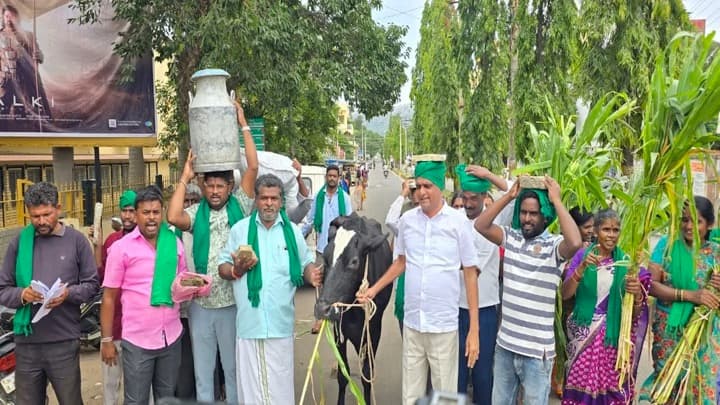
Condemning the Kolar-Chikkaballapur Cooperative Milk Union’s decision to reduce the procurement price, the farmers staged a protest in Kolar on Thursday, 4 July.

The milk union’s move to reduce by ₹2 per litre has shocked the milk suppliers, especially farmers in Kolar and Chikkaballapura.

“The milk union used to pay ₹33.40 per litre to farmers. The union has suddenly shocked everyone with reducing procurement price by ₹2 per litre. We vehemently oppose this.” farmers’ leader Narayangowda told South First.

“Before the elections, the government and union promised farmers of safeguarding their rights and increasing the procurement price of milk. After victory, they barely address the concerning issues of farmers or milk suppliers.”

“The cost of production of farmers is skyrocketing every year. It has been almost over five years, and the government has not increased the incentive as well. When will farmers get free from financial stress? Why won’t they consult stakeholders including farmers while fixing the price?” Narayanagowda asked.

He also accused the government of delaying the payments to farmers.

“I have 3 cows, where only two cows give milk. I supply around 14 to 15 litres of milk daily to the local cooperative society. I used to earn ₹18,500 to ₹20,000 every month,” dairy farmer Ambareeshappa N, a resident of Kithandur village in Kolar, told South First.

“Now the milk union has reduced procurement prices, which will affect the monthly income by a minimum of ₹1,500. The production cost has also skyrocketed as the price of all the cattle feed prices have been hiked.”

“I have to spend anywhere between ₹ 3,500 to ₹4,000 per month for the maintenance of each cow. The milk union decision will take a severe toll on farmers like us,” Ambareeshappa said.

“In my present financial condition, I am able to afford quality education only to my daughter and am compelled to put my son in a government school. Importantly, the government has not paid incentive for procuring milk for the last 13 months,” he said.

“The milk union has to increase the procurement price instead of reducing it. The costs of essential goods are going up as well. If the milk union gives such a shock, whom should we ask? Why will the government not come to the rescue of farmers like me?” Ambareeshappa asked.


Stay Updated

Get the latest dairy industry news directly in your feed.

Prefer Us on Google Search

Swipe to continue reading

Previous Article

Next Article