Logo
IndianGlobalBlogsPublicationsPodcastsMarketAboutContact
Logo
IndianGlobalBlogsPublicationsPodcasts
7News
Mandatory Daily Record of Production and Raw Material UtilisationHeritage Foods inaugurates new Ice Cream PlantFSSAI makes registration to all milk vendors in IndiaGujarat Ice Cream Makers Face Cone ShortageSummer Heat to Stress India’s Dairy Cold Chain

Indian Dairy News

FSSAI Licences Get Perpetual Validity
Mar 14, 2026

FSSAI Licences Get Perpetual Validity

India’s food regulator, the Food Safety and Standards Authority of India (FSSAI), has announced a major reform granting perpetual validity to food licences and registration certificates, eliminating t...Read More

Dairy Sector a ‘Safety Net’ for Farmers: NABARD
Mar 14, 2026

Dairy Sector a ‘Safety Net’ for Farmers: NABARD

The Chairman of National Bank for Agriculture and Rural Development, Shaji K V, has highlighted the crucial role of India’s dairy industry in protecting rural livelihoods, describing it as a “safety n...Read More

Bihar Dairy Officer Arrested in ₹30,000 Bribery Case
Mar 14, 2026

Bihar Dairy Officer Arrested in ₹30,000 Bribery Case

A field officer of the district dairy development department in Bihar was arrested by the Vigilance Investigation Bureau (VIB) for allegedly accepting a bribe of ₹30,000 in West Champaran district. Th...Read More

DairyNews7x7
Advertisement

Latest Blogs

See More
Mandatory Daily Record of Production and Raw Material Utilisation
Mar 14, 2026

Mandatory Daily Record of Production and Raw Material Utilisation

I recently reviewed the notification issued by the Food Safety and Standards Authority of India in the context of Schedule IV of the Food Safety and Standards (Licensing and Registration of Food Busin...Read More

FSSAI makes registration to all milk vendors in India
Mar 13, 2026

FSSAI makes registration to all milk vendors in India

The recent advisory issued by Food Safety and Standards Authority of India (FSSAI) mandating registration of milk vendors is a timely and progressive step towards strengthening traceability and accou...Read More

Rajahmundry Milk Incident: Accident or Adulteration?
Mar 10, 2026

Rajahmundry Milk Incident: Accident or Adulteration?

The recent editorial “Bitter Milk” published by The Hindu raises important concerns about food safety in India. The editorial deserves appreciation for attempting to broaden the conversation and under...Read More

Milk Prices Rise in South & West: Is North Next?
Mar 05, 2026

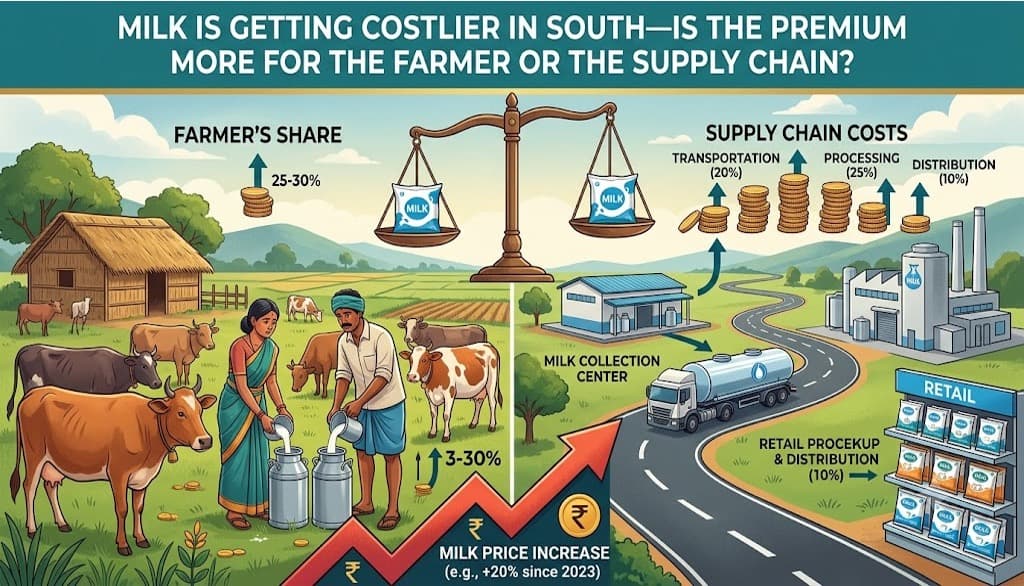
Milk Prices Rise in South & West: Is North Next?

The recent round of retail milk price increases across South India and Maharashtra is no longer an episodic adjustment but a clear signal of structural stress building up in India’s milk economy. Over...Read More

Global Dairy News

Global Dairy Commodity Prices Show Signs of Rally
Mar 14, 2026

Global Dairy Commodity Prices Show Signs of Rally

Global dairy commodity prices have shown a rally in the first quarter of 2026, particularly for products originating from Australia and New Zealand, according to a new Q1 Global Dairy Quarterly report...Read More

How Walmart Keeps Great Value Milk So Affordable
Mar 14, 2026

How Walmart Keeps Great Value Milk So Affordable

Retail giant Walmart has managed to keep the price of its private-label Great Value milk significantly lower than many competing brands through a vertically integrated dairy supply chain and direct co...Read More

Lactose-Free Milk Seen as Growth Driver in Coffee
Mar 13, 2026

Lactose-Free Milk Seen as Growth Driver in Coffee

Lactose-free milk is emerging as a major growth opportunity for the dairy industry, particularly in the rapidly expanding coffee and café segment. A recent US-based study highlighted that lactose-free...Read More

DairyNews7x7
Advertisement
Dairy News 7x7

Your trusted source for all the latest dairy industry news, market insights, and trending topics.

FOLLOW US
CATEGORIES
  • Global News
  • Indian News
  • Blogs
  • Publications
  • Podcasts
SUBSCRIBE TO OUR NEWSLETTER

Stay informed with the latest updates and trending news in the dairy industry.

No spam, unsubscribe at any time

GET IN TOUCH
C-49, C Block, Sector 65,
Noida, UP 201307
+91 7827405029dairynews7x7@gmail.com

© 2026 Dairy News 7x7. All Rights Reserved.

Terms of ServicePrivacy Policy
Prefer Us
Prefer Us

Australian Dairy farmers turning to housed systems

By DairyNews7x7•Published on October 09, 2024

Australian Dairy farmers turning to housed systems
Prefer on

The sight of dairy cows eating feed or lounging in a massive shed instead of green pastures might seem off-kilter, but it is becoming more common in Australia.

Dairy Australia reports that about 20 per cent of the country's cow's milk now comes from intensive or housed systems and expects it could reach 40 per cent within the next 20 years.

Instead of grazing paddocks, the cows stay in large sheds or feed pads and are fed a high-nutrition ration of grain and hay.

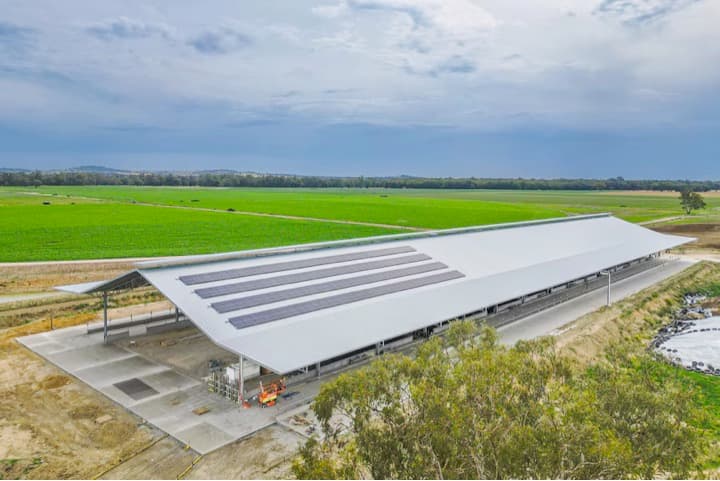
A picture of a large shed with green pastures in the background

A massive shed used for milk production at the Jolliffe dairy farm in southern NSW. (Supplied: Central Steel Build)

Dairy farmer Neil Jolliffe has invested $2.7 million in a large open shed to house his 300 milking cows at Euberta near Wagga Wagga in southern New South Wales.

"It's really hard to expand, with the cost of land, to run more cows," Mr Jolliffe said.

"With this shed, we designed it for 400 cows, I've got a 16,000-litre vat and basically my plan is to go as close to filling that as possible every day in the future."

The massive shed, two-thirds the size of a rugby league football ground, allows the cows to move freely around on a bedding of compost.

Cows in the shed at the Jolliffe dairy farm

The 150m x 38m shed houses hundreds of milking cows. (ABC News: Emily Doak)

"It's really about welfare for the cows," Mr Jolliffe said.

"They're not out exposed to the wet winters and extreme hot summers and it's a nice environment to be in.

"They can go for a feed, behind them is a water trough and then go in onto the pack, lie down, sit and ruminate."

Boosting production

Mr Jolliffe said the pastures that were once grazed by the milking herd will now be used to grow high-quality fodder or to grow out younger heifers.

"The biggest issue when we were grazing is you'd have a great feed that's absolutely perfect for the cows and then the season would turn or get hot, cold, or muddy," he said.

"They were wasting a lot of it, the quality would go off, and the cow's [condition] was constantly going up and down."

An image of a man leaning against a shed rail with cows in the background

Neil Jolliffe says production has increased significantly since housing the cows in the shed. (ABC News: Emily Doak)

Nine months after moving into the shed, Mr Jolliffe said production of milk solids, which is what the farmer is paid for, has increased by 25 per cent per cow.

Industry-wide trend

Dairy Australia's Alicia Richters heads up a program giving farmers resources to adapt production and said the move to housed systems has accelerated in the past decade.

"Particularly in inland systems, where water availability in response to climate is the key driver where farmers are trying to grow higher value crops with less water," she said.

"We're definitely seeing it across coastal areas where people are battling with heat stress as well."

Why Aussie dairy farmers are leaving the industry in droves

Photo shows A man in the middle of dairy cows being milkedA man in the middle of dairy cows being milked

Jamie Forster has received excellent farm gate prices for milk in recent years, but he is still giving up dairy farming — and he's not alone.

Ms Richters said despite the trend towards housed cows, she expected grazing pastures to continue being the main form of dairy production.

"While these systems are really good for some people, some farmers just may never want to move into this system," she said.

"In a lot of the dairy regions in Australia, growing grass can be really quite productive, and those systems may not easily convert to a higher value crop."

Senior scientific officer at RSPCA Australia Natalie Roadknight said that ideally cows should be given access to pasture and not kept solely indoors.

"Cows are motivated to spend at least some of their day at pasture when the weather is not extreme, so not having that could potentially impact negatively on their welfare," she said.

Dr Natalie Roadknight RSPCA

Natalie Roadknight says cows should be able to choose to go outdoors to graze pasture. (Supplied: RSPCA Australia)

Dr Roadknight said other management challenges in housed systems could lead to poorer outcomes.

"Higher rates of mastitis and lameness in indoor systems compared to pasture-based systems, and these are really painful conditions of dairy cows," she said.

"Higher stocking densities means that there's a higher risk of interactions between the cows that might be aggressive, and there might be more competition for food, water and comfortable lying areas."

Dr Roadknight said there were voluntary guidelines for intensive dairy production but she wanted legislation introduced to ban some practices used in housed systems overseas, such as tying cows up to stalls.

Stay Updated

Get the latest dairy industry news directly in your feed.

Prefer Us on Google Search

Swipe to continue reading

Previous Article

Next Article