Logo
IndianGlobalBlogsPublicationsPodcastsMarketAboutContact
Logo
IndianGlobalBlogsPublicationsPodcasts
7News
Summer Heat to Stress India’s Dairy Cold ChainSavencia Profit Drops on Rising Milk CostsTN Milk Output Claim Sparks Data DisputeHormuz Disruption Threatens Dairy Supply ChainUP Approves Dairy Expansion in Bundelkhand

Indian Dairy News

1.5 Lakh Kg Expired Amul Products Destroyed in Jaipur
Mar 11, 2026

1.5 Lakh Kg Expired Amul Products Destroyed in Jaipur

In a major food safety crackdown, authorities in Jaipur destroyed around 1.5 lakh kilograms of expired Amul-branded packaged food products after uncovering an alleged scheme to erase expiry dates and...Read More

Summer Heat to Stress India’s Dairy Cold Chain
Mar 11, 2026

Summer Heat to Stress India’s Dairy Cold Chain

India’s dairy industry could face a major operational test this summer as rising temperatures and growing demand for chilled dairy products put increasing pressure on the country’s cold-chain infrastr...Read More

TN Milk Output Claim Sparks Data Dispute
Mar 11, 2026

TN Milk Output Claim Sparks Data Dispute

A debate has emerged over Tamil Nadu’s milk production after the Tamil Nadu Milk Dealers’ Welfare Association (TNMDWA) challenged claims made by Chief Minister M.K. Stalin that the State produces 3 cr...Read More

DairyNews7x7
Advertisement

Latest Blogs

See More
Rajahmundry Milk Incident: Accident or Adulteration?
Mar 10, 2026

Rajahmundry Milk Incident: Accident or Adulteration?

The recent editorial “Bitter Milk” published by The Hindu raises important concerns about food safety in India. The editorial deserves appreciation for attempting to broaden the conversation and under...Read More

Milk Prices Rise in South & West: Is North Next?
Mar 05, 2026

Milk Prices Rise in South & West: Is North Next?

The recent round of retail milk price increases across South India and Maharashtra is no longer an episodic adjustment but a clear signal of structural stress building up in India’s milk economy. Over...Read More

India’s Dairy Climate Paradox: Production Triumph Meets Methane Time-Bomb
Mar 02, 2026

India’s Dairy Climate Paradox: Production Triumph Meets Methane Time-Bomb

India’s rise to the top of the global dairy league board has been one of the most remarkable agricultural success stories of the 21st century. With milk production surpassing 247 million tonnes per ye...Read More

India’s First Cow Culture Museum in Mathura
Feb 16, 2026

India’s First Cow Culture Museum in Mathura

India’s first national “Cow Culture Museum” is set to be established in Mathura, Uttar Pradesh, on the campus of Pandit Deendayal Upadhyaya Veterinary Science University, announced the Uttar Pradesh B...Read More

Global Dairy News

Savencia Profit Drops on Rising Milk Costs
Mar 11, 2026

Savencia Profit Drops on Rising Milk Costs

Savencia Profit Drops on Rising Milk Costs French dairy major Savencia Fromage & Dairy reported a sharp fall in profitability for 2025, with its net income dropping by €32.2 million to €74.7 million,...Read More

Hormuz Disruption Threatens Dairy Supply Chain
Mar 11, 2026

Hormuz Disruption Threatens Dairy Supply Chain

Escalating geopolitical tensions around the Strait of Hormuz are creating new risks for the global dairy sector by disrupting key inputs such as energy, fertilisers and shipping routes. The strait car...Read More

Data Replaces Handshakes in Dairy Lending
Mar 10, 2026

Data Replaces Handshakes in Dairy Lending

The dairy financing landscape is undergoing a major transformation as traditional relationship-based lending gives way to data-driven credit evaluation, according to industry insights. Historically, d...Read More

DairyNews7x7
Advertisement
Dairy News 7x7

Your trusted source for all the latest dairy industry news, market insights, and trending topics.

FOLLOW US
CATEGORIES
  • Global News
  • Indian News
  • Blogs
  • Publications
  • Podcasts
SUBSCRIBE TO OUR NEWSLETTER

Stay informed with the latest updates and trending news in the dairy industry.

No spam, unsubscribe at any time

GET IN TOUCH
C-49, C Block, Sector 65,
Noida, UP 201307
+91 7827405029dairynews7x7@gmail.com

© 2026 Dairy News 7x7. All Rights Reserved.

Terms of ServicePrivacy Policy
Prefer Us
Prefer Us

Antibiotic drugs on livestock cut carbon in soil and affect climate

By DairyNews7x7•Published on March 10, 2023

Antibiotic drugs on livestock cut carbon in soil and affect climate
Prefer on

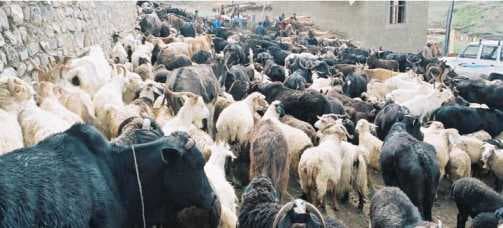
Researchers at the Centre for Ecological Sciences (CES), Indian Institute of Science (IISc), have found that grazing by livestock leads to lower carbon storage in soil compared to grazing by wild herbivores.

In a study conducted in the Spiti region of the Himalayas and which was published in Global Change Biology, CES researchers found that this difference appears to be due to the use of veterinary antibiotics such as tetracycline on livestock.

Released through dung

The researchers said that when released into the soil through dung and urine, these antibiotics alter the microbial communities in soil in ways that are detrimental for sequestering carbon.

“Today, livestock are the most abundant large mammals on earth. If the carbon stored in soil under livestock can be increased by even a small amount, then it can have a big impact on climate mitigation,” said Sumanta Bagchi, Associate Professor at CES and corresponding author of the study.

Previous study

In a previous study, the researchers had shown how grazing by herbivores plays a crucial role in stabilising the pool of soil carbon in the same region. In the current study, they set out to ask the question: Are livestock such as sheep and cattle similar or different in how they affect the soil carbon stocks compared to their wild relatives such as the yak and ibex?

To answer this, the researchers studied soils over 16 years in areas grazed by wild herbivores and by livestock respectively, and analysed them for various parameters including microbial composition, soil enzymes, carbon stocks, and the amount of veterinary antibiotics.

Carbon use efficiency

The study states that although soils from the wild and livestock areas had many similarities, they differed in one key parameter called carbon use efficiency (CUE), which determines the ability of microbes to store carbon in the soil. The soil in the livestock areas had 19% lower CUE.

Mr. Bagchi added that antibiotic usage in pastoral ecosystems like Spiti is fairly low and that the situation could be worse in areas where livestock are reared at large scales where they are often given antibiotics even when they are not sick.

Antibiotics such as tetracycline are long-lived and can linger in the soil for decades, the study adds.

Stay Updated

Get the latest dairy industry news directly in your feed.

Prefer Us on Google Search

Swipe to continue reading

Previous Article

Next Article