Logo
IndianGlobalBlogsPublicationsPodcastsMarketAboutContact
Logo
IndianGlobalBlogsPublicationsPodcasts
7News
Mandatory Daily Record of Production and Raw Material UtilisationHeritage Foods inaugurates new Ice Cream PlantFSSAI makes registration to all milk vendors in IndiaGujarat Ice Cream Makers Face Cone ShortageSummer Heat to Stress India’s Dairy Cold Chain

Indian Dairy News

FSSAI Licences Get Perpetual Validity
Mar 14, 2026

FSSAI Licences Get Perpetual Validity

India’s food regulator, the Food Safety and Standards Authority of India (FSSAI), has announced a major reform granting perpetual validity to food licences and registration certificates, eliminating t...Read More

Dairy Sector a ‘Safety Net’ for Farmers: NABARD
Mar 14, 2026

Dairy Sector a ‘Safety Net’ for Farmers: NABARD

The Chairman of National Bank for Agriculture and Rural Development, Shaji K V, has highlighted the crucial role of India’s dairy industry in protecting rural livelihoods, describing it as a “safety n...Read More

Bihar Dairy Officer Arrested in ₹30,000 Bribery Case
Mar 14, 2026

Bihar Dairy Officer Arrested in ₹30,000 Bribery Case

A field officer of the district dairy development department in Bihar was arrested by the Vigilance Investigation Bureau (VIB) for allegedly accepting a bribe of ₹30,000 in West Champaran district. Th...Read More

DairyNews7x7
Advertisement

Latest Blogs

See More
Mandatory Daily Record of Production and Raw Material Utilisation
Mar 14, 2026

Mandatory Daily Record of Production and Raw Material Utilisation

I recently reviewed the notification issued by the Food Safety and Standards Authority of India in the context of Schedule IV of the Food Safety and Standards (Licensing and Registration of Food Busin...Read More

FSSAI makes registration to all milk vendors in India
Mar 13, 2026

FSSAI makes registration to all milk vendors in India

The recent advisory issued by Food Safety and Standards Authority of India (FSSAI) mandating registration of milk vendors is a timely and progressive step towards strengthening traceability and accou...Read More

Rajahmundry Milk Incident: Accident or Adulteration?
Mar 10, 2026

Rajahmundry Milk Incident: Accident or Adulteration?

The recent editorial “Bitter Milk” published by The Hindu raises important concerns about food safety in India. The editorial deserves appreciation for attempting to broaden the conversation and under...Read More

Milk Prices Rise in South & West: Is North Next?
Mar 05, 2026

Milk Prices Rise in South & West: Is North Next?

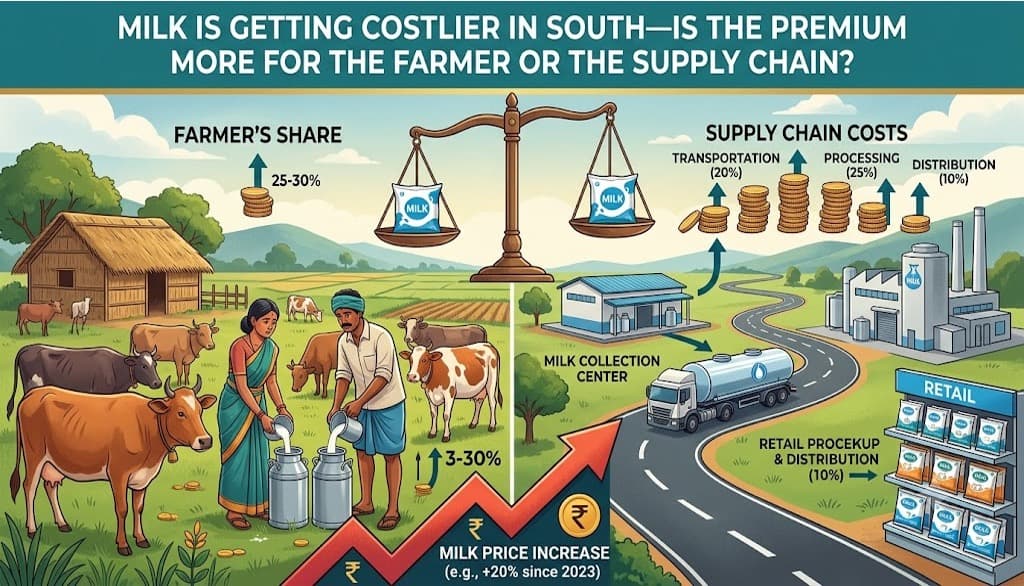
The recent round of retail milk price increases across South India and Maharashtra is no longer an episodic adjustment but a clear signal of structural stress building up in India’s milk economy. Over...Read More

Global Dairy News

Global Dairy Commodity Prices Show Signs of Rally
Mar 14, 2026

Global Dairy Commodity Prices Show Signs of Rally

Global dairy commodity prices have shown a rally in the first quarter of 2026, particularly for products originating from Australia and New Zealand, according to a new Q1 Global Dairy Quarterly report...Read More

How Walmart Keeps Great Value Milk So Affordable
Mar 14, 2026

How Walmart Keeps Great Value Milk So Affordable

Retail giant Walmart has managed to keep the price of its private-label Great Value milk significantly lower than many competing brands through a vertically integrated dairy supply chain and direct co...Read More

Lactose-Free Milk Seen as Growth Driver in Coffee
Mar 13, 2026

Lactose-Free Milk Seen as Growth Driver in Coffee

Lactose-free milk is emerging as a major growth opportunity for the dairy industry, particularly in the rapidly expanding coffee and café segment. A recent US-based study highlighted that lactose-free...Read More

DairyNews7x7
Advertisement
Dairy News 7x7

Your trusted source for all the latest dairy industry news, market insights, and trending topics.

FOLLOW US
CATEGORIES
  • Global News
  • Indian News
  • Blogs
  • Publications
  • Podcasts
SUBSCRIBE TO OUR NEWSLETTER

Stay informed with the latest updates and trending news in the dairy industry.

No spam, unsubscribe at any time

GET IN TOUCH
C-49, C Block, Sector 65,
Noida, UP 201307
+91 7827405029dairynews7x7@gmail.com

© 2026 Dairy News 7x7. All Rights Reserved.

Terms of ServicePrivacy Policy
Prefer Us
Prefer Us

How analyzing cow burps could help reduce dairy emissions

By DairyNews7x7•Published on September 11, 2024

How analyzing cow burps could help reduce dairy emissions
Prefer on

In a building on the edge of Cornell University’s campus in Ithaca, two large cows stand inside what looks like a giant metal box with windows and heavy, stainless steel doors.

While the cows go on with their lives — eating, sleeping, burping — the machine, called a respiration chamber, measures the exact amount of gas each one emits.

That’s key data for an industry that’s under pressure to reduce its methane emissions. Globally, cows and other livestock account for over one-third of human-caused methane emissions, which contribute to climate change. In New York, the agricultural industry is responsible for approximately 6% of the state’s total greenhouse gas emissions.

To curb those emissions, the beef and dairy industries have bet big on something called feed additives — the idea that feeding cows something new could make their burps contain less methane.

The four respiration chambers at Cornell are now poised to play a key role in that effort. The $2 million facility, unveiled earlier this year, is the only one of its kind in the U.S. While other technology can estimate daily emissions, the chambers record comprehensive data on exactly how much gas a cow burps for as long as they’re inside.

That data is essential for figuring out which feed additives work and how to improve them, said Joseph McFadden, associate professor of dairy cattle biology at Cornell.

“There's a real sense of urgency that we have to reduce methane emissions, and there's going to be a lot of pressure on livestock agriculture to step up and do so,” said McFadden, who led the university’s effort to acquire the new facility. “Now to actually have this equipment, it gives us a tool to be able to ensure that we have accurate measurements.”

Joseph McFadden, associate professor of dairy cattle biology at Cornell University, led the effort to open the animal respiration chambers at the university.
Rebecca Redelmeier / WSKG News
Joseph McFadden, associate professor of cattle biology at Cornell University, led the effort to open the animal respiration chambers at the university.
The promise of feed additives

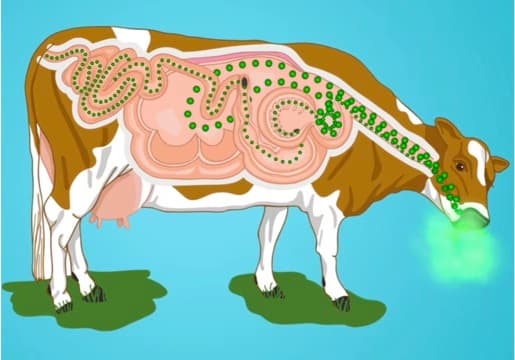
Cows make methane mostly because of an enzyme in their stomachs. When they burp, they release that methane into the atmosphere, where it traps heat and contributes to climate change.

Studies so far show that certain additives can suppress that enzyme, at least for a short while. Natural products, like seaweed and oregano, as well as engineered powders, have been found to reduce the amount of methane a cow burps out over a certain period. The FDA approved one powder additive for widespread use earlier this year.

No additive has yet been found to eliminate methane production completely. But tweaking what cows eat could make a significant dent to the dairy industry’s emissions, said Cornell animal science professor Michael Van Amburgh, who also plans to conduct research in the respiration chambers.

“I'm not under any illusion that we're going to figure out something that's just going to wipe them out,” said Van Amburgh, referring to the enzymes that create methane. “But what we could do is we could figure out how to put together better diets.”

To Eric Toensmeier, a fellow at the environmental think tank Project Drawdown, research into additives looks promising. But he’s wary of their potentially limited reach.

Additives will cost farmers time and money, which may restrict how many end up using them. And they are best used for cows raised in barns and fed feed, which is common in the U.S., but less so in some other parts of the world.

That's why Toensmeier doesn't want the beef and dairy industries to use additives as an excuse. The best way to reduce livestock emissions is still to cut down meat and dairy consumption, he said.

“It's great that some portions of the industry are actually accepting that methane is a real thing and trying to make a plan to do something about that,” said Toensmeier. “The concern is you don't want them sort of hiding behind it.”

The future of dairy farming

In New York and nationwide, there's growing interest and investment in research that unlocks solutions to lowering farming emissions. The Biden administration has allocated over $3 billion towards “climate smart” agriculture. Other countries, like Denmark, Australia and Canada, are funneling money towards similar initiatives too.

Each respiration chamber measures the exact amount of gas a cow emits while inside.
Rebecca Redelmeier / WSKG News
Each respiration chamber measures the exact amount of gas a cow emits while inside.
The research is intriguing to Keith Kimball, who raises cattle in Groveland, New York, and chairs the Northeast Dairy Producers Association. He has hope that additives will help farmers reduce their emissions, but he remains skeptical of their longterm benefit.

“This is something that farmers will for sure consider,” said Kimball. “But is it going to make us more efficient as an industry and improve our carbon footprint? I'm not positive that it is.”

For Kimball, raising cattle is full of careful calculations to make sure his cows are healthy and producing lots of milk. He is concerned that feed additives could mess up that equation and make his cows less productive.

“I am excited to see where it goes,” said Kimball.

For now, he’s standing by to see whether research will show if feed additives are worth it — if they can reduce emissions long term without harming cows. It is one of the major questions the animal respiration chambers at Cornell University could help answer.

Stay Updated

Get the latest dairy industry news directly in your feed.

Prefer Us on Google Search

Swipe to continue reading

Previous Article

Next Article