Logo
IndianGlobalBlogsPublicationsPodcastsMarketAboutContact
Logo
IndianGlobalBlogsPublicationsPodcasts
7News
GDT 396: Dairy Prices Rally Again After Nine DropsHatsun Agro Q3: Revenue, net profit surgeIndia Slaps 30% Duty on US Pulses; Trade Talks Feel StrainHigh-Oleic Soybeans Could Transform Dairy Feed & Milk QualityAmul Dairy Records ₹14,099 Cr Turnover, 9.2% Growth

Indian Dairy News

Hatsun Agro Q3: Revenue, net profit surge
Jan 19, 2026

Hatsun Agro Q3: Revenue, net profit surge

Dairy products maker Hatsun Agro Products Ltd. on Monday, January 19, reported a 48% year-on-year (YoY) growth in net profit to ₹60.6 crore for the quarter ended December 31, 2025. Net profit for the...Read More

Amul Dairy Records ₹14,099 Cr Turnover, 9.2% Growth
Jan 19, 2026

Amul Dairy Records ₹14,099 Cr Turnover, 9.2% Growth

The Kaira District Cooperative Milk Producers’ Union Ltd (Amul Dairy) reported a turnover of ₹14,099 crore in FY25, marking a 9.2 % year-on-year growth, according to figures announced at its 79th Annu...Read More

Hi-Tech dairy plant to be commissioned in Namakkal in February
Jan 19, 2026

Hi-Tech dairy plant to be commissioned in Namakkal in February

A hi-tech dairy plant, that is upcoming in Namakkal at a cost of ₹89.28 crore, will be commissioned next month (February) and the trial run of the plant has begun. The Namakkal Aavin that was bifur...Read More

DairyNews7x7
Advertisement

Latest Blogs

See More
5 Year Budget Plan to Make Indian Dairy Global Leader in 2047
Jan 15, 2026

5 Year Budget Plan to Make Indian Dairy Global Leader in 2047

I recently moderated a key session on India Dairy Vision 2047 at the TPCI's International Dairy Processing Conference 2026, gaining valuable insights from panellists. This led to me developing policy...Read More

From Forecast to Fact: 2025 Lessons, 2026 Dairy Outlook
Jan 01, 2026

From Forecast to Fact: 2025 Lessons, 2026 Dairy Outlook

As we step into 2026, it is worth pausing to reflect on how the Indian dairy sector navigated the challenges of 2025 and how closely reality tracked the forecasts I outlined in the first blog of last...Read More

India–NZ Dairy FTA: Safeguards or Silent Slippages?
Dec 26, 2025

India–NZ Dairy FTA: Safeguards or Silent Slippages?

The recently concluded India–New Zealand Free Trade Agreement (FTA) marks an important milestone in bilateral trade, while carefully ring-fencing India’s sensitive dairy sector. Under the agreement, c...Read More

Vision 2047: India’s Dairy Development Roadmap
Dec 21, 2025

Vision 2047: India’s Dairy Development Roadmap

As India moves steadily toward Vision 2047, the dairy sector stands at a strategic inflection point. From being a food security instrument in the decades following Independence, dairy has evolved into...Read More

Global Dairy News

GDT 396: Dairy Prices Rally Again After Nine Drops
Jan 20, 2026

GDT 396: Dairy Prices Rally Again After Nine Drops

The 396th Global Dairy Trade (GDT) auction — the second dairy trading event of 2026 — delivered a second consecutive rise in global dairy prices, with the GDT Price Index increasing by 1.5 % to 1,088...Read More

India Slaps 30% Duty on US Pulses; Trade Talks Feel Strain
Jan 19, 2026

India Slaps 30% Duty on US Pulses; Trade Talks Feel Strain

India has quietly imposed a 30 % tariff on pulses imported from the United States — including key crops like yellow peas and lentils — in what officials present as a protective trade measure for domes...Read More

High-Oleic Soybeans Could Transform Dairy Feed & Milk Quality
Jan 19, 2026

High-Oleic Soybeans Could Transform Dairy Feed & Milk Quality

New research shows that feeding high-oleic soybeans to dairy cows can both improve milk composition and cut feed costs, offering a promising feed strategy for producers amid rising input prices. This...Read More

DairyNews7x7
Advertisement
Dairy News 7x7

Your trusted source for all the latest dairy industry news, market insights, and trending topics.

FOLLOW US
CATEGORIES
  • Global News
  • Indian News
  • Blogs
  • Publications
  • Podcasts
SUBSCRIBE TO OUR NEWSLETTER

Stay informed with the latest updates and trending news in the dairy industry.

No spam, unsubscribe at any time

GET IN TOUCH
C-49, C Block, Sector 65,
Noida, UP 201307
+91 7827405029dairynews7x7@gmail.com

© 2026 Dairy News 7x7. All Rights Reserved.

Terms of ServicePrivacy Policy

Amul campaigns to bust “myths” about non-dairy beverages

By DairyNews7x7•Published on March 25, 2021

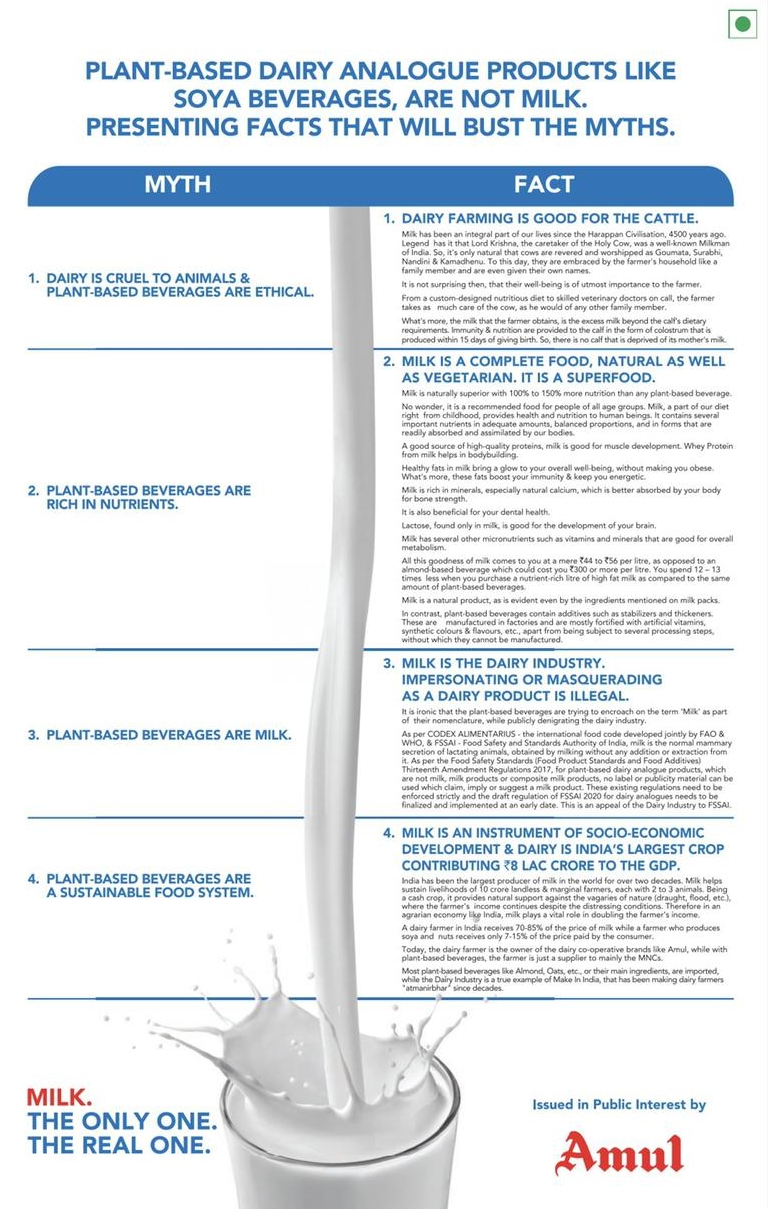
In a newspaper advertisement this week, dairy cooperative Amul sought to bust “myths” about non-dairy beverages that are alternative to milk.

The advertisement states that the term “milk” is being encroached by plant-based beverages made from soya, almonds, oats and others, which Amul believes is misleading for consumers.

Amul’s aggressive campaign

Amul has been very aggressive in defending its “milk” territory. Beginning with vanaspati, which was being marketed as “vegetable ghee”. The dairy industry’s claim is that ghee can only be milk fat, not vegetable fat.

Then came ice-cream – that contains about 10 per cent fat and 11 per cent SNF (solids-not-fat). The dairy industry (led by Amul) has led a campaign that only ice-cream containing 10 per cent milk fat can be called “ice-cream”. If the milk fat is replaced by vegetable oil, the resultant product can only be called “frozen dessert” even if it contains 11 per cent SNF from milk (because the “cream” in ice-cream can only be derived from milk).

More recently, Amul launched “peanut spread”. According to it, there is nothing called “peanut butter” because “butter” is nothing but clarified ghee and can only be derived from milk. So, “ghee” is 99.5 per cent milk fat and “butter” is 82 per cent milk fat.

FSSAI regulations

Under new regulations set by the Food Safety and Standards Authority of India (FSSAI) in 2017, a company cannot claim or suggest in advertisements and packaging that a non-milk product is made out of milk.

By drawing attention to this and other proposed regulations on dairy analogues, Amul is making “an appeal of the dairy industry to FSSAI” to enforce existing rules and implement others on the subject.

Milk is the normal mammary secretion derived from milking of healthy milch animals, whereas dairy analogues are plant-based milk substitutes made from almonds, soy, coconut and others.
The nutritional value of plant-based substitutes is lower than that of milk derived from a cow or a buffalo. However, they are used for the same purposes as milk, often by people having dietary restrictions, allergies or intolerances arising out of dairy products. They are also opted by people for ethical or environmental concerns.

A television advertisement on ice-creams made by Amul, which has been emphasising that “milk is the dairy industry” and “impersonating or masquerading as a dairy product is illegal,” was in 2018 found disparaging to frozen dessert products by the Bombay High Court.

The ad showed milk pouring into an Amul cup that said “Real milk. Real Ice Cream” and vanaspati or vegetable oil flowing into a cup that said “frozen dessert contains edible vegetable oil.

Hindustan Unilever, Vadilal and other manufacturers of frozen desserts had taken Amul’s parent company the Gujarat Cooperative Milk Marketing Federation ltd (GCMMF) to court over the ad.

However the latest advertisement is aimed at consolidating consumers from the middle and higher income sections, who can afford dairy alternatives and may switch to it.

Almond and soy milk alternatives are the two more popular choices available in the market at present, however their price is much higher as compared to cow or buffalo milk.

A litre of soy milk costs around Rs 100, whereas almond milk is about Rs 300 — significantly higher than cow or buffalo milk which is around Rs 50. For those allergic to soy and almonds, there are other milk alternatives made from rice, coconut and oats.

Environmental concerns like greenhouse gas emissions from the dairy sector, pollution of water by improper handling of manure and other waste from dairies, also sometimes make people switch to non-dairy alternatives.

Ethical reasons cited by people for switching to milk alternatives include cruelty to cows and buffaloes at farms.

Swipe to continue reading

Previous Article

Next Article