



How to bring about White Revolution 2.0
The new NSSO data reveals that milk is the food item Indians are spending the most on. To sustain high consumer demand and ensure a good income for farmers, focus needs to shift from hiking procurement prices to lowering production costs at the farm-gate.
- Based on the most recent Household Consumption Expenditure Survey (HCES) for 2022-23, milk has become the leading food expenditure item in both rural and urban areas of India.
- The monthly value of milk and dairy products consumed by an average person in rural India, at Rs 314, was ahead of vegetables (Rs 203), cereals (Rs 185) etc.
Challenges faced by the dairy sector:
- Indians spending more on milk – viewed as a “superior” food – is good news for the dairy industry, especially farmers.
- But this could face challenges from two sources.
- The first relates to consumer demand itself from inflation.
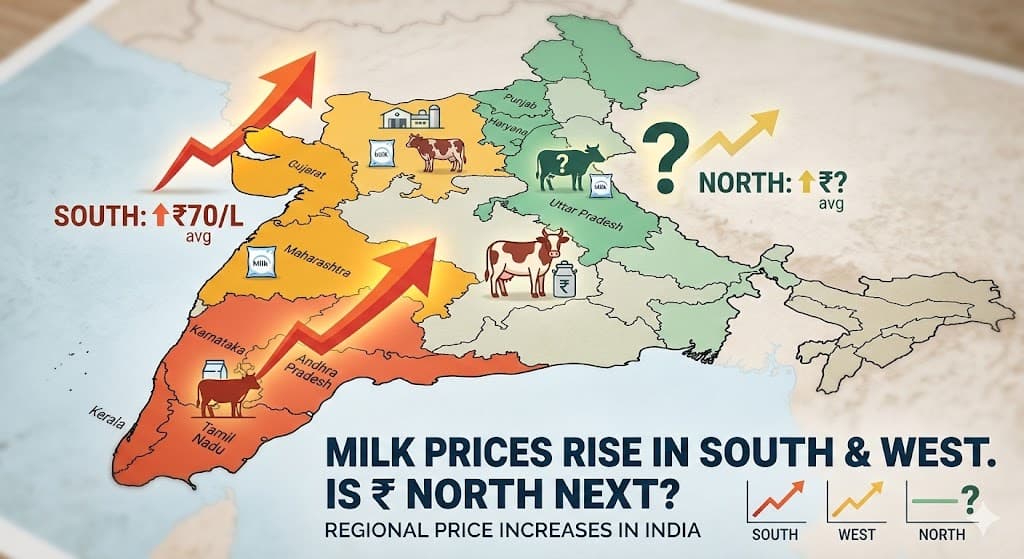
- The all-India average price of milk has gone up from Rs 42 to Rs 60 per litre in the last five years. Much of the increase – from Rs 52 to Rs 60 – has happened in the last one year alone.
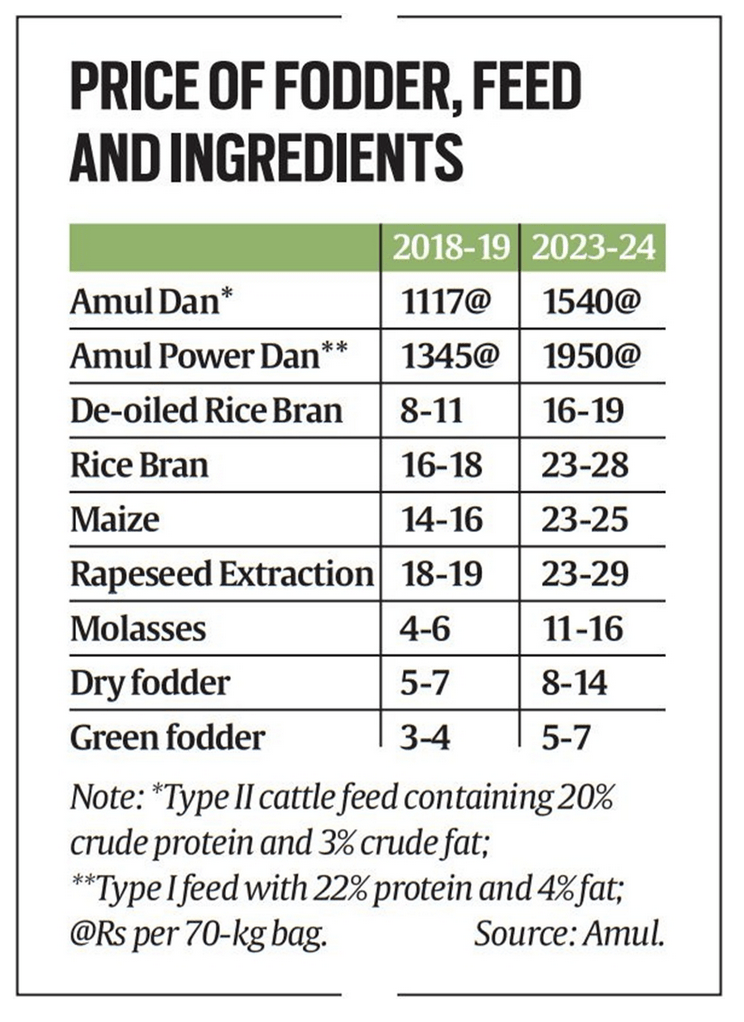
- The second has to do with the cost of fodder, feed and raw materials/ingredients.
- As these have increased significantly, dairies have had to hike procurement prices paid to farmers and, in turn, pass-through the same to consumers.
- The first relates to consumer demand itself from inflation.
- There’s a limit to how much more the consumer can pay for milk without it causing demand destruction.
- If farmer incomes are to be raised without shrinking domestic demand and eroding the global competitiveness of the Indian dairy industry, the only solution is to reduce the cost of milk production.
- One way to increase milk production is to boost milk yield per animal through genetic improvement and new breeding technologies.
- A typical crossbred cow giving birth first at 24-30 months can produce 5-7 calves over its lifetime.
- The normal breeding route, whether natural or via artificial insemination (AI), would result in only 50% of these being female calves or future milk-producing cows.
- But with the use of sex-sorted (SS) semen, there is a 90%-plus probability of only female calves being born, as against 50:50 with conventional semen.
- The Kaira District Co-operative Milk Producers’ Union, better known as Amul, performed 13.91 lakh AIs of its farmers’ cows in 2022-23 (April-March).
- Out of that, 2.86 lakh or 20.5% were based on SS semen.
- Roughly every third AI leads to conception. With 90% female calves, it means more cows than bulls down the line.
- A good cow, even with SS semen, can produce, at best, 5-6 as-good future cows.
- That’s where embryo transfer (ET) technology, to exploit the high genetic merit (HGM, i.e. milking potential) of an existing cow, comes in.
- ET entails injecting follicle-stimulating hormone in cows to make them release multiple ova (eggs) in a single estrous cycle.
- These ova – numbering 4-6 in Jersey, 6-8 in Holstein Friesian (HF) and 10-15 in Gir cows – are fertilised by sperms from the semen of a proven genetically-superior bull.
- The fertilised eggs (zygotes) are, then, collected from inside the donor cow and transferred for implanting in the uteruses of multiple recipient animals.
- Multiple ovulation and ET, thus, enables production of several calves from a single HGM cow.
- With 6 such procedures, each yielding 6 viable embryos, and 33-35% conception rate, it would result in some 12 calves being born from every donor cow per year.
- A more recent technology involves extracting oocytes or immature ova directly from the cow’s ovaries using an aspiration pump.
- Approximately 10-50 oocytes can be collected from each cow’s ovary during this process.
- The collected oocytes are incubated for 24 hours to develop into mature ova.
- Fertilization of the mature ova occurs in-vitro (outside the cow’s body) in a petri dish where sperm is introduced.
- The resulting zygotes remain in the in vitro culture medium for six days before being ready for transfer to recipient cows.
- With 20 procedures, yielding 5 viable embryos per procedure and achieving a conception rate of 33-35%, there can be 33-35 calves per donor cow per year.
- This is in stark contrast to the 5-7 calves typically produced during a donor cow’s entire lifetime through normal breeding.
- Amul, in March 2020, opened a Bovine Breeding Centre at Mogar in Gujarat’s Anand district.
- The goal was to establish a nucleus herd comprising HGM (High Genetic Merit) bulls and cows.
- This nucleus herd would produce superior semen and in-vitro fertilized embryos.
- These products would be cryogenically frozen at -196 degrees Celsius.
- The frozen semen and embryos would then be utilized for artificial insemination (AI) or transferred into animals of farmers.
- The Centre, set up with an investment of Rs 15 crore, has so far produced 170 male and 180 female animals through in vitro fertilisation (IVF) and ET technology.
- These include exotic (HF and Jersey giving 10,000-12,000 litres and 7,000-10,000 litres of milk respectively per year), HF-Gir and HF-Sahiwal crossbred (5,000-7,000 litres) and indigenous Gir, Sahiwal and Murrah buffalo (3,000-4,000 litres) breeds.
- The Kaira union has already taken IVF-ET technology to its farmers’ doorstep, with 63 pregnancies and 13 calvings recorded up till now.
- Other member unions of the Gujarat Co-operative Milk Marketing Federation have also followed suit.
Animal nutrition:
- Apart from genetics, intervention is needed to reduce feeding costs for animals.
- Farmers should cultivate high-yielding, protein-rich green fodder grasses to decrease reliance on expensive compound cattle feed and oil-meal concentrates.
- Amul is establishing a 30-tonnes-per-day Total Mixed Ration (TMR) plant in Sarsa, Anand.
- TMR will include dry and green fodder, concentrates, vitamins, and mineral mixtures in a ready-to-eat mashed form for animals.
- This initiative will save farmers the expense of purchasing and storing fodder separately and administering it in addition to cattle feed.
- The plan involves sourcing fodder from farmer producer organizations, whose members will exclusively grow maize, jowar, hybrid napier, or oat grass and produce silage for use in the TMR plant.
- The primary focus of White Revolution 2.0 should be on reducing the cost of producing milk at the farm-gate rather than continually increasing procurement prices.
The White Revolution 2.0 presents a transformative opportunity to revolutionize the dairy industry through modernization, innovation, and sustainability. Implementing the learnings from the Kaira union and adopting newer technologies, stakeholders can work together to bring about White Revolution 2.0 and drive sustainable growth and development in the dairy industry.
| The Household Consumption Expenditure Survey (HCES):HCES is conducted by the The National Sample Survey Office (NSSO), Ministry of Statistics and Programme Implementation (MOSPI).The Household Consumption Expenditure Survey (HCES) is designed to collect information on consumption of goods and services by the households. The survey also collects some auxiliary information on household characteristics and demographic particulars of the households. Information collected in HCES is useful for understanding the consumption and expenditure pattern, standard of living and well-being of the households. Besides, the data of HCES provides budget shares of different commodity groups that are used for preparation of the weighting diagram for compilation of official Consumer Price Indices (CPIs).The data collected in HCES is also utilized for deriving various other macroeconomic indicators. |