Latest Blogs
See More


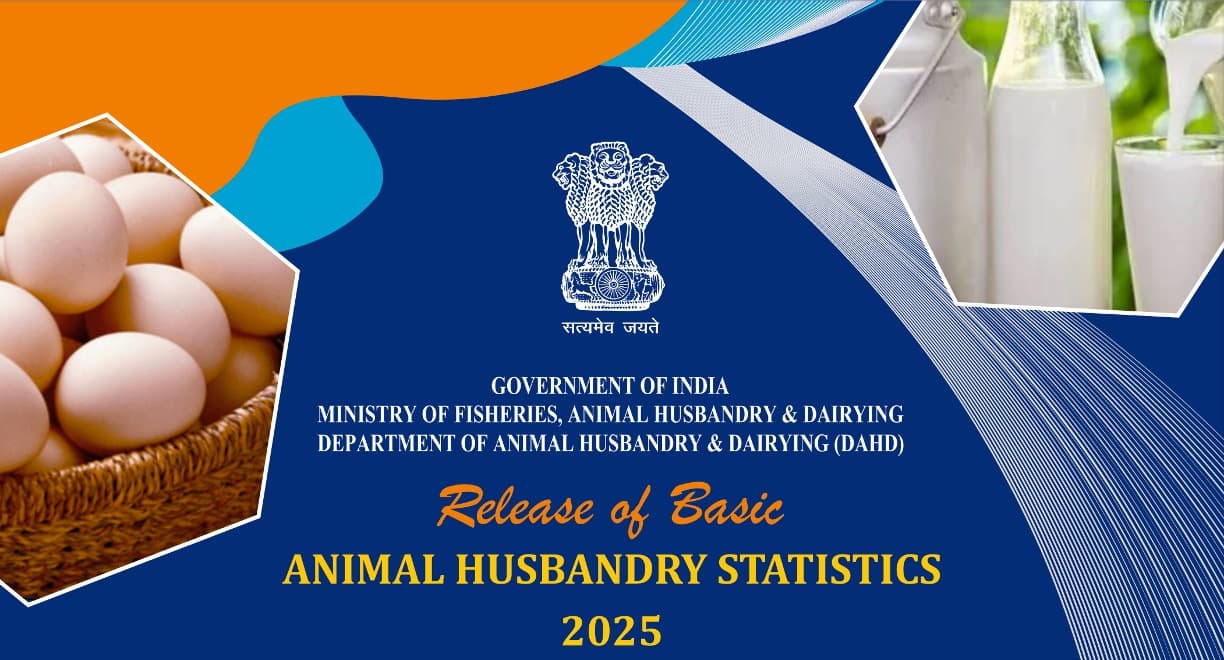
India’s dairy sector continued its dominant rise in 2024-25, with national milk production touching 247.87 million tonnes, a 3.58% increase over the previous year. With this, India retained its position as the world’s largest milk producer, contributing 25% of global output, according to the Basic Animal Husbandry Statistics 2025 report.
Animal_Husbandry_Statistics_2025
Per-capita milk availability rose from 471 grams/day in 2023-24 to 485 grams/day in 2024-25—reflecting the steady expansion of dairy herds, improving productivity, and rising demand across rural and urban India
India’s dairy engine continues to be driven by buffalo milk, which contributes the largest share to the national milk pool. Species-wise contribution for 2024-25 shows:
Indigenous buffaloes: 31.18%
Non-descript buffaloes: 11.97%
Crossbred cattle: 30.80%
Indigenous cattle: 11.20%
Non-descript cattle: 9.64%
Goat: 3.32%
Together, buffaloes account for over 43% of India’s national milk supply, underscoring their centrality to farm incomes and dairy processing. Crossbred cattle make up the second-largest segment due to higher yields and intensive dairy farming in states such as Punjab, Haryana, and Karnataka.
Milk production remains concentrated in a few large dairy states. For 2024-25, the top five contributors are:
Uttar Pradesh: 15.66%
Rajasthan: 14.82%
Madhya Pradesh: 9.12%
Gujarat: 7.78%
Maharashtra: 6.71%
Together, these states generate 54.09% of India’s total milk output.
This regional dominance is supported by strong cooperative networks (notably in Gujarat and Maharashtra), large buffalo populations in the northern belt, and rapid expansion of crossbred cattle in central India.
The livestock sector—powered by dairy—has shown exceptional growth over the past decade. Between 2014-15 and 2023-24, the Gross Value Added (GVA) from livestock rose 195%, far outpacing crop agriculture. Livestock now contributes 31% to total agricultural GVA and 5.5% to national GVA.
Animal_Husbandry_Statistics_2025
Milk alone accounts for nearly two-thirds of the value of India’s livestock output, serving as an income stabiliser for nearly 8 crore rural families.
FAO data confirms India's leadership in milk, ranking No. 1 globally, well above the USA, Pakistan, China, and Brazil. India also stands:
No. 2 in global egg production
No. 4 in global meat production
But in milk, India remains the undisputed global leader with one-quarter of world supply.
The report highlights several structural drivers behind India’s dairy expansion:
Crossbreeding and genetic improvement in major producing states
Rise of organised dairies and cooperatives enabling assured procurement
Improved fodder management and veterinary services
High domestic demand for liquid milk, curd, ghee, paneer, and value-added dairy
Buffaloes remain central because of India’s cultural preference for high-fat milk, which supports lucrative ghee, paneer, khoa, and sweet manufacturing.
With milk production reaching 247.87 million tonnes and per-capita availability at 485 grams/day, India’s dairy sector remains not only the largest in the world but also one of the fastest-growing. Driven by the strength of its buffalo and crossbred cattle populations, supportive cooperatives, expanding market demand, and improving productivity, India’s dairy landscape continues to be the backbone of rural livelihoods and a critical contributor to the national economy.
Source : Dairynews7x7 Nov 29th 2025 Basic animal Husbandry statistics 2025