Latest Blogs
See More


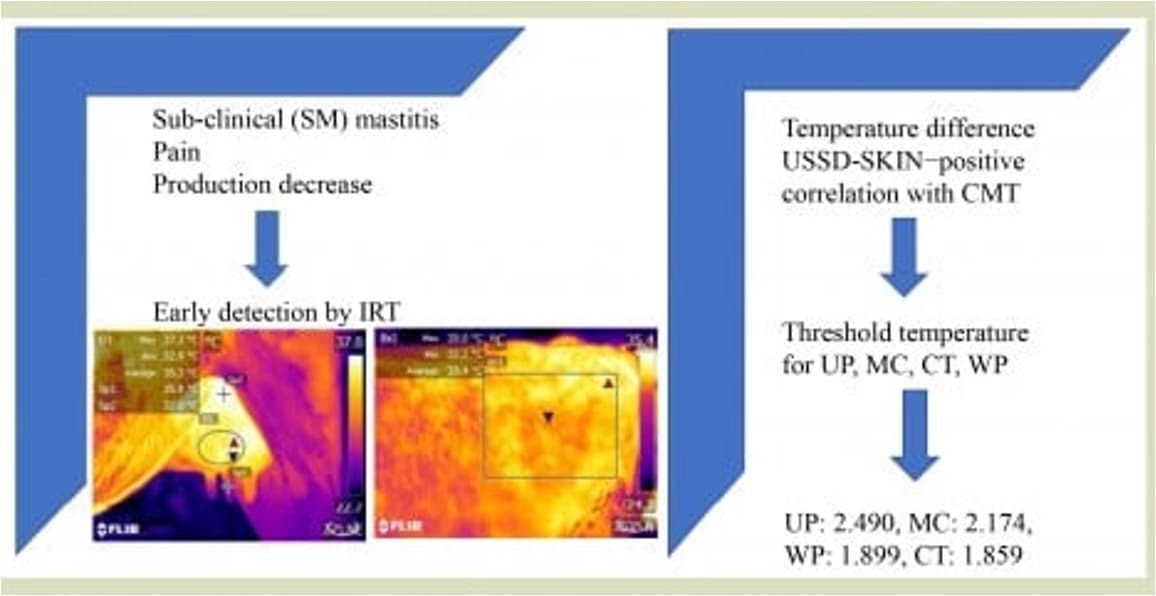
The article describes how infrared thermography (IRT)—a non-invasive imaging method—can accurately screen for subclinical mastitis (SM) in dairy cows by measuring the skin surface temperature of the udder relative to surrounding body parts. In one dataset cited, SM-positive quarters (udder quarters) showed a statistically significant higher udder skin surface temperature (USST) compared with healthy quarters. For example, in one region the difference (ΔT) was about 2.49 °C in lower ambient temps (22.6 °C) and about 1.86 °C in higher ambient temps (29.7 °C).
The article also underscores that the thresholds for ΔT vary depending on environmental temperature and temperature-humidity index (THI): as ambient temperature increases, the temperature difference between udder surface and flank skin decreases (approx. 0.08 °C per °C ambient increase, and 0.05 °C per unit THI increase) because cows’ thermoregulation raises the baseline of flank/udder similarly.
In short: the method can flag potential SM by detecting higher surface temperatures, but success depends on controlling for ambient conditions and using region-specific thresholds.
Advantage: IRT provides a rapid, contact-free, on-farm screening tool. Unlike somatic-cell-count (SCC) lab tests which require sampling and waiting, thermal imaging gives almost immediate visual feedback.
Limitations: The diagnostic threshold (ΔT) is not universal — it must be calibrated for the local climate, breed, housing/ventilation conditions. Also, IRT alone cannot confirm infection—it gives a strong suspicion requiring follow-up with SCC or bacteriological tests. The review paper by Korelidou et al shows there are still gaps in standardization of camera settings, anatomical region selection, and interpretation protocols.
Practical integration: For a dairy laboratory or farm analytics operation, pairing IRT with existing udder-health monitoring (like SCC, EC, CMT) makes sense. The workflow could be: image → raise alert if ΔT above threshold → collect milk sample for confirmatory test → segregate/quarantine if needed.
Cost-benefit: Early detection of subclinical mastitis can reduce yield losses, improve milk quality (lower SCC), reduce antibiotic use and improve animal welfare. Implementing IRT requires investment in camera, software and training but may yield ROI in large herds.
Key for the Indian context: Given varied ambient conditions across India (from cool hill farms to hot plain farms), thermography thresholds must be locally validated. Also breed differences (Indigenous, crossbreds) may influence baseline surface temperatures.