Latest Blogs
See More


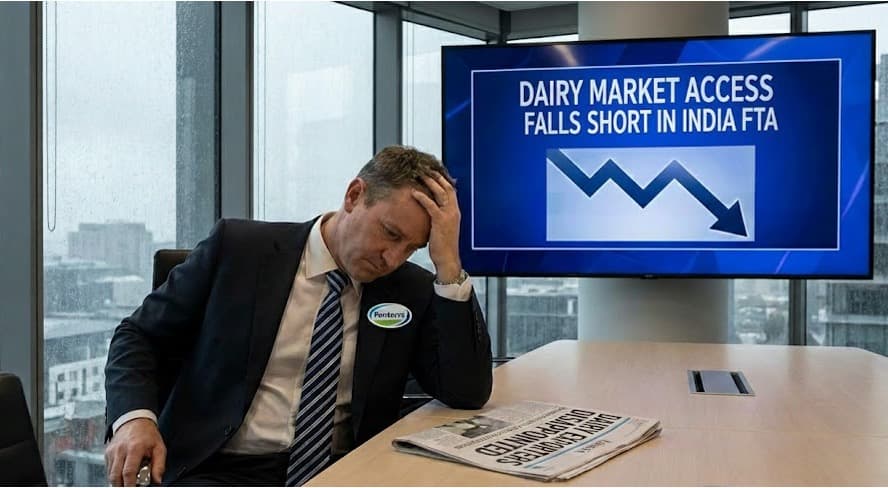
New Zealand’s largest dairy co-operative, Fonterra, has acknowledged the conclusion of the India–New Zealand Free Trade Agreement (FTA) but described the outcome as disappointing for dairy access, particularly for core dairy exports. In an official statement, Fonterra’s Global External Affairs Director Simon Tucker said that despite strong advocacy by New Zealand negotiators, the agreement was “unable to secure any significant new core dairy access opportunities” into the Indian market — a result that reflects India’s longstanding sensitivities over opening its dairy sector to foreign competition.
Under the FTA concluded in December 2025, India and New Zealand agreed to reduce or eliminate tariffs on most goods, with India gaining zero-duty export access for nearly all its products to New Zealand and New Zealand reducing tariffs on around 95 per cent of its exports. However, India explicitly excluded its dairy sector from tariff concessions, maintaining high import duties on key dairy products such as milk, cream, cheese, butter, yoghurt and whey to safeguard its domestic dairy industry and the livelihoods of millions of smallholder producers.
Fonterra’s disappointment has been echoed within New Zealand political circles. The New Zealand Foreign Minister, Winston Peters, labelled the agreement “neither free nor fair” for New Zealand, criticising the exclusion of major dairy categories and arguing that the deal gave too much away on other fronts without securing meaningful dairy market access. New Zealand’s dairy exports are substantial globally — accounting for roughly 30 per cent of the country’s merchandise exports — yet exports to India have historically been minimal (around US$1.07 million in FY2025), underscoring why access was a key negotiating priority for Wellington.
Despite these concerns, both sides emphasised that the agreement contains provisions allowing dairy ingredients to be imported into India for processing and re-export, and that future consultations on dairy market access could be revisited if India negotiates similar terms with other comparable economies. The Indian Commerce Ministry stressed that the dairy sector remains a “red line” in all trade negotiations due to its importance for rural incomes and food security, and reiterated that no duty concessions were granted for core dairy imports under the pact.
Industry analysts say that while the FTA does not deliver immediate dairy market access for New Zealand producers, the inclusion of processing and re-export provisions, together with the potential for future negotiation clauses, could create niche opportunities for value-added dairy and ingredient trade, particularly if evolving consumer demand and bilateral business partnerships support specialised export supply chains.
Source : DAirynews7x7 Dec 25th 2025 Fonterra and other source