Why Dairy’s Sustainability Debate Must Move beyond the Cow
As the world celebrates World Environment Day on June 5th, every sector is once again discussing climate change, carbon emissions, resource conservation and sustainable development. The dairy sector too finds itself at the centre of this conversation. Globally, discussions around dairy sustainability often focus on methane emissions from cattle, feed efficiency, manure management and the role of farmers in reducing environmental impact. These are important aspects and cannot be ignored. However, if India wants to build the world’s most sustainable dairy ecosystem, the sustainability conversation must expand beyond the farm gate.
The Forgotten Carbon Footprint After Milk Production
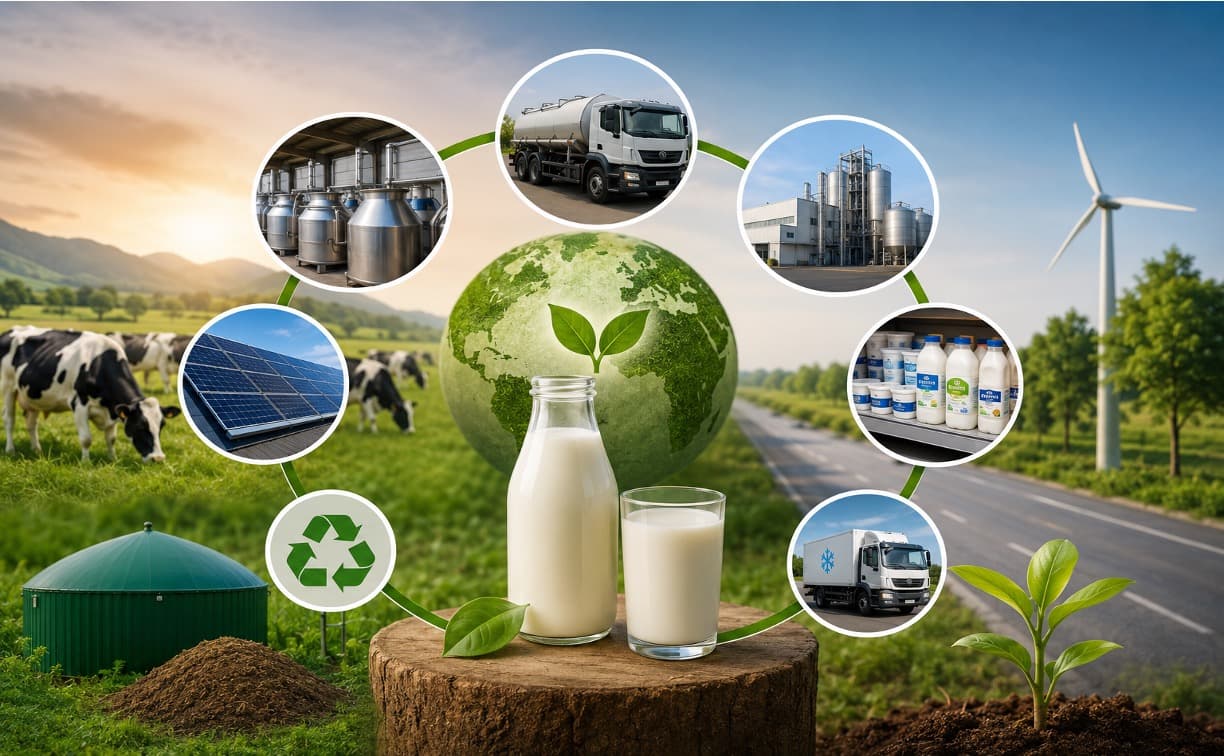
A litre of milk does not travel directly from a cow to the consumer. Between production and consumption, it passes through a complex network of milk collection centres, bulk milk coolers, chilling plants, transportation systems, processing facilities, packaging units, warehouses, cold chains, retail shelves and finally the consumer’s refrigerator. Each stage consumes energy and resources, and each stage contributes to the environmental footprint of dairy.
India has created one of the world’s largest dairy value chains, collecting and processing hundreds of million litres of milk every day. This achievement has transformed rural livelihoods and strengthened food security, but such a massive network also requires a large infrastructure footprint. The environmental impact after milk collection remains one of the least discussed areas of dairy sustainability.
The first sustainability challenge begins immediately after milk collection. Maintaining milk quality requires rapid cooling, and bulk milk coolers and chilling centres operate continuously to bring down the temperature of milk. In many rural areas, where power reliability remains a challenge, diesel-based backup systems have traditionally supported chilling infrastructure. While this ensures food safety, it also adds to emissions. The opportunity now is to redesign rural milk collection around renewable energy, energy-efficient refrigeration systems and solar-powered chilling solutions.
Dairy Processing Plants: The Energy-Intensive Heart
The dairy processing plant is another major area where sustainability interventions can create a significant impact. Modern dairy plants are engineering marvels, converting liquid milk into products such as milk powder, cheese, butter, yogurt, ice cream and several value-added dairy products. However, these processes require substantial thermal and electrical energy. Pasteurisation, sterilisation, evaporation, spray drying, refrigeration, boiler operations and cold storage are among the most energy-intensive activities.
Studies on dairy processing emissions indicate that processing alone can contribute around 80–120 kg of CO₂ equivalent per tonne of milk processed, depending on plant efficiency, technology and energy source. For a large dairy processing around one million litres of milk per day, this can translate into approximately 80–120 tonnes of CO₂ equivalent emissions daily from processing operations alone. This highlights an important reality — the dairy plant is not just a place where milk is converted into products; it is also a place where significant carbon reduction opportunities exist.
India’s dairy sector is actively adopting 100% renewable energy to create sustainable, zero-emission green processing plants. Leading this green transition is Milky Mist Dairy, which has achieved an impressive 70% to 100% reliance on clean energy across its processing lines. The brand powers its state-of-the-art, fully automated manufacturing facilities through an integrated network of wind turbines and massive rooftop solar installations.
Similarly, the dairy cooperative giant Amul is systematically decentralising its energy footprint. The federation is introducing solar-powered bulk milk coolers across thousands of village collection points and utilizing waste-to-energy biogas systems to heat pasteurisation boilers.
Down south, the Milma Ernakulam Dairy in Kerala has set a benchmark by working to become the nation's first fully solar-powered public cooperative dairy plant. The plant utilises a massive 2 MW solar grid setup funded through the National Dairy Development Board (NDDB) to slash grid dependency. By combining biomass tri-generation, thermal ice storage, and effluent biogas capture, these pioneering dairies prove that shifting to 100% green processing is a commercially viable strategy that shields producers from volatile fuel costs while delivering eco-friendly products to carbon-conscious consumers.
The future dairy plant must move from merely monitoring electricity consumption to actively reducing carbon intensity. Heat recovery systems, high-efficiency compressors, variable frequency drives, renewable energy integration, biomass-based boilers and smart energy management systems can significantly reduce emissions. Several Indian dairies have already demonstrated that dairy processing can move towards greener operations through investments in solar, wind and energy-efficient technologies. These examples prove that a dairy plant does not have to remain only an energy consumer; it can become a renewable energy hub.
Cold Chain: The Invisible Emission Source
Cold chain is another silent contributor to the dairy sector’s environmental footprint. Dairy is among the most temperature-sensitive food categories, requiring continuous refrigeration from chilling centres to processing plants, refrigerated tankers, warehouses, retail refrigerators and household storage. While cold chain is essential for food safety and reducing food losses, it also requires continuous energy. Improving insulation, adopting energy-efficient refrigeration systems, optimising transport routes and using renewable energy-powered cold storage can significantly reduce emissions.
Another important sustainability challenge lies on the consumer side — packaging. The dairy industry has used packaging innovation to improve food safety, extend shelf life and reduce wastage. Plastic milk pouches, multilayer packs and aseptic cartons have played a critical role in ensuring that milk reaches consumers safely. However, packaging waste has become a visible environmental concern.
The Missing Link: Compostable Packaging Needs a Complete Ecosystem
India has already taken important steps through Plastic Waste Management Rules and Extended Producer Responsibility (EPR) regulations, which place responsibility on producers for collection, recycling and management of plastic waste. However, gaps still exist, especially when it comes to creating a complete circular economy for dairy packaging.
Biodegradable and compostable packaging is often presented as the future solution, but the discussion needs more depth. A compostable package does not automatically disappear after disposal. It requires certified material, proper segregation, industrial composting facilities and controlled conditions for degradation. A compostable milk pouch thrown into mixed municipal waste may not deliver the expected environmental benefit. India needs stronger standards for compostable dairy packaging, clear consumer communication, composting infrastructure and effective implementation of EPR.
Green Logistics: Time to Move Beyond Diesel
The sustainability conversation must also include logistics. Milk tankers, refrigerated vehicles and distribution fleets consume significant amounts of fossil fuel. The dairy sector has a unique opportunity to shift towards cleaner mobility. Electric vehicles can play a major role in short-distance milk collection, urban distribution and last-mile delivery. At the same time, compressed biogas (CBG) can create a circular model where organic waste streams are converted into clean transport fuel.
The dairy ecosystem itself provides the raw material for such a transition. Animal waste and food waste can be converted into biogas, upgraded into CBG and used for transportation. This creates a powerful circular economy model where waste becomes energy and sustainability becomes a source of additional value.
Sustainability Must Become a Dairy Boardroom Agenda
Environmental responsibility can no longer remain only a CSR activity. Sustainability needs to become a boardroom agenda for every dairy organisation. Future dairy businesses must measure carbon footprint per litre of milk processed, energy consumption per tonne of product, water usage, packaging recovery, transport emissions and waste recycling rates.
Most importantly, we need to broaden the way we discuss dairy and climate change. The farmer and the cow are often placed at the centre of the sustainability debate because their emissions are visible. But sustainability is a value-chain responsibility. A farmer producing milk responsibly cannot compensate for inefficient refrigeration, carbon-intensive processing, fossil fuel-based transportation, poor packaging recovery systems or wasteful consumption patterns.
Let Us Stop Blaming Only the Cow and the Farmer
The real question is not only how sustainable milk production is. The larger question is how sustainable the journey of milk is from the collection centre to the consumer table.
This World Environment Day, the dairy sector must move beyond the traditional farm-to-table conversation and adopt a broader vision — from collection-centre-to-consumer sustainability.
Because the future of dairy will not only be measured by how much milk India produces, but by how responsibly every drop reaches the consumer.Source : Editorial by Kuldeep Sharma Chief editor Dairynews7x7 on World Environment Day June 5th