Latest Blogs
See More
As India moves steadily toward Vision 2047, the dairy sector stands at a strategic inflection point. From being a food security instrument in the decades following Independence, dairy has evolved into the single largest agricultural economic activity, engaging over 8 crore rural households and contributing nearly 5% to India’s Gross Value Added (GVA). With milk production crossing 230 million tonnes, India today produces more milk than the next three largest producers combined. Yet, Vision 2047 demands a deeper question—not how much milk India produces, but how sustainably, efficiently, and equitably it is produced and monetised.
Self-reliance in dairy, therefore, cannot be interpreted merely as production sufficiency. India has been self-sufficient in milk for over two decades. The real challenge lies in farmer viability, where rising costs of feed, fodder, labour, energy, animal healthcare, and compliance have sharply altered farm economics. Studies indicate that input costs have risen by 40–50% over the last decade, while milk procurement prices have not always kept pace on an inflation-adjusted basis. Vision 2047 must address this widening gap through productivity enhancement, genetics, fodder security, and efficient procurement systems.
Sustainability is emerging as the second pillar of the roadmap. Dairy contributes significantly to rural resilience, but it is also increasingly exposed to climate volatility, water stress, and methane-related scrutiny. India’s per-animal productivity remains low—averaging 5–6 litres per day, compared to 25–30 litres in developed dairy economies. Improving productivity per animal is not only an economic imperative but also a sustainability necessity, reducing emissions intensity per litre of milk produced.
Another defining element of Vision 2047 is value-led growth. Despite being the largest milk producer, India processes less than 30% of its milk into value-added products, with a heavy dependence on liquid milk and low-margin commodities. By contrast, countries like New Zealand and the EU derive a majority of dairy revenues from cheese, specialised ingredients, and nutrition products. Bridging this gap will require large-scale investments in processing infrastructure, R&D, and skill development—particularly in emerging categories such as protein-rich dairy, functional nutrition, and ethnic dairy with global appeal.
Equally critical is the role of institutions. India’s dairy success has been anchored in cooperatives, which remain vital for inclusion and price assurance. However, Vision 2047 also calls for stronger private sector participation, startups, and public-private partnerships to bring speed, innovation, and global market alignment. The future roadmap is not cooperative versus private, but cooperative plus private, working toward a common national objective.
Vision 2047 ultimately positions dairy as more than a commodity sector—it is a social, economic, and nutritional institution. Achieving this vision will depend on policy coherence, technology adoption, farmer-first economics, and a shift from volume-centric thinking to value-centric dairy development.
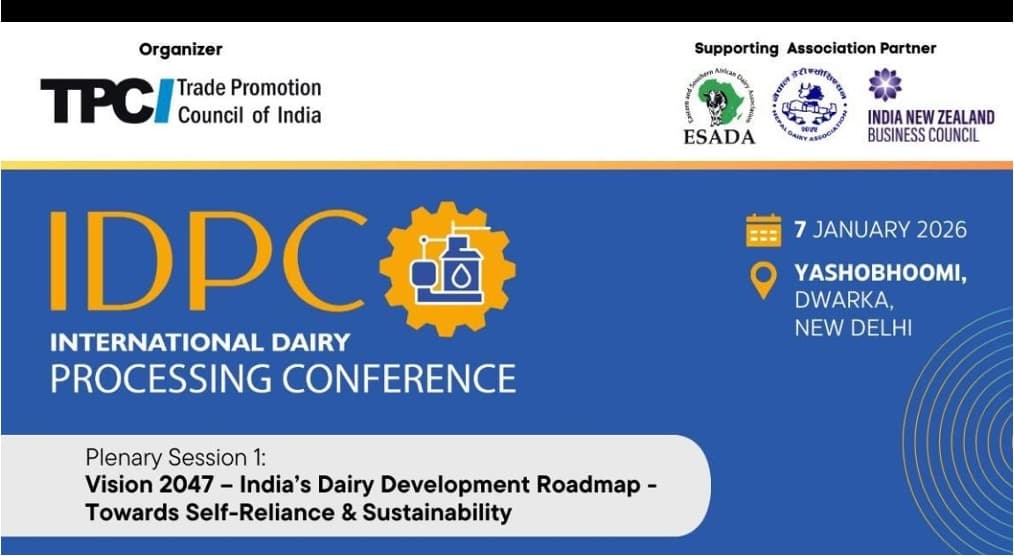
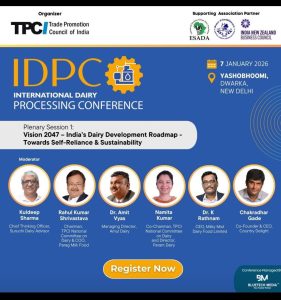
The International Dairy Processing Conference (IDPC), organised by the Trade Promotion Council of India (TPCI) with support from leading industry associations, will be held on 7 January 2026 at Yashobhoomi, Dwarka, New Delhi. The opening Plenary Session 1 will focus on “Vision 2047 – India’s Dairy Development Roadmap towards Self-Reliance and Sustainability”, bringing together senior leaders from cooperatives and the private sector. The session will be moderated by Kuldeep Sharma, Chief Thinking Officer, Suruchi Dairy Advisor, and will feature eminent panelists including Rahul Kumar Shrivastava (TPCI/Parag Milk Foods), Dr Amit Vyas (Amul), Namita Kumar (TPCI/Param Dairy), Dr K Rathnam (Milky Mist) and Chakradher Gade (Country Delight), offering a strategic dialogue on the future of India’s dairy processing ecosystem.
Source : Dairynews7x7 Dec 21st 2025. A micro blog by Kuldeep Sharma IDPC 2026 by TPCI