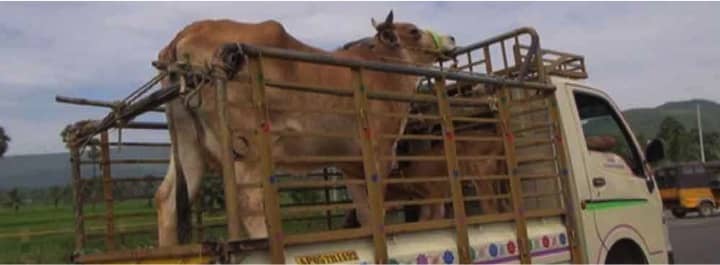
The Mumbai Police have ordered the prohibition of cattle transportation in the city to prevent the spread of the lumpy skin disease (LSD). The order came into force on September 14 and will stay in place till October 13. The disease has killed 127 cattle in Maharashtra, having spread to 25 districts. The contagious viral infection has spread in cattle in more than 10 States and Union Territories so far.
Lumpy skin disease is caused by the lumpy skin disease virus which affects the lymph nodes of the infected animal, causing the nodes to enlarge and appear like lumps on the skin. The cutaneous nodules, 2–5 cm in diameter, appear on the infected cattle’s head, neck, limbs, udder, genitalia, and perineum. The nodules may later turn into ulcers and eventually develop scabs over the skin.
The spread of the disease can lead to “severe” economic losses according to FAO and the World Organisation for Animal Health (WOAH). The disease leads to reduced milk production as the animal becomes weak and also loses appetite due to mouth ulceration. The income losses can also be due to poor growth, reduced draught power capacity and reproductive problems associated with abortions, infertility and lack of semen for artificial insemination. Movement and trade bans after infection also put an economic strain on the whole value chain.
Diksha Munjal
The story so far: The Mumbai Police have ordered the prohibition of cattle transportation in the city to prevent the spread of the lumpy skin disease (LSD). This means cattle cannot be moved out of the place they are being raised or transported to marketplaces. The order came into force on September 14 and will stay in place till October 13. The disease has killed 127 cattle in Maharashtra, having spread to 25 districts. The contagious viral infection has spread in cattle in more than 10 States and Union Territories so far. Prime Minister Narendra Modi informed last week that the Centre and States are working together to control the spread of the disease, which has emerged as a concern for the dairy sector.
What is the lumpy skin disease and how does it spread?
Lumpy skin disease is caused by the lumpy skin disease virus (LSDV), which belongs to the genus capripoxvirus, a part of the poxviridae family (smallpox and monkeypox viruses are also a part of the same family). The LSDV shares antigenic similarities with the sheeppox virus (SPPV) and the goatpox virus (GTPV) or is similar in the immune response to those viruses. It is not a zoonotic virus, meaning the disease cannot spread to humans. It is a contagious vector-borne disease spread by vectors like mosquitoes, some biting flies, and ticks and usually affects host animals like cows and water buffaloes. According to the United Nations Food and Agriculture Organisation (FAO), infected animals shed the virus through oral and nasal secretions which may contaminate common feeding and water troughs. Thus, the disease can either spread through direct contact with the vectors or through contaminated fodder and water. Studies have also shown that it can spread through animal semen during artificial insemination.
LSD affects the lymph nodes of the infected animal, causing the nodes to enlarge and appear like lumps on the skin, which is where it derives its name from. The cutaneous nodules, 2–5 cm in diameter, appear on the infected cattle’s head, neck, limbs, udder, genitalia, and perineum. The nodules may later turn into ulcers and eventually develop scabs over the skin. The other symptoms include high fever, sharp drop in milk yield, discharge from the eyes and nose, salivation, loss of appetite, depression, damaged hides, emaciation (thinness or weakness) of animals, infertility and abortions. The incubation period or the time between infection and symptoms is about 28 days according to the FAO, and 4 to 14 days according to some other estimates.
The morbidity of the disease varies between two to 45% and mortality or rate of date is less than 10%, however, the reported mortality of the current outbreak in India is up to 15%, particularly in cases being reported in the western part (Rajasthan) of the country.
What is the geographical distribution and how did it spread to India?
The disease was first observed in Zambia in 1929, subsequently spreading to most African countries extensively, followed by West Asia, Southeastern Europe, and Central Asia, and more recently spreading to South Asia and China in 2019. As per the FAO, the LSD disease is currently endemic in several countries across Africa, parts of the West Asia (Iraq, Saudi Arabia, Syrian Arab Republic), and Turkey.
The spread in South Asia first affected Bangladesh in July 2019 and then reached India in August that year, with initial cases being detected in Odisha and West Bengal. The FAO points out: “The long porous borders between India, Nepal and Bangladesh allow for a significant amount of bilateral and informal animal trade, including cattle and buffaloes.” This, the UN body says, may have contributed to the spread of LSD in July-August 2019 between Bangladesh and India. While the 2019 outbreak later subsided, the recent spread in India began in June this year.
Is it safe to consume the milk of affected cattle?
Studies say that it has not been possible to ascertain the presence of viable and infectious LSDV virus in milk derived from the infected animal. FAO notes, however, that a large portion of the milk in Asia is processed after collection and is either pasteurised or boiled or dried in order to make milk powder. This process ensures that the virus is inactivated or destroyed.
Notably, Joint Director at the Indian Veterinary Research Institute (IVRI) told PTI that it is safe to consume milk from cattle infected by LSD, as it is a non-zoonotic disease. “It is safe to consume milk from the infected cattle. There is no problem in the quality of milk even if you have it after boiling or without boiling,” Mr. Mohanty said.
What are the economic implications?
The spread of the disease can lead to “substantial” and “severe” economic losses according to FAO and the World Organisation for Animal Health (WOAH). The disease leads to reduced milk production as the animal becomes weak and also loses appetite due to mouth ulceration. The income losses can also be due to poor growth, reduced draught power capacity and reproductive problems associated with abortions, infertility and lack of semen for artificial insemination. Movement and trade bans after infection also put an economic strain on the whole value chain. A risk assessment study conducted by the FAO based on information available from 2019 to October 2020 revealed that the economic impact of LSD for South, East and Southeast Asian countries “was estimated to be up to $1.45 billion in direct losses of livestock and production”.
The current outbreak in India has emerged as a challenge for the dairy sector. India is the world’s largest milk producer at about 210 million tonnes annually. India also has the largest headcount of cattle and buffalo worldwide. In Rajasthan, which is witnessing the worst impact of LSD , it has led to reduced milk production, which lessened by about three to six lakh litres a day. Reports indicate that milk production has also gone down in Punjab owing to the spread of the disease. According to FAO, the disease threatens the livelihoods of smaller poultry farmers significantly. Notably, farmers in Uttar Pradesh and Punjab have incurred losses due to cattle deaths and are seeking compensation from their State governments.
How bad is the current spread in India and what is the government doing?
The current outbreak started in Gujarat and Rajashthan around July and had spread to Punjab, Himachal Pradesh, Andaman & Nicobar and Uttarakhand by early August. It then spread to Jammu and Kashmir, Uttar Pradesh and Haryana. In recent weeks, it was reported in Maharashtra, Madhya Pradesh, Delhi, and Jharkhand. The virus has infected over 16 lakh cattle in 197 districts as of September 11. Of the nearly 75,000 cattle that the disease has killed, more than 50,000 deaths, mostly cows, have been reported from Rajasthan.
The FAO has suggested a set of spread-control measures for LSD, which involves vaccination of susceptible populations with more than 80% coverage, movement control of bovine animals and quarantining, implementing biosecurity through vector control by sanitising sheds and spraying insecticides, strengthening active and passive surveillance; spreading awareness on risk mitigation among all stakeholders involved, and creating large protection and surveillance zones and vaccination zones.
The Union Ministry of Fisheries, Animal Husbandry and Dairying informed that the ‘Goat Pox Vaccine’ is “very effective” against LSD and is being used across affected States to contain the spread. As of the first week of September, 97 lakh doses of vaccination have been administered. The affected States have put movement bans in place and are isolating infected cattle and buffaloes, spraying insecticides to kill vectors like mosquitoes, with some affected States such as Maharashtra, Rajasthan, Delhi, and Uttar Pradesh also setting up dedicated control rooms and helpline numbers to guide farmers whose cattle have been infected.
In a major breakthrough, two institutes of the Indian Council of Agricultural Research (ICAR) have developed an indigenous vaccine for LSD, which the Centre plans to commercialise and roll out in the next three to four months. The vaccine is based on LSD virus samples from cattle in Ranchi afflicted in the 2019 outbreak and experimental trials conducted on animals afflicted in the ongoing 2022 outbreak with the vaccine have revealed encouraging results, ICAR and the Ministry of Agriculture have stated.
Never miss an important dairy update
Follow DairyNews7x7 on Google to get live milk prices, policy alerts, and daily headlines directly in your feed.