Latest Blogs
See More
Indian Dairy News

DairyNews7x7
Global Dairy News

DairyNews7x7
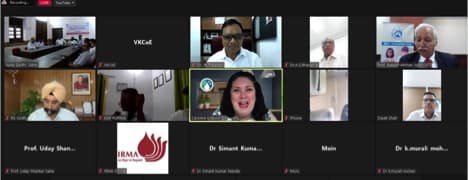
On the occasion of World Milk Day, 1st June, the Verghese Kurien Centre of Excellence at IRMA organized a virtual technical session on ‘Challenges and Opportunities for Indian Dairy Industry’. The dairy stalwarts discussed important issues related to Indian Dairying. Dr JB Prajapati gave a welcome speech on behalf of Director, IRMA and set the platform for discussion. Ms Caroline Emond, the director-general of the International Dairy Federation gave a brief opening speech and highlighted the significance of dairy at global level in nutrition, health and economy.
Prof R M Joshi, Director of the Indian Institute of Plantation Management, Bangalore (previously Dean, Indian Institute of Foreign Trade) delivered a lead talk. Based on his experience, he shared important features of our dairy market, both domestic and international.
One of the biggest challenges facing the dairy industry right now is the trend of villainising milk to promote dairy analogue products. The vegan and alternative plant-based beverage lobbies market hard to promote their products by creating false and exaggerated claims about dairy. People, in general, are sensitive to perceived threats to their health. Prof. Joshi gave an example of how two Time Magazine articles about milk had a favourable and unfavourable effect on milk prices based on what stance the article took.
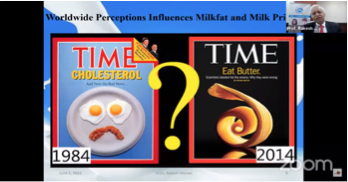
The milk prices trend showed a sharp drop in 1984 and a sharp increase in 2014. Through this example, he highlighted the importance of marketing for the dairy industry in general.
The next main challenge he described was the price competitiveness of the dairy industry in the international market. The international skim milk powder and butter prices are much cheaper than our domestic prices. The main dairy exporters like the EU, Australia and New Zealand provide considerable subsidies to their dairy farmers which allow them to sell cheaply abroad. Fortunately, the Indian Government so far has taken the dairy industry’s importance into consideration. The dairy sector is consistently excluded from the Free Trade Agreements signed by the government so that they will not be vulnerable to cheap international imports. But government policies can change at any time and dairy as an industry should not be reliant on them.
The Indian dairy market is also incredibly attractive to international exporters. India is the largest consumer of dairy products. That is why they are all eager to sell in our market. Prof Joshi asked the industry to not remain reliant on government policies and strive to make ourselves more efficient in terms of yield and value addition. In the next 10 years, all agricultural real prices are expected to fall, including dairy. Hence, we need to identify the inefficient areas in dairy production and innovate to manage our surplus production to be the most valuable.
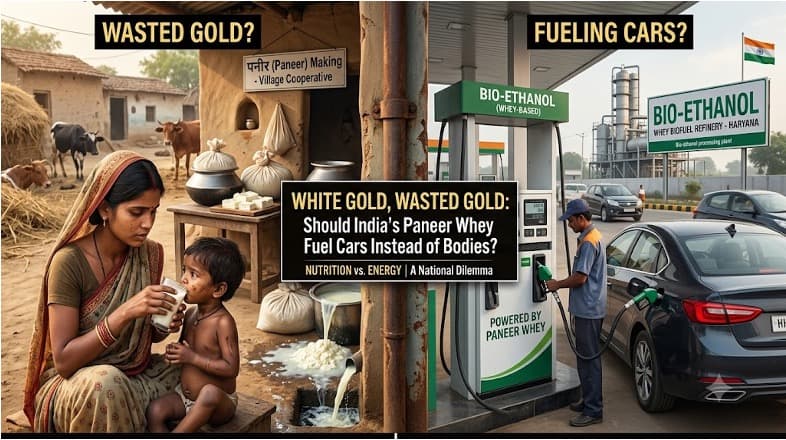
Towards the end, he gave areas where we have opportunities to capitalize such as further developing and marketing India specific products like Ghee, Paneer, milk-based sweets, turmeric milk etc. Creating product differentiation like that is surely going to help us stand up on our own in the competitive international market.
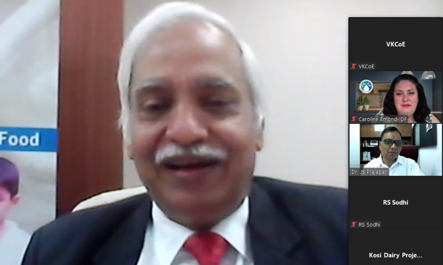
The session chair and MD of GCMMF Dr Sodhi expressed his views based on practical and commercial realities at floor level.Through his speech, he elaborated on how the Indian dairy farmers have managed to come together and make India self-sustainable in dairy despite the limited resources. India is currently the largest dairy producer and the rate at which it’s growing is also tremendously admirable. In terms of growth, currently, the dairy production is growing at the rate of 6% but the branded dairy product industry is growing at 12%, showing the increasing demand for the value additions. With the increasing population and increasing disposable income, the dairy prospects are good in India. The online dairy market gets around 11-12 crore litres of milk per day and it is expected to grow to 30 crore litres per day in 10 years.
In India, dairy is a business where it’s produced by the masses and consumed by the masses. So any change to be brought will affect a huge chunk of the population. Dr Sodhi entreated that before we blindly go to follow the so-called efficient practices of the developed countries we have to carefully consider if they will actually benefit the farmers and consumers. Currently, India has minimal dairy inflation in the world. The Indian dairy supply chain is also vastly efficient in that the producer farmer gets 70-80 % of the revenue, whether it is sold by a cooperative or a private company. In the case of agricultural food chains, it is important to consider the welfare of two stakeholders above all else, the grower and the consumer. In the words of Dr Sodhi, it is India where the consumers pay the minimum and the farmers get paid the maximum.
The Indian dairy production model is ‘low input-low output’. Productivity is increased mainly by ‘better feeding-better breeding’. Indian farmers face challenges in feeding as the milch animals are primarily fed the leftover crops. The farmers can rarely afford to spare land and water to grow fodder in place of actual food crops. Whatever fodder is grown, it is grown as an intercrop. Buying fodder is also difficult due to rising input prices. Towards the end, he called on the youth to get into dairy farming, disparaged the plant-based beverages trying to prove themselves better than milk, and pointed to China’s current complete dependence on imports for dairy as a case against more global integration. He pointed out that the biggest growth potential is not outside but within India. Only 20% of India’s dairy market is organized, meaning there’s 80% more to tap into. He said if Indian farmers are happy and the consumers are happy then we should not worry about the surplus production of foreign countries and open up our borders.
Finally, he talked about the challenge of sustainability. Dr Sodhi gave examples of many ways GCMMF is currently working to reduce carbon emissions and water wastage but in the end he said ‘sustainability starts when the stomach is full’. In India where dairy is a source of sole income for many, forcing sustainability should not come at the cost of livelihood for them.
After Dr Sodhi, Mr Amit Vyas briefly gave an overview of the efforts taken by the AMUL to digitise the breeding and animal health of the member farmers. He displayed the possibility of growth and efficiency brought by AMUL through their efforts. He displayed the scope for innovations the dairy industry currently has, giving hope for more streamlined dairy farming.
The session convener Dr Prajapati, Chairman of Verghese Kurien Centre of Excellence (IRMA) invited comments from the participants and the representative of Gaya dairy expressed how the social health part of wholistic health is being taken care of by following the Anand Pattern.
Dr Prajapati closed the session by delivering a vote of thanks, expressing gratitude for the presence of the chief speakers and other eminent personalities. He also indicated at how VKCoE at IRMA is committed to wholistic growth of dairying in India which can result into socio-economic development in rural sector.