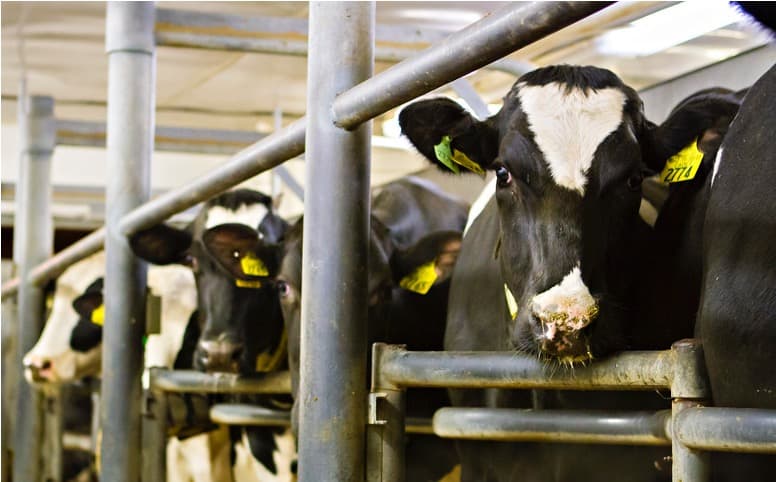
“Until the Covid pandemic the dairy sector was growing really well, then it started to decrease due to inflation and other issues, and has not really recovered,” said Shirley Kaston, co-founder of the Kök Projekt, a food start-up accelerator and consultancy in Istanbul.
Raw milk production has declined quite significantly over the past four years, with total output dropping from 25.3 million tonnes in 2020, to 23.2 million in 2021, before dropping by a further 7.1% to 21.56 million tonnes in 2022. Production was 21.48 million tonnes in 2023, according to the Turkish Statistical Institute (TURKSTAT) figures.
Türkiye is the ninth largest producer of cow milk in the world and the third largest in the European region after Germany and France, according to Ankara-based Gıda Sanayicileri ve Üreticileri Birliği Derneği (SETBİR – Union of Dairy, Beef, Food Industrialists and Producers of Türkiye). Key production areas include the Aegean coast, northwestern regions and central Anatolia.
Cow milk accounts for 92.9% of overall Turkish dairy production, sheep milk 4.35, goat milk 2.5% and buffalo milk 0.2%, according to SETBIR.
The production decline has been most pronounced in cow and buffalo milk. Cow milk was 21.7 million tonnes in 2020, then dropped to 21.37 million tonnes in 2021, and then to 19.91 million tonnes in 2022, before recovering slightly to 19.96 million tonnes in 2023.
Buffalo milk has dropped from 63,767 tonnes in 2020, to 43,025 tonnes in 2023. For sheep milk, production marginally increased in 2021 on the previous year to 1.14 million tonnes, then dropped to 1.067 million tonnes in 2022, and to 933,576 tonnes in 2023. Goat milk production has declined marginally by comparison to other segments, increasing from 589,617 tonnes in 2020 to 622,785 tonnes in 2021, then declining to remain steady in 2022 and 2023, at 540,426 tonnes and 543,058 tonnes respectively, according to TURKSTAT figures.
This decline is attributed to reduced animal numbers and productivity, accompanied by increased production costs, especially for feed, affecting both small and large businesses, said a Turkish agricultural analyst, who requested anonymity.
The total number of milk-producing animals in Türkiye has declined from 31.9 million in 2019, to 25.75 million in 2022, although numbers did rise marginally last year to 25.91 million in 2023, according to TURKSTAT.
Producers as well as consumers have struggled with rising inflation, which has surged from 12.3 percent in 2020 to 75.5 percent in May (2024), according to TURKSTAT figures. Meanwhile, the Turkish lira has lost more than 80% of its value against the US dollar over the last five years, according to World Bank figures. In June 2019, USD1 bought Turkish Lira TRY5.90; in June 2024, it buys TRY32.10. Annual inflation hit an eye-watering 75% last month (May 2024). “These economic pressures have increased production costs, particularly for feed, energy, and other inputs. Consequently, many dairy farmers have struggled to maintain profitability, leading to a reduction in herd sizes and milk production. Political instability and fluctuating market conditions have compounded these issues, making it difficult for the industry to stabilise and grow,” said the analyst.
Over the past decade there has been a shift towards larger, higher yielding dairy producers, away from family-owned farms with fewer than 10 cows, said SETBIR. Türkiye has 2,464 approved dairy enterprises, according to Turkish ministry of agriculture and forestry figures.
The surge in inflation has hit consumers particularly hard, with Turkish unions estimating the hunger threshold for a family of four in May to be about TRY19,000 (USD590) a month, more than the minimum wage of TRY17,000, according to the Turkish Deep Poverty Network.
Kaston said there had been a downward shift in purchasing habits as a result: “On average, everyone is cutting back on whatever they can,” she said.
This has put a dent in the wider consumption of speciality products such as organic produce, which had been increasing, in line with consumer trends in Europe. It has also strained smaller sized manufacturers that had started to sell online since the pandemic.
There has also been a shift away from larger supermarket chains, such as Paris-headquartered French supermarket giant Carrefour and Zurich, Switzerland headquartered food retail chain Migros, towards discount stores that sell white label products without brand names, said Kaston. That said, imports of dairy products increased in 2023, to 16,627 tonnes with a value of USD92.65 million, up from 11,526 tonnes, at USD53.36 million, in 2022. Volume however is still lower than 2020’s 18,399 tonnes (USD68.3 million), and 19,479 tonnes (USD80.33 million) in 2021, according to TURKSTAT figures.
Despite the negative impact of inflation, certain segments are holding up due to being a core part of the Turkish diet, such as ayran, a salty yoghurt drink typically consumed with meals. Turkish ayran production increased from 766,278 tonnes in 2022, to 829,554 tonnes last year, said TURKSTAT.
“Ayran is cheaper than cola, and a popular option. People are not cutting back on ayran,” said Kaston.
Yoghurt is another staple, which has kept up demand, with production increasing from 1.16 million tonnes in 2022 to 1.21 million tonnes in 2023, according to TURKSTAT. There has also been a rise in yoghurt offerings in recent years, with more flavours, supplementing the more traditional non-flavoured yoghurt.
However, certain other dairy products that are newer to the Turkish diet have not seen such strong demand, negatively impacting production. Production of butter marginally declined from 95,655 tonnes in 2022, to 87,066 tonnes in 2023, TURKSTAT data shows. Skimmed milk powder has also dropped, from 89,227 tonnes to 67,628 tonnes in 2023, as has full fat milk powder, from 45,388 in 2022, to 45,288 in 2023.
Drinking milk production has, however, marginally increased, from 1.49 million tonnes in 2022 to 1.52 million tonnes in 2023. Kaston said such demand was driven by the popularity of American style coffee chains, which has come at the expense of the more traditional thick Turkish coffee and Turkish tea, which are consumed without milk. “There has been a shift, to have milk in coffee, or have a milkshake. It is an indulgence, but many are not cutting back on this,” she said.
While Turkish dairy consumption has been impacted by inflation, overall production has been bolstered by the substantial number of tourists the country attracts, as well as exports. “Around 60 million tourists are expected to come to Türkiye in 2024, and we are hosting approximately 4 million immigrants. Considering Türkiye’s own population of 87.2 million, it is quite normal for the demand for milk and dairy products to increase,” said SETBIR in a statement to Dairy Industries International.
Cheese is another key staple of Turkish cuisine, eaten raw or in baked breads and pastries. And as a result, cow cheese production increased from 702,868 tonnes to 773,082 tonnes in 2023, according to TURKSTAT figures.
Türkiye produces over 200 types of cheese, particularly beyaz peynir (white cheese) and kaşar (medium hard yellow cheese). However, demand has increased in recent years for imported cheeses such as mozzarella, cheddar, and gouda: “The cheese market is diversifying with more options available in supermarkets, reflecting a broader taste profile among consumers,” said the analyst.
One variety of cheese has gained a high profile – Ezine Peyniri, made from a blend of cow, sheep, and goat milk that is primarily sourced from the Kaz Mountains in the north-west, near the site of Troy.
In 2022, high production costs and low prices for this cheese pushed farmers to slaughter animals, but in December 2023, the variety was awarded a protected designation of origin (PDO) by the European Union (EU), the first Turkish food to gain such protection in EU markets (2). The designation has opened more potential for exports, said Kaston. “Everybody that eats white cheese asks for Ezine Peyniri,” she said.
Animal count is improving in the Ezine Peyniri producing area, and throughout the country, with the government in 2022 permitting the import of 160,000 head of feeder cattle, according to the United States Department of Agriculture’s Foreign Agricultural Service.
Türkiye’s dairy exports more than doubled from 2010 to 2020, to 182,091 tonnes, valued at USD336.7 million, said TURKSTAT. In 2021, exports rose to 208,151 tonnes, at USD356.8 million. While export volumes declined in 2022, to 192,440 tonnes, the value increased to USD573.5 million, due to the global spike in dairy prices, despite the fall in value of the Turkish Lira. Exports dropped to 123,307 tonnes, worth USD333.3 million in 2023, according to TURKSTAT figures.
The primary export destinations are the Middle East and central Asia, while emerging markets are the EU, Russia, and China, particularly for milk powder, whey powder, cheese and ice cream. Iraq, Saudi Arabia and the United Arab Emirates (UAE) are the top export destinations for Turkish cheese. There are 39 dairy farms permitted to export to the EU, nine to Russia, and 75 to China, according to SETBIR. China became an export market in 2020, following a bilateral agreement.
Kaston expects the dairy sector to start turning a corner over the next year as inflation is tamed and exports rise. “We are projecting that from 2025 onward, the sector will be better,” she said.
NOTES
- Turkish Dairy Industry
2.
Turkish Cheese-EUSource : DAirynews7x7 Feb 28th 2025 by International news services by Paul Cochrane *This article was previously published by the leading publication, Dairy Industries International –