Latest Blogs
See More

Indian Dairy News


DairyNews7x7
Global Dairy News

DairyNews7x7
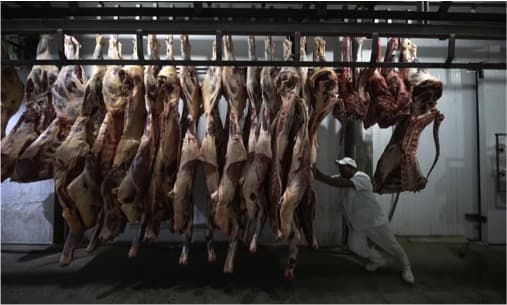
Big meat companies and lobby groups are planning a large presence at the Cop28 climate conference, equipped with a communications plan to get a pro-meat message heard by policymakers throughout the summit.
Documents seen by the Guardian and DeSmog show that the meat industry is poised to “tell its story and tell it well” at the Dubai conference.
The files show how the world’s largest meat company, JBS, is planning to come out in “full force” at the summit, along with other big industry hitters such as the Global Dairy Platform and the North American Meat Institute.
The documents, which were produced by the industry-funded Global Meat Alliance (GMA), emphasise the industry’s desire to promote “our scientific evidence” at the summit.
Members of the alliance have been asked to stick to key comms messages, which include the idea that meat is beneficial to the environment.
Meat and dairy companies are under increasing pressure over their large greenhouse gas footprints. The dairy industry is responsible for 3.4% of global human-induced emissions, a higher share than aviation.
Trade groups also give some indication in the documents of how they hope to shape conversations in Dubai. One said it will “push” the UN’s Food and Agriculture Organization to host “positive livestock content” at Cop28. The Guardian recently revealed that pressure from the industry led to censorship of FAO reports on the role of cattle in increasing greenhouse gas emissions.
Animal agriculture is the largest emitter of methane, a greenhouse gas 80 times more potent than carbon dioxide when measured over a 20-year period. Scientists said that unless swift action is taken, methane from agriculture alone will push the world beyond a 1.5C (2.7F) rise in temperature above preindustrial levels that risks tipping the world into irreversible climate breakdown.
“These companies are stepping up their game because the exposure they are facing is stepping up,” says Jennifer Jacquet, professor of environmental science and policy at the University of Miami. “It used to be that they were caught on the back foot, but now they’re completely prepared.”
“Any credible action to reduce emissions in the food sector will inevitably lead to a reduction in the total volume of meat and dairy products produced,” says Nusa Urbancic, CEO of campaign group the Changing Markets Foundation. “The industry is terrified of that and has been deploying multiple tactics to delay the inevitable.”
The meat sector’s largest emitters plan to be on the ground at Cop28 in large numbers, the documents show. At Cop27, JBS, the world’s most polluting meat company, gained access to talks because it came as part of Brazil’s national delegation.
Companies at the summit will be accompanied by lobby groups that represent them, some of which have a history of obstructive action. They include the North American Meat Institute (Nami), which represents large meat producers in the US and which in 2022 was still questioning on its website whether climate change was caused by humans.
While the leaked documents are aimed at the meat sector, they also show that dairy companies are planning on sending a “large delegation” to Cop28.
Earlier this year, backlash from several countries with interests in meat led to the watering down of the Intergovernmental Panel on Climate Change’s recommendations on diets.
Companies and trade groups are told in the documents that one of the ways to “have the most influence” is to “equip delegates with your key messages and solutions”, a list of which are provided in the pack.
The files also detail collaborations planned for the event itself, with meat lobbying groups hosting events at country pavilions, including those of the US and Australia.
Australia and the US are the second and third largest beef exporters globally after Brazil, and their governments have a strong economic interest in supporting the growth of these industries, as well as close political ties with them.
Researchers said government support is a significant factor in determining the continued power of the animal agriculture industry over alternatives. A study this year found that in the EU, meat and dairy farmers received 1,200 times more public funding than new alternative protein sources, while in the US, they received 800 times more support.
Jacquet said addressing the cosy relationship between governments and industry was crucial to changing diets to align with climate goals.
“Typically, the talk is about demand-side interventions, like you can get schools or individuals to give up meat,” she said. “But I’m a little worried that some of this [meat] production is so baked into subsidies and policy, that even with decreased demand, this apparatus will just keep flowing.”
In the documents, trade groups also reveal their plans to influence non-country pavilions via sponsorship, which can cost between $10,000 and $200,000. This is championed as a way to host sessions and bring guests along to receptions.
The documents also include a messaging summary with key talking points that present meat as “sustainable nutrition” and suggest that meat production can be beneficial to the environment.
In a four-page set of arguments, the Global Meat Alliance claims that producers can “play a key role in environmentally sustainable food systems” and that the sector is “continuously driving towards carbon-friendly farming”.
Several of these arguments reference the idea that grazing livestock can help maintain healthy soils, which can store carbon. This is often described as “regenerative agriculture”. It is a favoured line with many food companies, despite the fact that scientists have said that soils are not a reliable way to store carbon in the long term, and that removals can be easily undone.
In its messaging, the industry also heavily references the role of meat in relieving hunger in the global south, claiming that it “plays a key role in reducing food insecurity and malnutrition”. However, the UN-linked Committee on World Food Security has repeatedly pointed out that hunger and malnutrition are not caused by a lack of food, pointing instead to problems with access, distribution and power.
Meat eating worldwide is very unequal. Europeans eat more than twice the global average, and consumption levels in north America and Australia are even higher. One 2018 study found western countries would have to reduce their meat intake by 90% to limit global heating to acceptable levels.
The documents make passing reference to cutting methane, and encourage participation in events where this is discussed. This is despite the fact that emissions from beef production globally are roughly equal to the emissions of the entire nation of India, with science pointing to a shift in diets as the one surefire way to cut emissions.
The Food4Climate pavilion, which aims to promote plant-based food, is labelled in the documents as “extreme”, which also show displeasure at the Cop28 presidency’s choice of a mostly vegan menu.
While the Global Meat Alliance presents itself as supporting an “aligned global meat sector” the group’s membership is skewed heavily toward producers in the global north.
Fourteen of the group’s 16 partners come from the UK, Ireland, Australia, New Zealand or North America. The remaining two partners are global lobby groups representing large companies and multiple countries.
This follows a wider trend in multi-stakeholder climate initiatives, where smallholder groups are sidelined. A recent report found that small-scale farmers, who produce a third of the world’s food, receive just 1% of climate finance.
A GMA spokesperson said: “The GMA is an international networking group with an aim to support a better connected, aligned global meat sector by providing industry with accumulated insights, best practice, and collaboration opportunities to address shared challenges such as sustainability in the pre-competitive space. This includes visibility on intergovernmental events which are often dominated by an anti-meat narrative. GMA works to simplify and distil public information around these events, which is largely complex, to ensure industry understand how and where to engage, having equal opportunity to be heard.”
Livestock experts with a focus on the global south have repeatedly stressed the importance of including a range of perspectives in discussions of livestock pollution. Ian Scoones, a researcher at the Institute of Development Studies, said: “My big fear in all of this debate is that the likes of pastoralists who we work with around the world will get stuffed because they don’t have a voice.”
Source : The Guadian: Nov 29th 2023 by Rachel Sherrington