Fonterra, the giant that controls 80% of national production, has adjusted its farmgate payout forecast for the 2025/26 season to an average of NZ\$10.00 per kg of milk solids, with a tightened range of NZ\$9.00 to NZ\$11.00 per kgMS. This reflects robust global demand and favourable weather conditions.
Milk production grew 3.1% in the season to December 2024, and the peak in the second half of 2025 is expected to drive exports even higher, with a projected total of 1.49 billion kgMS for Fonterra alone.
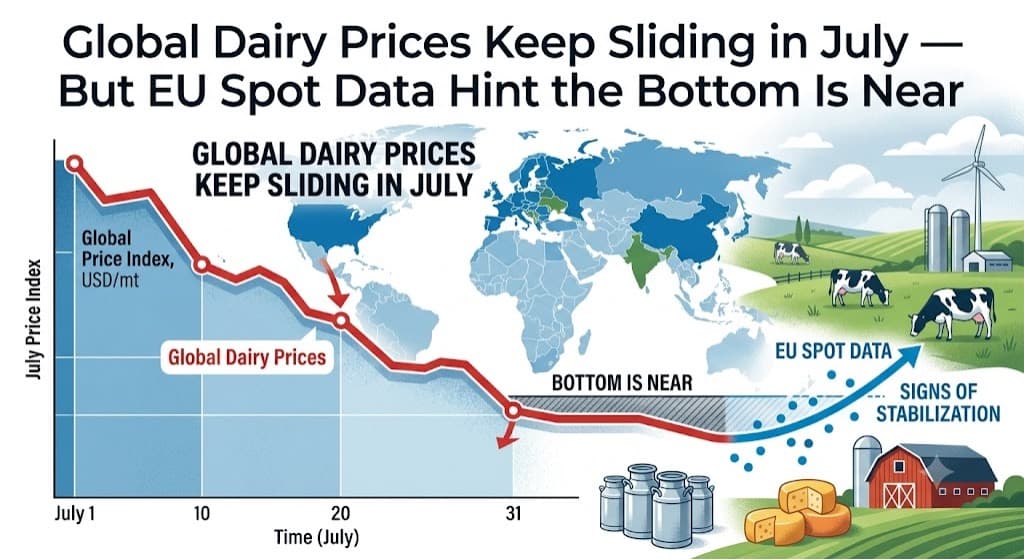
At Global Dairy Trade (GDT) auctions, whole milk powder reached US\$4,000 per metric tonne, boosted by recovering Chinese demand and a 7.1% lift in total exports to NZ\$26.2 billion in the year to March 2025.
This is no accident: the sector represents 30% of global dairy exports, and New Zealand is positioning itself as a reliable supplier in a volatile world.
A key catalyst has been the resolution of the Canada trade dispute under CPTPP in July 2025.
After years of tensions, Canada adjusted its tariff-rate quota management, allowing smoother access for New Zealand products such as butter, cheese, and milk powder.
This could add up to NZ\$157 million annually in export value, according to official estimates, by removing barriers that previously restricted flow. In addition, the New Zealand government has introduced “common-sense cuts” to export bureaucracy.
Since 25 September 2025, food exporters – including dairy – no longer require special exemptions from domestic rules if their products meet destination market standards, saving both time and costs in a sector where speed is critical.
These changes make it easier to access new markets, such as the potential FTA with India, and position New Zealand to capitalise on projected global dairy growth to 2034, according to the OECD-FAO Agricultural Outlook.
However, the trade boom does not come without friction on the sustainability front.
In regions such as Canterbury, intensive fertiliser use has raised nitrate levels in aquifers, prompting Environment Canterbury to declare a “nitrate emergency” in September 2025.
This has been partly attributed to the increase of 15,000 dairy cows in the first half of the year, exacerbating nitrate leaching into drinking water.
While studies suggest nitrate pollution can impact ecosystems and health, with potential links to issues such as colorectal cancer, the evidence is nuanced and not always direct. Bowel Cancer NZ has clarified that nitrates in drinking water are “highly unlikely” to increase significant risks.
New Zealand’s dairy industry, far from ignoring these challenges, has been leading with well-understood ecological practices – such as reducing nutrient losses through proven technologies that cut leaching by up to 15% on model farms.
The sector is investing in practical solutions, recognising that better effluent and fertiliser management is essential to maintaining productivity without unnecessary trade-offs.
To act in this environment, here’s concrete material you can implement now:
On trade: Diversify markets by monitoring GDT auctions weekly to identify trends in milk powder and butter prices.
With the Canadian resolution, prioritise shipments to North America; a 10% increase in quota access could raise income by NZ\$50,000 per medium farm, based on average volumes of 300,000 kgMS.
Use tools such as New Zealand Trade & Enterprise export guides to navigate updated regulations, ensuring your products meet destination standards without gazetted exemptions – cutting processing times by 30%.
Invest in forward contracts with Chinese buyers, where infant formula demand has driven a 16% increase in dairy exports.
On sustainability: Take measurable actions to mitigate nitrate risks and avoid harsher regulation. Implement precision irrigation systems that optimise nitrogen fertiliser use, reducing leaching by 20–30% according to New Zealand farm studies.
Monitor nitrate levels on your property with accessible kits, aiming to keep them below the 11.3 mg/L recommended by MAF, and document improvements to defend your case in regulatory consultations such as the recent freshwater review.
Explore anti-methane vaccines in late-stage development, such as investments by ArkeaBio, which could cut emissions by 30% and unlock carbon credits as additional income.
For costs, factor in the rise in TB levies to NZ\$14.50 per head from October, but offset this with savings on M. bovis (down 50%).
Model scenarios: a 500-cow farm could save NZ\$10,000 annually by optimising fertiliser use, while also gaining points in green certifications that premiumise products in European markets.
For the long term: Integrate AI into operations – use software to predict production peaks and adjust insemination, boosting yields by 5–10% without expanding herd size.
Diversify into value-added products such as organic cheese or A2 milk, which capture margins 20% higher.
Track global forecasts such as Rabobank’s Q3 2025 outlook, which sees moderate supply growth, and adjust inventories to avoid overproduction.
Be proactive on regulation: join lobbies such as DairyNZ to influence policy, ensuring freshwater reforms are “practical” rather than suffocating.
New Zealand’s dairy boom in 2025 is an epic opportunity for those who act with data in hand.
With trade expanding and sustainability manageable through innovation, the sector can lead globally without giving ground.
Don’t wait – implement these strategies to capture white gold before the market shifts.
The dairy future is yours – take control!
Blog sharing by our partner channel - edairynews Read full story here
Source : Dairynews7x7 Sep 23rd 2025