Logo
IndianGlobalBlogsPublicationsPodcastsMarketAboutContact
Logo
IndianGlobalBlogsPublicationsPodcasts
7News
TN Minister Urges Farmers to Adopt Tech for Value Addition in DairyListen to the Farm, Not the Farmer—The New Productivity LensWhat’s Driving Change In Beverages, FMCG And Dairy in 2025ED begins money laundering probe in dairy investment fraud caseIndo-Brazil pact aims to boost cattle genetics and dairy yield

Indian Dairy News

TN Minister Urges Farmers to Adopt Tech for Value Addition in Dairy
Dec 12, 2025

TN Minister Urges Farmers to Adopt Tech for Value Addition in Dairy

In Coimbatore this week, Tamil Nadu’s Minister for Milk and Dairy Development, Mano Thangaraj, called on dairy farmers to embrace modern technologies to boost productivity and value addition across th...Read More

Listen to the Farm, Not the Farmer—The New Productivity Lens
Dec 12, 2025

Listen to the Farm, Not the Farmer—The New Productivity Lens

India’s dairy sector, valued at nearly $30 billion, has reached a point where incremental changes will not deliver the next breakthrough. For decades, improvement programs have focused on what farmers...Read More

What’s Driving Change In Beverages, FMCG And Dairy in 2025
Dec 12, 2025

What’s Driving Change In Beverages, FMCG And Dairy in 2025

India’s retail landscape in 2025 was marked by a decisive shift in how consumers choose, consume and connect with brands. From beverages to daily nutrition and even the most essential dairy products,...Read More

Latest Blogs

See More
More Milk, Less Money: India’s Dairy Crisis
Dec 01, 2025

More Milk, Less Money: India’s Dairy Crisis

With the release of the BAHS 2025 summary report, I felt compelled to deep dive into its findings and reflect on the real progress and challenges facing India’s dairy sector. Over the last six years,...Read More

India Milk Prices: Cost Shock and Procurement Pressure
Nov 28, 2025

India Milk Prices: Cost Shock and Procurement Pressure

Milk prices in India face upward pressure as rising feed costs and procurement hikes reshape farm economics. Insight on dairy procurement, feed costs, and market outlook. Official government and coope...Read More

Stop Blaming, Start Claiming: Livestock’s Carbon Credit Future
Nov 16, 2025

Stop Blaming, Start Claiming: Livestock’s Carbon Credit Future

This week, I had the opportunity to attend an Agri Carbon Masterclass conducted by CII FACE. The deliberations, case studies, and discussions presented during the session were both insightful and thou...Read More

India Powers the Gulf’s Dairy Revolution -Gulf Food 2025
Oct 31, 2025

India Powers the Gulf’s Dairy Revolution -Gulf Food 2025

As Gulf Food Manufacturing prepares to open its doors from November 4–6 in Dubai, Indian dairy product and equipment manufacturers have a unique opportunity to explore one of the most promising region...Read More

Global Dairy News

Why the global milk business needs a structural shake-up
Dec 08, 2025

Why the global milk business needs a structural shake-up

The New Zealand dairy stalwart Fonterra has sold its consumer dairy-brands (milk, butter, cheese) — including “Anchor” and “Mainland Cheese” — to French agribusiness giant Lactalis in late October 202...Read More

Raw-milk prices in Europe hit 5-yr low; ripple effect looms
Dec 07, 2025

Raw-milk prices in Europe hit 5-yr low; ripple effect looms

European raw-milk prices have plunged to their lowest in five years, as oversupply and weak demand weigh on dairy markets across the region. According to recent data from DCA Market Intelligence B.V.,...Read More

Global food prices ease; FAO dairy index slips — impact looms
Dec 06, 2025

Global food prices ease; FAO dairy index slips — impact looms

The FAO Dairy Price Index averaged 137.5 points in November, down 4.4 points (3.1 percent) from October and 2.4 points (1.7 percent) from its value a year ago. International dairy prices fell for the...Read More

Dairy News 7x7

Your trusted source for all the latest dairy industry news, market insights, and trending topics.

FOLLOW US
CATEGORIES
  • Global News
  • Indian News
  • Blogs
  • Publications
  • Podcasts
SUBSCRIBE TO OUR NEWSLETTER

Stay informed with the latest updates and trending news in the dairy industry.

No spam, unsubscribe at any time

GET IN TOUCH
C-49, C Block, Sector 65,
Noida, UP 201307
+91 7827405029dairynews7x7@gmail.com

© 2025 Dairy News 7x7. All Rights Reserved.

Terms of ServicePrivacy Policy

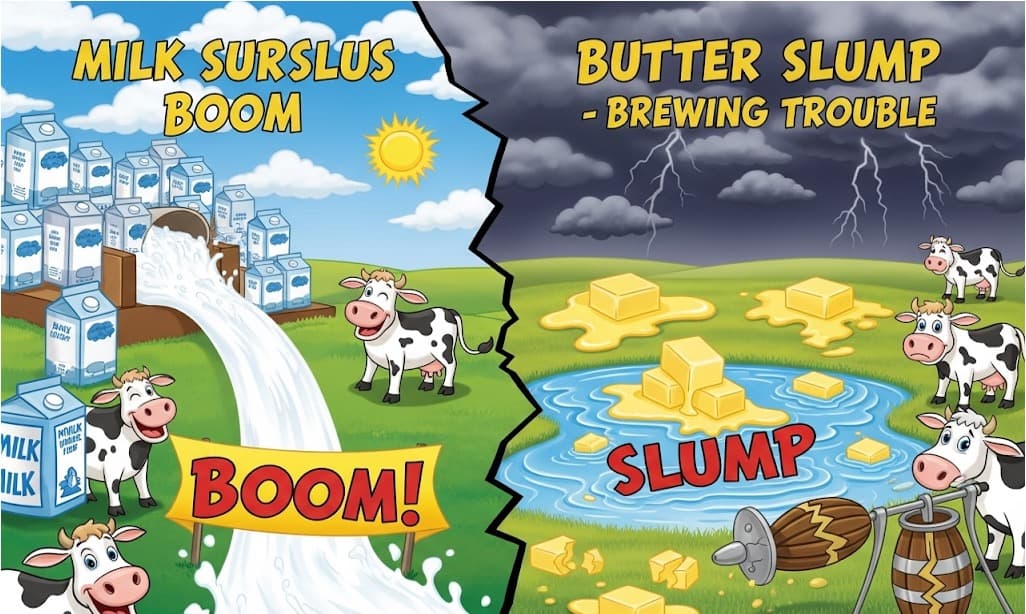
Milk Surplus, Butter Slump: Boom or Brewing Trouble?

By DairyNews7x7•Published on August 27, 2025

Last week we returned from our summer break and found the market immediately in full swing. Our activity focused on butter, with cheese prices showing wide gaps and powder prices moving in boring ranges. Although activity was high, out-of-office replies also remained high. Many producers—who had to admit the price trend was down last week—expect returning buyers to bring support to the market. Who knows, they just might. With Linda back from her summer break, we hope to restore activity and visibility in the powder market. We spoke with her on Friday; with her batteries recharged, she is back to assist our powder partners.

This week might become a make-or-break week for the dairy industry. All the data we can find point to higher production, and little data show higher consumption. Our regular readers know our take on the import surge and export decline for most commodities, leaving the EU in a better-supplied state compared to last year. The question is how much demand for this year still needs to be covered, and how much product still needs to be sold. The sum of those two will likely set the price direction.

More Milk: More commodities.

The latest milk figures are strong. Last week we saw US milk collections up over 4% on an MS basis for July, and NZ continues to show increases over last year. Focusing on the EU: week-on-week figures from France point to 3.9% more milk, and Germany shows 2.6% more milk. Speaking to partners in other countries, that stronger milk trend can be felt everywhere. Milkflow in Belgium has been down a lot this year, is reported to show a strong increase in the recent weeks that should become visible in the reported data in the weeks that follow. But where does this milk end up?

A relatively small percentage of EU milk collections goes to commodity production for the products we broker. It varies by country and there is no hard data, but the majority goes directly to retail or speciality products like drinking milk, UHT milk, yoghurts, etc. The butter, SMP and yellow cheese segment is usually the lowest valorisation part and comes last. That means if there is less milk to collect, it has a relatively big impact on commodity production—and vice versa. 1% less milk can impact block butter production by a multifold. Last year, when bluetongue spread across the EU, we saw a relatively strong impact on product availability, driving up prices.

Update on divestment of Consumer and associated businesses

Now that milk is flowing (in some countries well above the 3- and 5-year averages), commodity production appears to be running strong. Even in the lower production months ahead, that can have a big impact. Last week Germany’s numbers showed a 2.6% increase in milk collections, but almost 10% more butter production and 25% more SMP production. If these numbers continue at this pace, we expect EU commodity production data to hit an all-time high by the end of 2025.

Weather still poses a slowdown risk, of course. Partners in the UK and Ireland are reporting dry weather that might lead to lower milk collections, while the south of Europe is fighting fires and extreme heat. The question is how those weather extremes compare to last year and what that means for milk comparables.

Return of activity

Last week we debated with both the sales and purchase sides of the market whether demand for this year would return. Those active on the purchase side focused mainly on Q1 and even Q2/Q3 2026 demand. The majority seems covered for Q4. Last year, many buyers came back from their summer break still needing to cover the Christmas/Holiday/December demand. Asking around why the focus is different this year, answers varied.

Some are experiencing slower or hesitant demand and have pushed stocks into Q4, effectively covering part of the demand with unused stock. Some are still waiting for additional requests from their buyers in retail. It seems nobody wants to buy too much at these relatively high prices. But the majority cited last year’s rally as a reason to cover needs before going on break, fearful of a repetition of a price surge like last year.

On the sales side, we see a mirrored logic. Last year’s rally came as a surprise to many producers. The majority returned from their summer break oversold. With reduced milk production in the second half of 2024 still in mind as a likely scenario for this year, they seemed to have gone on holiday with fewer sales in their books. In addition, their logic is that—similar to last year—buyers will come back after their break, looking for their Q4 needs.

So the big market question is: who will turn up with bigger numbers—buyers or sellers? Judging from one week of activity, sellers appear ready for an end-of-year rally, while buyers show little interest in engaging yet. For powders—especially SMP—there is plenty of fresh product on offer from producers around €2,300 or slightly higher. Cheese producers are already showing some aged stock, with Irish cheddar coming close to €4,200, Gouda dropping below €4,000 (ages between 5–7 weeks), and mozzarella sellers eager to close some Q4 and Q1 sales.

And on our favourite product, butter… it seems some forgotten warehouses have been opened. With plenty of product from Q1 production this year (and even Q4 last year), producers are actively looking for quick offtakes. We see plenty of offers from French, Swedish, Danish and Polish products around. One of the bigger German producers reportedly offered sizable quantities to almost all traders, signalling that supply is unlikely to be an issue this year. Only the Irish still manage the hide-and-seek game best. With strong export numbers continuing to surprise, they show no pressure to sell for now. But with sufficient stocks from Sweden, France, Germany, Poland and Denmark, it’s only the buyers who specifically need Irish product that might have to pay up; those with options have plenty of alternatives.

One thing seems sure: whether buyers or sellers lead the way back this week, activity and volatility will be joining the party.

Butter: Bounce or Break?

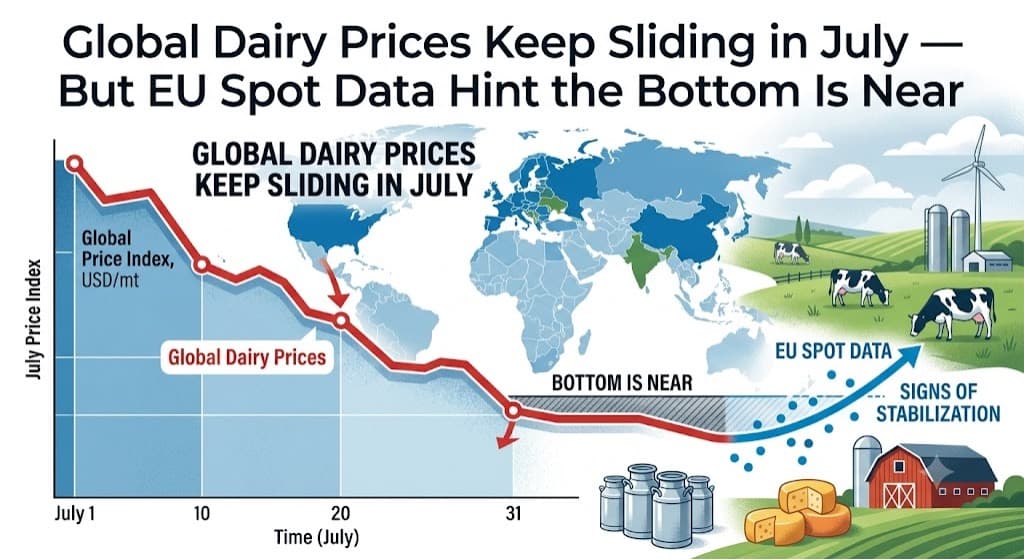
Butter took a clear step down last week. Trading at € 6685 for Q4 and € 6600 for Q1 on NL/DE/BE butter, the market is about € 150 lower than the week before. Looking back to 2022, the market held above € 7000 until mid-September, it was only than that cream prices broke and Q4 demand proved too weak to support the market. A similar move could occur this year, keeping the markett afloat for a few more weeks. On the other hand, last year, the last week of August pushed cream to € 10,000 before easing back during September; if that repeats, prices could start to slide again once cream loses firmness. Some spot offers for cream around € 8000 last week point to the latter scenario.

Our expectation is that if producers who actively sought buying interest at the end of last week don’t see indications that demand will return, we’re set up for a 2022-style sell-off, taking prices back to—and possibly below € 6000. We know this forecast may draw criticism, but a 10% decline in butter versus other agro commodities would still feel like a modest correction to us. If production numbers continue to rise as the trend suggests, producers may have to brace for a deeper drop. Keep in mind that in 2022, butter fell from € 7200+ in August to € 4300 in February.

For those comparing data: butter and AMF imports in 2022 YTD (June) totaled 11.500 mt, with 2025 imports already at 25.000 mt. Exports that year dropped >5.5% to 105.000 mt YTD in June, exactly the same as last year. Butter production this year is up roughly 10% (≈10.000 mt) versus 2022. So, saying the years are not comparable… we can find some similarities.

That said, we start the week with the following offers:

  • 6 loads of Irish butter for September at € 6700 FCA Ireland
  • 6 loads of Polish Sweet Cream for September at € 6800
  • 4 loads of Polish lactic for August/September at € 6750
  • 9 loads of NL/DE/BE butter for Q4 at € 6700
  • 12 loads of Irish butter for December / January at € 6500 (winter product)
  • 12 loads of Irish butter for Q1 at € 6550
  • 12 loads of NL/DE/DE butter for Q1 at € 6625
  • 12 loads of Polish lactic for Q1 at € 6550

Bids seen last Friday (sentiment weak; several buyers pulled out):

  • 12 loads of Irish butter for Q1 at € 6450
  • 12 loads of Irish butter for Q1 at € 6400
  • 9 loads of NL/DE/BE butter for Q4 at € 6550
  • 6 loads of Irish lactic (good FFA) for December at € 6425

Cheese: On the break as well

Keeping it short, as most of what we want to say for cheese we have already said for butter. Sellers are waiting for the return of buyers, but speaking to industrial buyers, sellers might be waiting up until Christmas. Demand seems largely covered and is unlikely to match increased production. Demand for WPCs and other high whey-protein products is keeping a bit of margin for producers, but we fear that won’t last. Although official quotations are still much higher, we keep hearing that lower prices are being booked out of sight of the market.

Gouda prices between € 3800–€ 3900 for Q4 and Q1 are possible when buyers take volume. Cheddar in the UK and Ireland—some even claim purchases below € 4200. On mozzarella, we hear a wide range: as low as € 3750 Q4 from one buyer and as high as € 4000 from a producer for last-minute sales.

But the data show a bearish scenario. EU cheese production is at its highest level in at least five years. At the same time, imports have risen versus last year, while exports YTD (June) show the EU isn’t taking any extra volumes. With our forecast that butter prices are likely to lose 10–15% over the next few months, cheese seems very likely to follow. We would expect Gouda/Edam/Mozzarella prices over the next week to drop toward € 3500–€ 3600.

We start with sellers
  • Offer for 6–12 loads Gouda Q4–Q1 at € 3950

  • Offer for 6–12 loads Mozzarella Q4–Q1 at € 3850

Powders: No Update

We will keep our powder update clean and give Linda a chance to catch up with our partners. So far, producers continue to offer at prices just above € 2300, while some sellers from our trading partners would even consider prices just below € 2300. Demand might come from Ramadan programs likely to ship between November and early January, so those contracts should be closed over the next weeks.

But if that doesn’t pull up the market, some partners think we need to prepare to leave the comfortable range for SMP and test the lower end toward € 2000. That scenario remains unlikely to us, but with worldwide milk production increasing combined with an already two-year stretch of sluggish demand… who knows. Give Linda a call to catch up and get the powder market moving again.

Source : Article from partner edairynews7x7.com.. Read full article here 

Dairynews7x7 Aug 27th 2025

Swipe to continue reading

Previous Article

Next Article