Latest Blogs
See More



Indian Dairy News



DairyNews7x7
Global Dairy News


DairyNews7x7
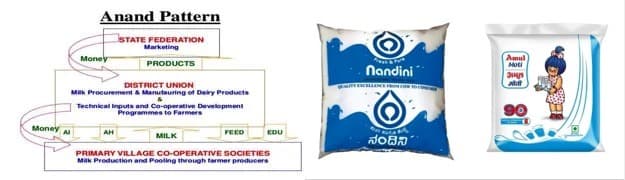
The new controversy in election-bound Karnataka is, surprisingly, around two large and successful dairy cooperatives —Amul (brand owned by Gujarat Cooperative Milk Marketing Federation, GCMMF) and Nandini (brand owned by Karnataka Milk Federation, KMF).
The debate seems to have been kick-started by two events: a statement in December 2022 that if Amul and Nandini work together jointly, there will be primary diaries at every village level in three years; and the announcement of GCMMF (on April 5) that it will be introducing milk and curd (‘dahi’ for the FSSAI obsessed) in Karnataka.
The first statement gave rise to fears (though unfounded) that KMF and GCMMF may be merged to form a multi-State cooperative — given the slew of new multi-State cooperatives (with control shifting to the Union Government) announced by the new Ministry of Cooperation recently. The second, a purely commercial announcement by Amul on its entry, did ruffle a few feathers. Amul later clarified that it is not in competition with Nandini. These statements have, however, sent conflicting messages to the farmers, particularly in Karnataka.
The fact is that both Amul and Nandini sell milk and milk products outside their respective States. Amul is humongous in size (procures about 26-27 million litres of milk daily) and has huge marketable surpluses. It also has a large portfolio of products to sell with an excellent brand image and a strong distributor network. Amul competes with Mother Dairy (a subsidiary of NDDB) in Delhi and it is understood that the latter has inched ahead in the National Capital Region in terms of volume and value. One can argue that this has prevented large private companies from taking a big share of the market.
On the other hand, Nandini is the second largest (procures about 8 million litres of milk per day) and is buoyed by the huge market distorting subsidy given by the Karnataka Government, of ₹6 per litre of milk, to dairy farmers (a burden of about ₹1,200 crore on the State budget). The catch is: this is limited to the milk supplied to KMF (Nandini). It is more a subsidy to KMF which that enables it to sell milk cheaper than any of its competitors.
Given this price advantage, can Amul take a major share of the Karnataka market? Most unlikely. But the twist in the tale seems to be the recent entry of Amul into Andhra Pradesh. It is reported that AP is providing subsidy for dairy farmers associated with milk cooperatives in some districts (almost on the same lines as Karnataka), under its ‘Amul- Palavelluva’ scheme. This gives Amul the muscle to price the milk sourced in AP lower than their declared ‘price structure’.
There were instances when Kerala, till recently a perennial deficit State for milk, used to buy large quantities of milk from KMF through its milk federation (MILMA). The regional unions made substantial profits by selling this milk at par with MILMA prices. The design of the subsidy to dairy farmers in Karnataka (and now AP) does create major distortions in the market.
Both Amul and Nandini have surplus milk and they have no option but to sell milk and its products in other States. Additionally, Amul has milk collecting and processing plants in other States (Rajasthan, Uttar Pradesh, West Bengal, Maharashtra, Madhya Pradesh, Punjab and Odisha). The State law governing cooperatives allows it to procure milk from outside the State, and process and sell in whichever market it chooses.
While Gujarat itself is surplus in milk, investments in other ‘high milk producing, low procuring’ States give that much more marketing muscle to Amul. The disturbing point about Amul’s entry into other States is that the law does not prescribe that it collects milk exclusively from cooperatives in such States, giving rise to the possibility of procuring through private middlemen. Even if cooperatives are formed in these States, they will only be suppliers of milk and not be eligible to be members of GCMMF, which will remain under the exclusive ownership of Gujarat farmers.
While the Karnataka issue may die down after the elections, what happens to comparatively smaller local brands like Aavin (Tamil Nadu), Sudha (Bihar), Gokul (Maharashtra), Saras (Rajasthan), Sanchi (MP), Verka (Punjab), and the like. Uttar Pradesh, the largest producer of milk in the country, has also the lowest procurement of milk through its coop milk federation, leaving the farmers at the mercy of the middlemen. A fertile ground for private investment.
The twin issues of a market distorting subsidy enabling a State milk federation to sell cheaper in other States and the ability of strong State milk federations to invest in other States without giving equal rights to their dairy farmers violate the fundamental principles of the Anand model of dairy cooperatives. For such States which have lost their dairy cooperatives due to mismanagement and inefficiency, large dairy cooperatives from other States will behave almost like the private sector, at best, a benevolent one.
This is the exact opposite of Dr Kurien’s vision of farmer owned dairy cooperatives as the principal instrument of rural prosperity. What would NDDB, with its legal mandate of ‘adopting a co-operative strategy on an intensive and nationwide basis ’(NDDB Act) do under the circumstances? Will the Amul-Nandini-Mother Dairy combine (which procures about half of the total milk procured by cooperatives) strike at the very root of the Anand model so passionately advocated and developed by Dr Kurien? A larger debate on the issue may throw up new options.