Latest Blogs
See More
Indian Dairy News

DairyNews7x7
Global Dairy News

DairyNews7x7

Historic fall in farm households’ income in 2022-23 points to the agrarian crisis which calls for multipronged policy responses
For the first time in Indian history, farm households’ monthly expenditure (MPCE) has fallen below non-farm (and average) rural households, a national daily has reported (MoSPI released only a three-page brief). The HCS/MPCE being the proxy for income (no income survey is done in India, unlike, say the US) it points to a dramatic fall in farm households’ income.
This is not unexpected. Agrarian distress is chronic and well documented, including by NITI Aayog member Ramesh Chand. As farmers’ agitation on legal guarantee for higher MSP for 23 crops continues, a few other facts must be kept in mind to assess if the demand is warranted, or even sufficient.
Surely, demand for legal and higher MSP is very old.
In fact, back in 2002, the Abhijit Sen Committee had recommended “statutory” and higher MSP – “strictly on the basis of C2 cost of production (all cost including the imputed cost of family labour, owned capital and rental on land)”. The 2006 Swaminathan formula of C2+50% profit is, therefore, not new. All this had to do with prolonged agrarian crisis, manifested in distress migrations from rural areas in 1990s and 2000s and massive spike in farmers’ suicide in 2000s. This was followed by the reverse migration of 2020.
Why did it provoke such strong protests in 2020-21 and 2024?
There are four proximate factors (the UPA didn’t accept the C2+50% formula).
One, a series of promises to implement this formula and give it legal status were made. In the run-up to the 2014 general elections (a) then prime ministerial candidate Narendra Modi promised MSP on the similar lines (Swaminathan was conferred ‘Bharat Ratna’ posthumously recently); (b) the BJP’s 2014 manifesto promised “a minimum of 50% profits over the cost of production”, without mentioning the Swaminathan formula; (c) agitating farmers’ leader Jagjit Singh Dallewal says, as Gujarat Chief Minister, Modi had supported legal status for C2+50% in 2011 (so also says the Congress) and the Centre assured of it during the negotiations in 2020-21. None of these has been disputed.
Two, the Centre promised, in 2016, to double farmers’ income by 2022 (more of it later).
Three, a far bigger factor was the three new farm laws of 2020 (without consultations with farmers, state governments or due diligence in the Parliament. One of those – Farmers’ Produce Trade and Commerce (Promotion and Facilitation) Act, 2020 – sought to dismantle MSP through private unregulated markets without MSP, outside state-regulated APMCs and pitting farmers directly against private businesses without recourse to dispute resolution of trade through the courts of law. Before this law, multiple government reports had sought to review/restrict procurement of wheat and paddy at MSP in Punjab and Haryana.
Four, while withdrawing the farm laws in November 2021, the Centre set up a 26-member committee to look into MSP afresh (on July 18, 2022, seven months later) but nothing more has been heard of it. It was not given any deadline.
The current MSP formula is AF2+FL – “paid out” cost (A2) plus family labour (FL), excluding other “imputed” costs which C2 has, like rental value of owned land, rent paid for leased-in land, farm saved seeds, manure, owned machine labour etc.
Have farmers’ income doubled?
There is no data after 2018-19 to show the status of farmers’ income.
The 2018-19 Situation Assessment of Agricultural Households and Land and Livestock Holdings of Households in Rural India, released in September 2021, said “total income” of farm households was ₹10,218 per month. This needs to be put in perspective:
It must be noted that after announcing the election-eve sop, PM-Kisan, in 2019, the Centre brought new farm laws in 2020 (later withdrawn) to leave farmers to market – private market for trade, contract farming outside state-control and higher stocking limits for private business.
This wasn’t a good idea because markets across the world have failed farmers.
The best evidence of this is the current farmers’ protests and agitations across Europe and the US. The other is continued subsidies to agriculture/farmers by these market-driven economies. An OECD report of 2023 says, government-support to agriculture “reached record levels” of $851 billion per year during 2020-22 for 54 countries (OECD members plus 11 emerging economies like India) – a 2.5-fold rise over two decades.
Does MSP help and is it a silver bullet?
The MSP regime, brought in 1965, made India food sufficient and raised incomes of Punjab and Haryana farmers (Green revolution states) and later that of Madhya Pradesh farmers more than others. A 2020 study by the University of Pennsylvania found Punjab’s completely regulated APMCs brought 30-35% higher income to farmers than Odisha’s partly-regulated and Bihar’s unregulated APMCs. It concluded: “…those who have access to the public procurement machinery unequivocally benefit both from a higher price and lower uncertainty in their income stream.”
Evidence and logic dictate that procurement of pulses and edible oil at MSP would have made India self-sufficient in these areas too. A 2024 NITI Aayog report (formally unveiled on February 22, 2024 but not made public) warns India might fail to meet demand for pulses in edible oil even by 2047-48 – despite a 2016 report of then CEA Arvind Subramanian) – which pleaded for “higher” MSP for pulses with “effective procurement” on “war footing”.
Procurement of crops other than wheat and paddy would have forced Punjab and Haryana to diversify, prevented groundwater depletion and eliminated stubble burning/air pollution (a big factor for it being Punjab and Haryana governments’ orders to delay sowing of paddy by a month to time it to monsoon, but this leaves little time to prepare the field for wheat).
But many experts and industry estimate suggest otherwise due to the following concerns:
(a) Shifting to legal C2+50% for 23 crops would cost ₹13 lakh crore for 16 crops, although a differential payment system (gap between MSP and market price) would cost ₹21,000 crore (for 8 of 16 crops for which market price was lower than MSP in 2022-23 (MY23).
(b) It would lead to 25-30% inflation.
(c) Sectors like horticulture, livestock, fisheries and milk have boomed without MSP.
Surely differential payment is better than MSP – but is fraught with high risks. Madhya Pradesh tried this (Bhavantar Bhugtan Yojana) in 2017 but withdrew it less than six months later as traders gamed it and market prices of supported crops (mainly pulses and oil seeds) crashed, in some cases to less than one-fourth of MSP. Haryana has a variation of it (Bhavantar Bharpai Scheme) which gives “input costs” since 2018, but farmers demand MSP instead. Karnataka has another (Price Deficiency Payment Scheme) limited to potato, onion and tomato. Any attempt to adopt this would require study and pragmatic design/implementation mechanisms.
Concerns about inflation are misplaced because procurements at MSP is meant for PDS (subsidised for consumers) and buffer stocks (emergency use). Small amounts (excess in buffer) are sold in open market but to do the reverse – tame inflation. While farmers have been dumping their produces on streets for years due to low market price, the world learnt two new phrases in 2022 and 2023 – “sellers’ inflation” and “greedflation” – high inflation caused by concentrated market power. Former RBI Deputy Governor Viral Acharya even called for “dismantling” India’s Big 5 (Reliance, Tata, Birla, Adani, Bharti groups) to tame inflation caused by them.
As for high-flying sectors, the HCS data of 2022-23 shows animal and horticulture products overtook cereals and pulses for the first time since 1990-2000. As against 14.9% household expenses going to cereals and pulses, 28.6% went to animal products (milk, eggs, meat and fish) and 19.6% to horticulture (vegetables and fruits).
These are all secular trends since 1990-2000 – cereals and pulses going down while the latter two going up (normal in growing economy). Going by the high consumption demand for animal and horticulture products, these items don’t even need MSP – but the reverse is true for crops. Don’t forget the 1960s’ food crisis and dependence on the US brought MSP and Green Revolution to Punjab and Haryana.
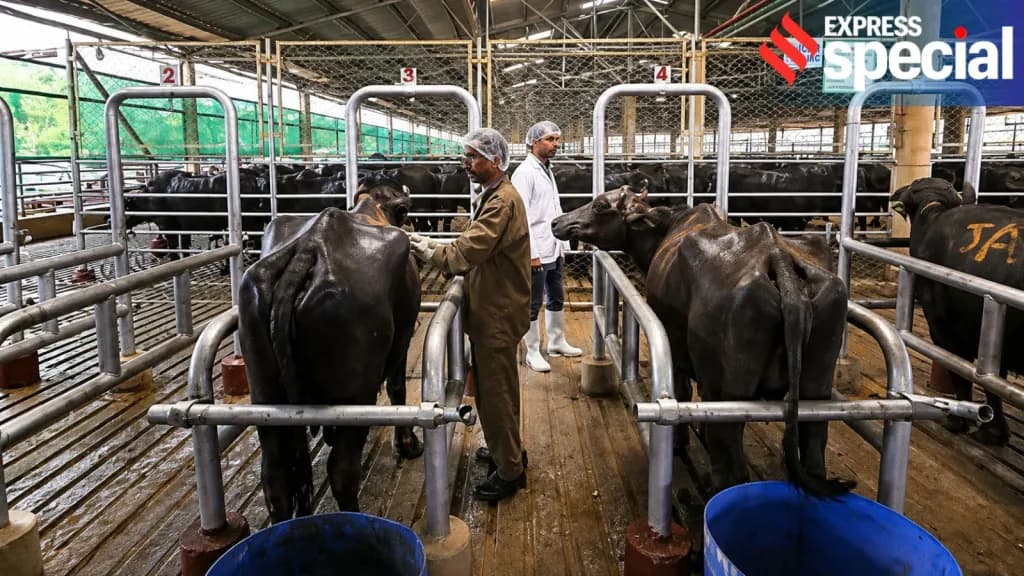
Milk production has grown not due to market but farmers’ cooperatives like Amul. MD of the cooperative that runs Amul RS Sodhi said in 2018 that farmers get 80-82% of market realisation. The pandemic saw private businesses dumping milk suppliers while Amul and other cooperatives came to their rescue. Horticulture is fetching high market price but for traders/companies, not farmers. Farm gate prices routinely crash (capsicum crashed to ₹1 per kg in 2023, kinnow to ₹6-11 per kg in 2023-2024, apple prices down after corporate takeover of trade).
The solution lies in a mix of measures: